
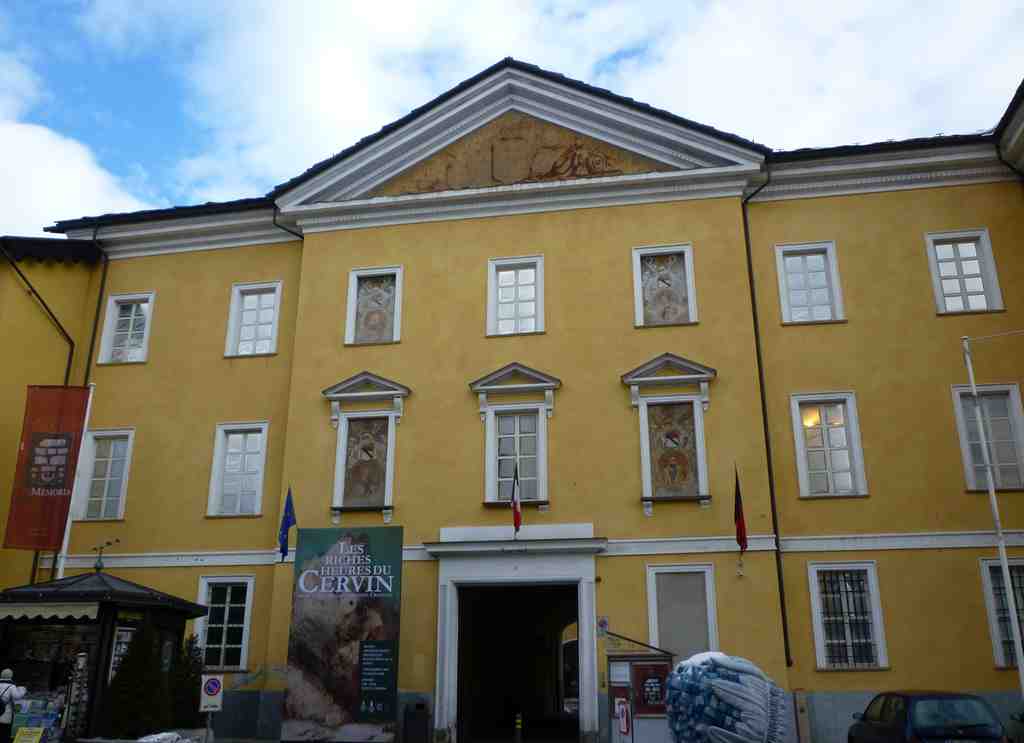
You’re looking for a large yellow building with rows of white windows and a grand triangular top-just ahead, right where the banners hang and frescoes peek out above the entrance.
Welcome to the Regional Archaeological Museum of Valle d’Aosta! Now, I know what you’re thinking-does this elegant, golden building whisper old secrets? Actually, it does one better-it practically shouts them through layers of time. Right here, beneath your shoes, once stood the mighty Roman Porta Principalis Sinistra, a gateway into ancient Augusta Praetoria. The ground below is a treasure trove, so packed with history that eager archaeologists are still busy digging, dusting, and discovering forgotten fragments. You can even tiptoe atop walkways inside that let you gaze into the ongoing excavations.
And believe it or not, this venerable spot didn’t start its life as a museum. First, it was a fort for the proud Vaudan nobles, then, in 1633, it transformed as the Convent of the Visitandine-created by the high-and-mighty Marquis Pierre-Philibert Roncas and his wife, who wanted to give a home to the nuns devoted to Saint Jeanne de Chantal. The peaceful sound of prayers and whispers of cloaked footsteps must have filled these halls back then. But peace never seems to last-a couple centuries later, the building geared up for action as Caserma Challant, a roaring military barracks. If these walls could have rolled their eyes, they would’ve seen horses, soldiers, and even a stage with wild local theater. At some point, they even ended up being used as a barn and-wait for it-a storage room for farm tools. It’s a museum now, but its résumé is as wild as a time traveler’s diary.
Once inside, you’ll discover objects from every age of Valle d’Aosta. Imagine holding a prehistoric vase, or a stony funerary ornament-each item a thread to a different world altogether. The museum's Roman exhibits glisten with glass plates, statues, old spoons, and-my favorite-toys from centuries past. Just picture a Roman child, grumbling over a lost game piece; apparently, kids haven’t changed all that much. Then step into the Christian-Medieval section, where you’ll see an 8th-century ambo, dug up from the Cathedral. Try to spy the golden cups with painted saints, or even a knight’s sword-spurs and all-from Sant'Orso, ready for battle or a jousting selfie.
Make sure to look for the scale model of Augusta Praetoria: it’s like Google Maps, but for Romans. Downstairs, even more mysteries lurk. Among the museum’s most guarded secrets are the underground ruins of the south-west corner of the original Roman gate, complete with ancient layers and-would you believe it-the last standing section of the ancient city ramparts with earthy embankments.
Now for a numismatic twist: fancy meeting coins from the Greek era to the times of the Savoy? You’ll find them here, plus Celtic, Gallic, and Padane coins-a real pocketful of history. If you like to globe-trot without leaving Aosta, hunt for the Etruscan, Egyptian, and Mesopotamian relics housed in the Carugo collection.
You might stumble into a temporary exhibition, too: from vibrant Swiss expressionism to the poetic dreamscapes of Joan Miró, the modern magic of Felice Casorati, or even artistic explorations of numbers across centuries. Sometimes, the museum even transforms to showcase the works of Italo Mus, local artist and chronicler of his times.
So when you step inside, take a moment-this isn’t just a museum; it’s a time machine that has worn many hats-a convent, a theater, a barn, a barracks-and now, a keeper of the region’s secrets, waiting for you to uncover each one!
For further insights on the the headquarters, the main collection or the other collections, feel free to navigate to the chat section below and inquire.


