
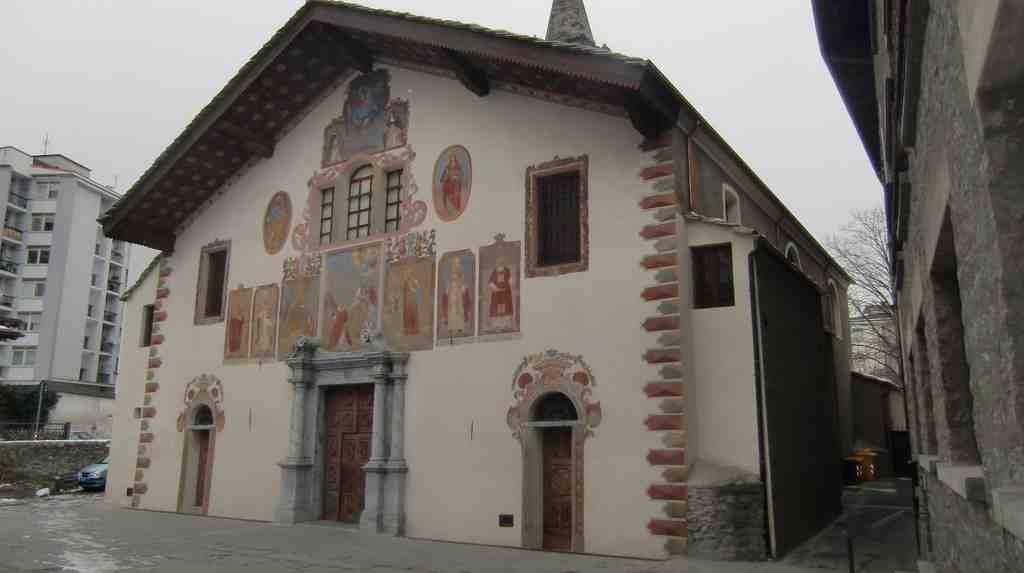
To spot the Church of Santo Stefano, look for a building with a sloping roof and a beautifully painted façade featuring colorful religious frescoes and two arched wooden doors, right at the busy city corner.
Step closer and imagine you’re standing where ancient footsteps echo-because beneath your feet once lay a Roman necropolis, a city of the dead, that predates this very church by centuries! As you look up at the lively frescoes on the façade, freshly restored, you’ll see saints, angels, and even the dramatic martyrdom of Saint Stephen himself, their painted expressions almost daring you to guess what secret conversations they might have at midnight.
The first whispers of the Church of Santo Stefano date all the way back to a parchment from 1234. Back then, this was a parish traded between religious orders bigger than the biggest football trades! Fast forward to the 18th century, and the present church emerges, built over the older 15th-century structure, proudly displaying the inscription of a certain Jaquemin Pastor above the right door. He might not have been a medieval influencer, but his signature work still welcomes everyone who walks through these doors. The robust, stone portal in front of you was carved from Aymavilles stone in 1729 and remains as solid as your grandma’s fruitcake-nobody’s getting through here uninvited!
Inside, if you could sneak a peek (no climbing through windows, please), there are three long naves leading to an immense, gold-painted baroque altar. It’s like something out of a royal palace, adorned with twisting columns, golden statues, reliquaries, and even paintings of the Holy Trinity and the dramatic martyrdom of Saint Stephen. Peer around and you’ll spot a grand chorus area, rich walnut wood decorated with garlands and angel heads, rescued from a long-vanished Franciscan convent. But wait for it-the left aisle is home to a true giant: a wooden statue of Saint Christopher, over four and a half meters tall, carved from a single trunk. It’s so huge he’d have trouble fitting on any bus in Aosta!
And high above, the sound of music might surprise you-the magnificent 19th-century pipe organ, all gears and pipes, designed by Costantino Mazzia, still waits to breathe life into the church’s ancient stones. There’s mystery, memory, and marvel all crammed into this street corner. So, look up, listen close, and see if you can hear the stories swirling through the air…


