
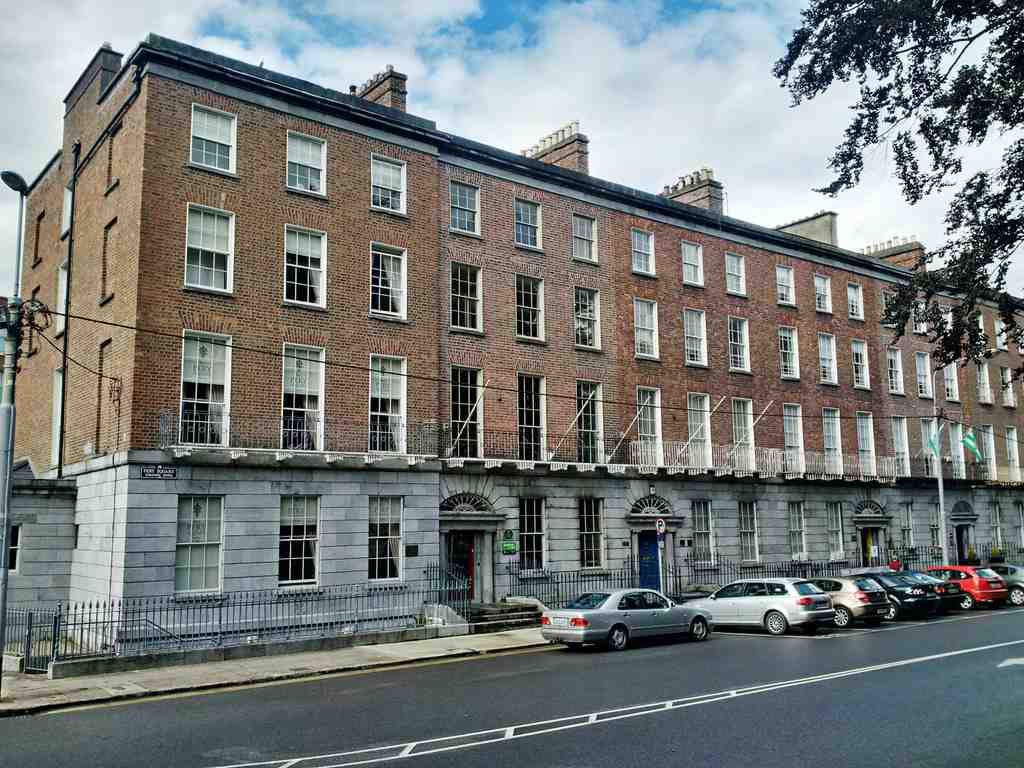
You are standing before a grand terrace of flat-fronted red brick townhouses, defined by their tall, slender sash windows and an elegant ground-floor facade of smooth grey limestone. If you want a wider view, take a quick glance at your screen to see a photo of this elegant row of buildings, known as Pery Square.
Constructed between eighteen thirty-five and eighteen thirty-eight under the supervision of architect James Pain, this is one of the finest examples of late Georgian architecture in Ireland. It was also the last development of its kind here before the Great Famine brought a crippling economic decline to the country.
But the financing behind these dignified walls is quite a story. The construction actually relied on a high-stakes gambling scheme known locally as the Life and Death Lottery. It was a tontine system, which is an investment pool where buyers purchase shares and nominate a living person to be attached to each share. As those nominated people died, their shares became worthless, and the property value consolidated among the dwindling group of survivors. The original list of eighty-nine lives included high-profile targets like Prince Albert.
This morbid waiting game ran for over seventy years. It finally concluded in nineteen thirteen when the number of surviving lives dropped to six. The ultimate victor was Sophia Vanderkiste, a widow in her seventies. According to local lore, her father had nominated her as a child without her knowledge. She simply awoke one morning to find she had outlived the vast majority of her competition and was the sole owner of numbers one, two, and three Pery Square.
Today, number one operates as a boutique hotel. It opened in two thousand and nine, precisely as the Irish economic boom collapsed, but fought its way through a perilous eighteen percent occupancy rate to survive. Number two is now a museum, beautifully restored by the Limerick Civic Trust.
Before we move on, look toward the War Memorial in the center of the square. When it was proposed in nineteen twenty-eight to honor the dead of World War One, it faced fierce political opposition. One local councillor ominously warned that if it was erected, it would eventually come down. That prediction came true in the early hours of the seventh of August, nineteen fifty-seven, when the monument was blown up using gelignite, a highly explosive jelly. The blast shattered the stone cross and warped the bronze sword, though the city eventually rebuilt it in nineteen sixty.
It is quite a square, blending formal architectural beauty with a rather explosive history. Take a moment to appreciate the square, and when you are ready, we can head over to our next stop.




