
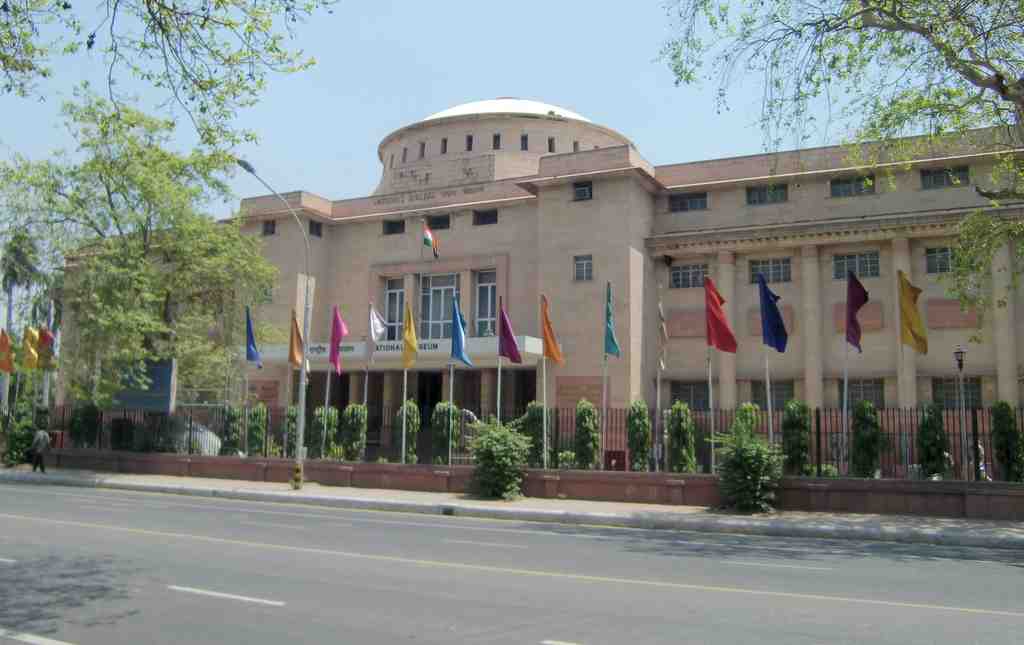
The museum was planned by the Gwyer Committee, a committee set up by the Government of India in 1946. Sir Maurice Gwyer, the former Chief Justice of India and Vice Chancellor of Delhi University, headed the committee. Sir Mortimer Wheeler, then heading the Archaeological Survey of India, was also a member and is credited with advocating for the museum's development.
The National Museum houses over 200,000 works of art, primarily Indian but also some of foreign origin, covering a span of more than 5,000 years. Additionally, it is home to the National Museum Institute of History of Art, Conservation and Museology, which offers master's and doctoral level courses.
The museum's origins can be traced back to an exhibition of Indian art and artifacts organized by the Royal Academy of Arts in London. After the exhibition, with the support of Jawaharlal Nehru, it was decided to showcase these collections in India, leading to the establishment of the National Museum.
Initially, the exhibits were displayed in the state rooms of the Rashtrapati Bhavan, also known as Government House, until the construction of the current location on Janpath was completed in 1960. However, upon Nehru's request, the statue of Buddha and the Rampurva Bull remained at the Rashtrapati Bhavan.
The National Museum drew inspiration from the Indian Museum in Kolkata, with some of its first curators being former employees of the Indian Museum. Nonetheless, the National Museum aimed to surpass its predecessor and provide a comprehensive view of India's cultural heritage.
The museum not only displays objects of historical and artistic significance but also encourages visitors to view them in a broader historical context. It seeks to facilitate a deeper understanding and appreciation of India's rich heritage.
Grace Morley, the founding director of the San Francisco Museum of Art, played a pivotal role as the first director of the National Museum in New Delhi. During her tenure, which lasted six years, she emphasized the importance of making art accessible to all, believing that museums have a vital role to play in cultural democracy.
As we continue our tour, I encourage you to explore the diverse and captivating exhibits within this magnificent museum.


