
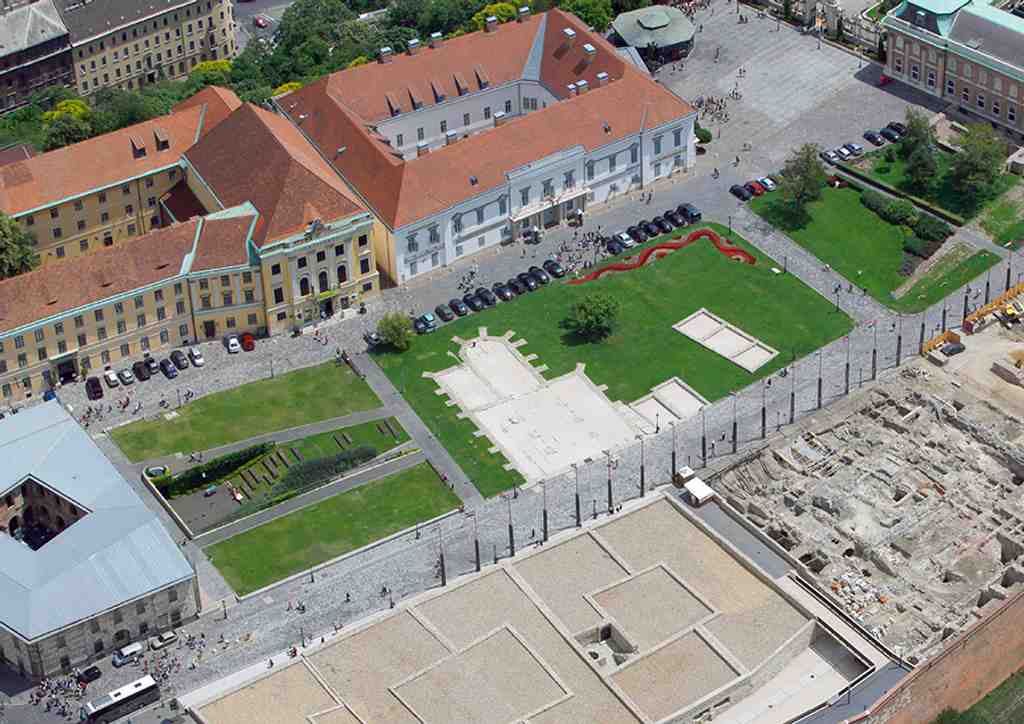
Directly in front of you, look for the flat, white stone foundation walls forming the shape of a cross set into the wide green lawn. What you are looking at is the ghost of Saint Sigismund Provost's Church. Back in the early fifteenth century, King Sigismund poured thousands of gold florins into this project, an amount easily equal to millions of dollars today. He wanted a magnificent royal church. Being a provost's church, it was run by a provost, a high-ranking cleric just below a bishop, meaning this site held immense religious and political power.
It stood proud for centuries, but like so much of this city, what we see on the surface rarely tells the whole story. The prominent church above ground was converted into a mosque during the Ottoman era, only to be ultimately destroyed by siege and the devastating 1723 gunpowder explosion. The rubble was cleared, the church was eventually dismantled, and the site was buried and forgotten until archaeologists finally unearthed these exact stones in the twentieth century. Yet, the most profound truth hidden below this soil is not architectural. It is human.
This was a royal burial site, and it holds a deeply heartbreaking history. It became the final resting place for two young queens who suffered the same tragic fate. The first was Katalin Podjebrád. In 1464, she died of childbirth fever. She was only fourteen years old. Her newborn infant died as well, and they were likely buried together right here in this earth. The loss cast a dark shadow over her husband, King Matthias, who was suddenly a twenty-four-year-old widower, forced to proceed with his coronation just weeks after burying his young wife.
Then, in 1506, history repeated itself. Queen Anna passed away just weeks after giving birth to the future King Louis the Second. Her death absolutely shattered the royal court. Her husband, King Vladislaus the Second, was so thoroughly paralyzed by grief that when her funeral mass was held in this very church, he could not bring himself to attend.
We spend so much time looking up at the stately palaces and towering monuments that define this district. But sometimes, the heaviest history is entirely invisible, resting quietly out of sight. These modest white stones are the only markers left of an immense royal project, and the only reminder of the profound, life-altering grief of the young queens who were laid to rest below them. This brings our journey through Buda Castle to a close. Thank you for walking with me today.




