
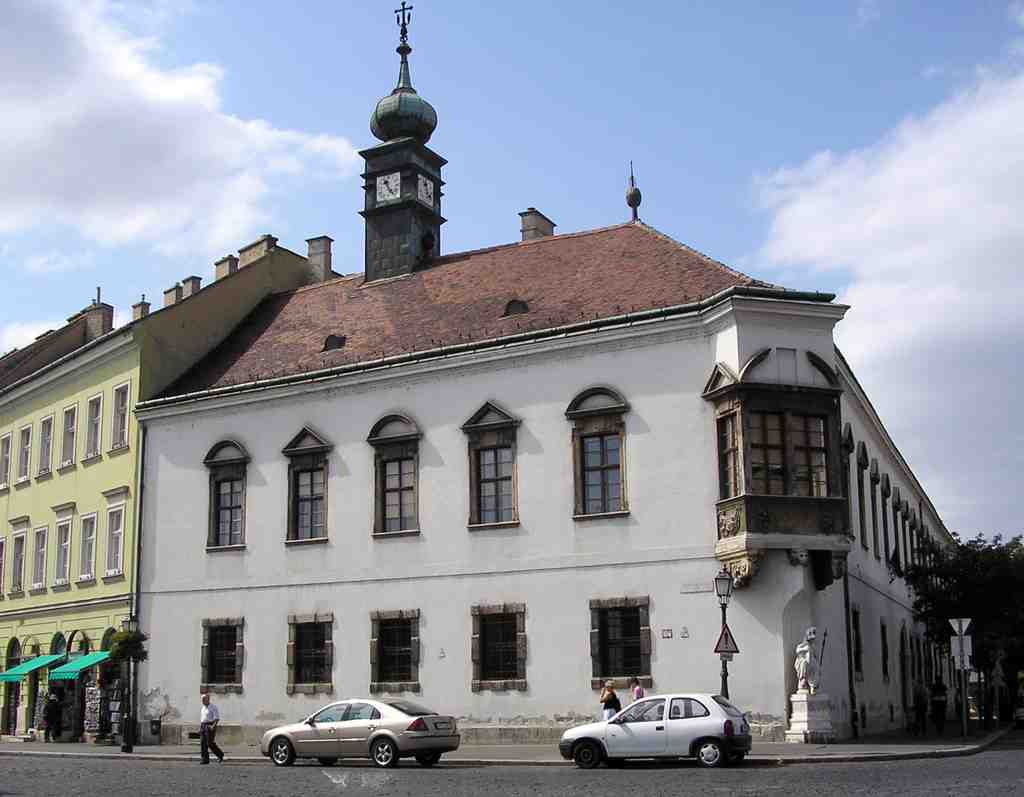
Look to your left at the two-story white building with a red-tiled roof, an enclosed corner balcony projecting outward, and a small copper-domed clock tower crowning the eastern wing.
It looks like a perfectly unified piece of architecture, a neat administrative center built in the highly decorative Baroque style of the eighteenth century. But appearances in this city love to lie.
This structure is actually a jigsaw puzzle. It was not built from the ground up as a single, unified town hall. Instead, the architects merged five separate, pre-existing medieval plots together. If you were to walk through the ground floor or explore the cellars today, you would find a chaotic, tangled maze of spaces. The heavy walls you are looking at rest directly on the stone foundations of citizen homes that stood here long before the Ottoman Empire took the city. The neat geometry above ground is entirely dictated by Subterranean Buda below.
See the statue standing in the corner niche? That is Pallas Athena, the Greek goddess of wisdom, holding a shield stamped with Buda's coat of arms. She has not had an easy time here. The original statue from 1785 was retired in the early twentieth century and moved to a waterworks yard. The caretaker's family nicknamed her Aunt Bábi and routinely draped their wet laundry over her to dry. Eventually, the yard workers got tired of tripping over her, so in 1920, the waterworks sold her to a private citizen for twelve thousand korona... which, thanks to intense post-war inflation, is roughly equivalent to just a few hundred US dollars today.
An art historian tracked the original down decades later, but the copy left here did not fare much better. During the 1956 revolution, scrap metal collectors stole her bronze spear, which had to be remade.
The building itself is also a survivor. In 1723, a massive fire started in a nearby barrel-maker's house. Gale-force winds pushed the flames to a military bastion, detonating over forty thousand pounds of stored gunpowder. The shockwave shattered windows across the river in Pest, and the blast sent up a cloud of ash so thick that witnesses described it as daytime darkness. The town hall's roof collapsed, incinerating the irreplaceable city archives stored inside.
This building is a masterclass in adaptation, a place where layers of disaster and governance sit literally atop a medieval maze. And speaking of ancient mazes... it is time to leave the tangled cellars of governance behind and head into an even deeper, darker network. Our next stop is the Buda Castle Labyrinth, just about a three-minute walk away.




