
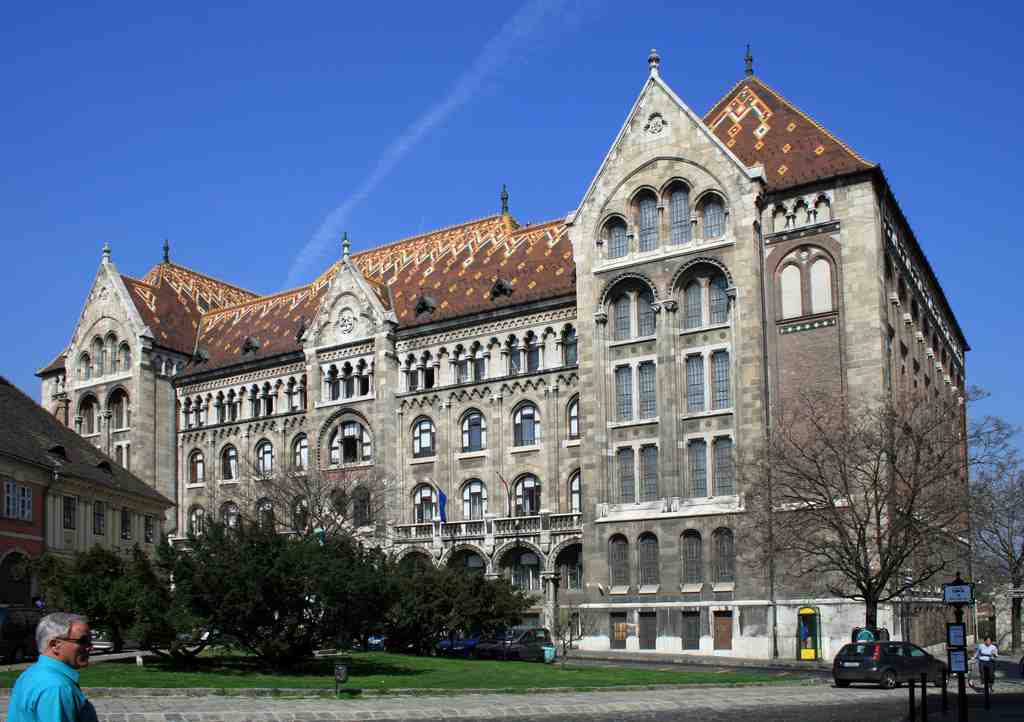
You should be looking at a massive gray stone building crowned with a steeply pitched roof of colorful patterned tiles and defined by its tall, arched windows.
Up here, it is easy to get distracted by grand monuments, but the true, hidden history of this city isn't carved in stone at all. It is written on fragile paper. This is the National Archives of Hungary.
Keeping that paper safe has been a desperate, centuries-long struggle. Go back to August 1526. The Battle of Mohács went disastrously wrong for the Hungarians, and the Ottoman army was marching closer. Queen Maria frantically packed the kingdom's most vital documents into wooden chests and loaded them onto boats to escape down the Danube river. But in the thick fog and the sheer panic of the retreat, boats capsized, and scavengers broke open the chests that made it ashore. A huge portion of early Hungarian history was swallowed by the river or simply scattered to the wind.
They eventually built this grand Neo-Romanesque fortress, an architectural style reviving heavy medieval arches and thick walls, to finally keep things secure. Take a look at your screen to see an aerial view of the building today. Notice how flat the roofline is. Originally, it featured a towering 75-meter spire. People thought it was a water tower, but it was actually just a giant chimney for the central heating. After it took heavy damage in World War Two, the city decided to blow it up. Not just for safety, but mostly because urban planners thought the skyline looked cleaner without it.
But the ultimate trial came in November 1956, during the Hungarian Revolution. An artillery shell hit the building, sparking a massive blaze. The local fire department arrived, but they were completely helpless. A Soviet tank had literally rolled over and crushed the fire hoses laid out on the street.
Inside, it was chaos. A retired archive director named Béla Kossányi and his family were trapped in the deep underground cellar, listening to the fire rage above them. Above ground, a group of local university students defied a strict military curfew, broke into the burning building, and formed a human chain. As flames consumed the upper floors, these students desperately passed bundles of ancient documents down the stairs, saving whatever they could before the smoke forced them out.
Over eight thousand meters of stacked records turned to ash that day, but thanks to those students, the core of the nation's memory survived.
If you ever want to do your own historical digging, the archives are open to the public Monday through Thursday.
For now, let us leave the fragile papers behind and walk toward a place carrying the weight of lost history in its stones. We are heading to Matthias Church, which is about a six-minute walk from here.




