
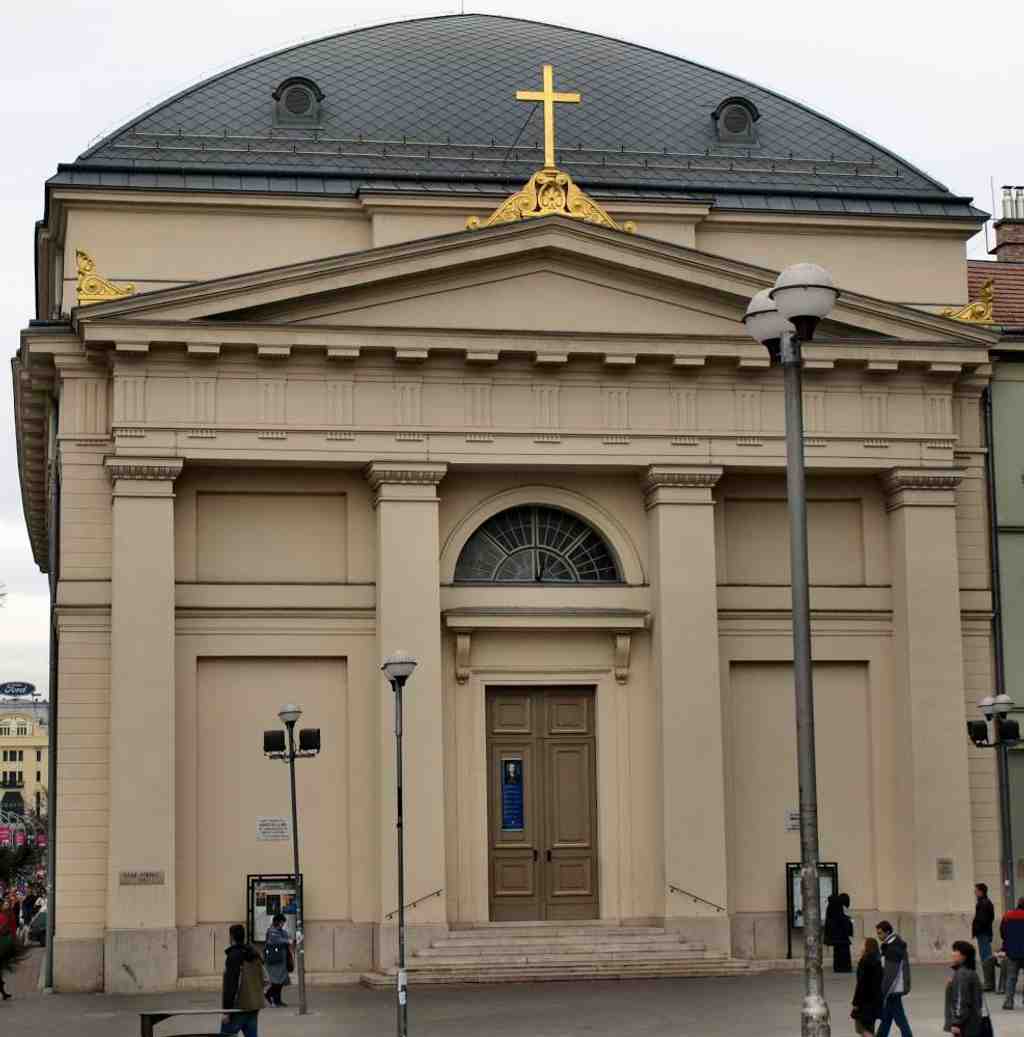
To spot the Lutheran Church on Deák Square, just look for a stately, creamy-colored building with no tower at all, a grand triangular roof topped with a golden cross, and four massive columns right above the entrance, facing directly onto the busy square.
Now, while you’re standing here, let’s slip back in time and imagine the square as it was over 200 years ago. The Lutheran Church of Deák Square is not just the oldest Lutheran church in Budapest-it's also the largest Protestant church in the entire city! Built without a steeple, it stands out for its understated classical elegance, with those strong Doric pillars holding up a clean, triangular pediment. Just above you, the enormous curved metallic roof gleams faintly, keeping watch over the “Lutheran Island”-this whole block, filled with Lutheran institutions like a school, pastor’s offices, a bookstore, even a museum and a kindergarten. It’s practically a small town!
Its story begins with a master architect, Mihály Pollack, who started building the church in 1799. By the time it was finished in 1808, it had already had a taste of drama. In 1809, right after its construction, soldiers commandeered the space, turning it into a uniform warehouse-a far cry from the peace it was meant for. But by 1811, music once again filled the air as the church was consecrated for worship.
Step inside with your imagination: one vast, rectangular space, two balconies stacked atop each other. At the front sits an altar inspired by Raphael’s stunning Transfiguration, sculpted by Ferenc Lochbihler. And at the side, a pulpit and a baptismal font crafted from deep red marble-if only church furniture could talk!
But every old building has its scars. The church was damaged by cannon fire in the mid-1800s, and later lost its petite classical tower for safety reasons. The grand ceiling? Once it was domed, but that had to be swapped for a flat, coffered one after the tower came down-proving that even churches get a makeover now and then! If you listen closely around noon, you might hear the cheerful chimes of a computerized bell system, added at the turn of the millennium, since the church is still famously without a real bell tower.
History has left its mark in other ways too. In March 1838, when the great flood filled the city, this church became a literal island of safety, sheltering families from the rising waters. On the facade, there’s a marble tablet commemorating the legendary Hungarian leader Lajos Kossuth, who had both his sons baptized right here. Meanwhile, the courtyard walls display bronze plaques honoring Martin Luther and Johann Sebastian Bach. Imagine the hopeful voices, the worried families, and the spirited hymns swirling through these halls.
Through wars, floods, and construction of the M2 metro-which rattled its bones a bit-the church has stood strong. Today, it hosts services every Sunday and on special holidays. Fancy a bit of music? Since 1985, dazzling pipe organ recitals and the Budapest Bach Week have filled this space with heavenly sound. The church’s modern organ, built in 1971, was once the biggest of its mechanical kind in Hungary, so you know the acoustics mean business!




