
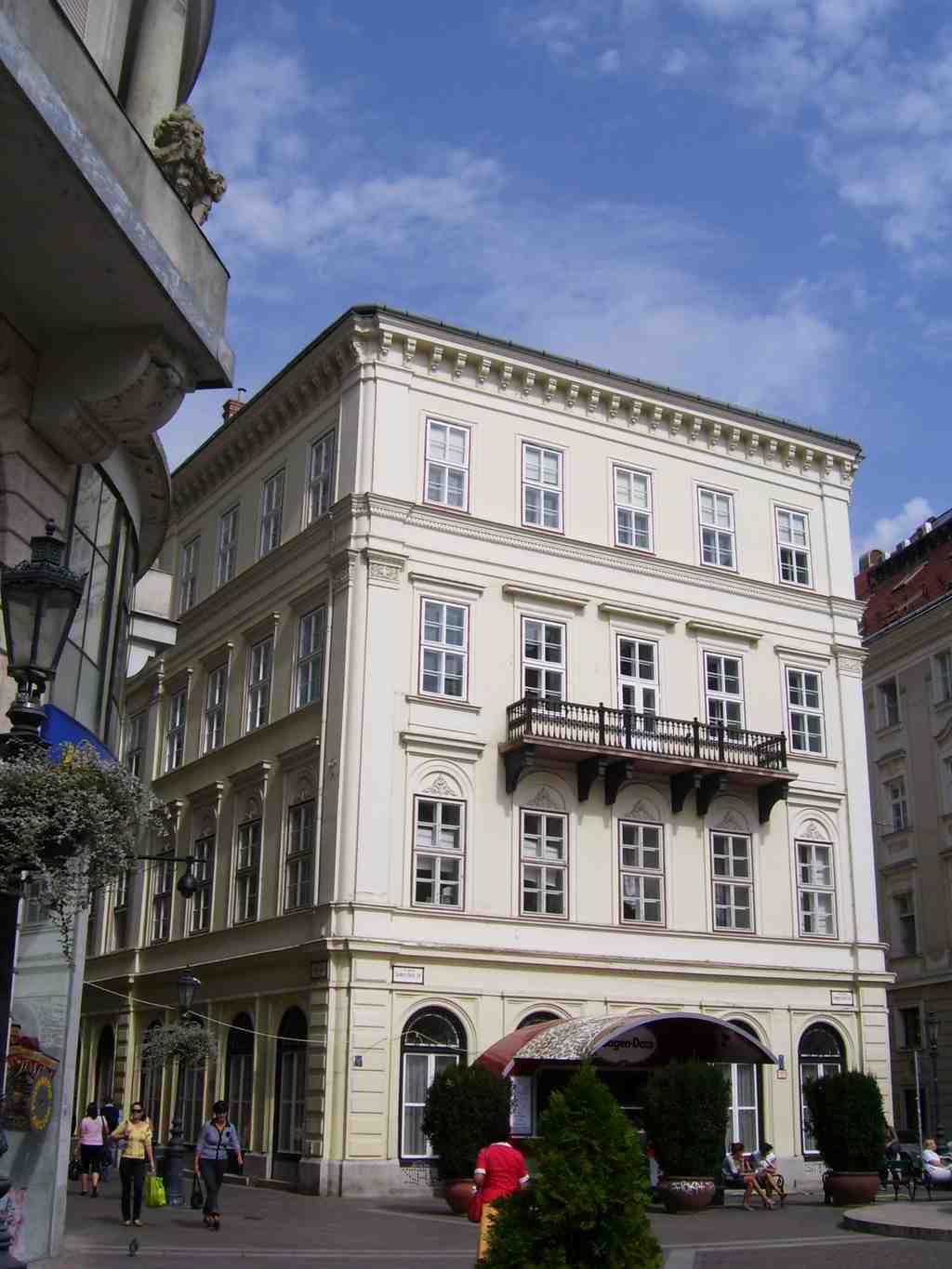
Ahead of you, you’ll see a pale, cream-colored corner building with rows of tall, arched windows and a dark wooden balcony jutting from the upper floor-simply look for the stately facade perched at the edge of the square as you walk.
Welcome to one of Budapest’s intellectual sanctuaries: the Deák Square Lutheran Grammar School, known to locals as DEG! Now, imagine the early morning sounds here over two hundred years ago-the chime of church bells, the rattle of horse carriages on cobblestones (so noisy, teachers sometimes had to shout over them!), and the laughter of children echoing from this very spot. In fact, the noise from the stone-paved streets was so intense that, when a wagon rolled by, lessons would come to a complete stop, as the teachers had no chance against the clatter.
It all began in the late 1700s, when the Lutheran community in Pest, seeking both spiritual and scholarly pursuit, squeezed their budding congregation and their humble school into a single, rented city room. Imagine a cantor, multitasking as both choir leader and teacher, instructing eager little ones in both the basics and faith. By 1791, they’d secured this very plot next to what was once the Kohlmarkt, and in 1793, what would become this elegant school was raised from the blueprints of famed architect Pollack Mihály. It had just one floor, but from the moment lessons began in the ground-floor prayer room, education here was the real deal.
In 1811, right beside the newly built Lutheran church, the school expanded. Now, in addition to elementary classes, there were grammar lessons: a golden ticket to higher learning! The language of instruction was German, but soon, subjects like geography and literature were taught in Hungarian-a sign of the times, and maybe, a hint that mastering languages in Hungary could be as tricky as juggling goulash with one hand while playing chess with the other.
In 1818, boys and girls went their separate ways. The classes soon filled up, and, in true Budapest fashion, upwards growth was the answer: the building sprouted a second story! By 1823, the school had a brand-new focus: Latin. The kids were tackling filology, Greek, and local history-who said grammar school couldn’t be glamorous?
Now, here comes a twist: in 1833, an eleven-year-old boy arrived-Petőfi Sándor. Yes, the future national poet himself shuffled through these halls, put here by his dad in hopes he’d master German. Spoiler alert: folklore has it, his German was shaky, and he nearly landed at the very bottom of the class list. But hey, he excelled in art, and if there’s one thing you can’t test, it’s a poet’s heart.
By 1840, there were nearly 350 students, with both boys’ and girls’ classes. Thunderous carriages and smoky bakeries made city life ever-present. The teachers lived right next door, ready to help rain or shine-or shout over raucous city traffic. Some of those teachers were literally geniuses, writing textbooks and poetry, and teaching in multiple languages. School trips weren’t all that different from today, except instead of buses, imagine a merry trek into the Buda hills or even to the ancient Roman ruins in Óbuda-now those were real field trips!
The school soon became a hotspot for bright minds: politicians, inventors, writers, and-fun trivia-a future designer of the Budapest tram lines (yes, it wasn’t all bookworms here, some students genuinely sparked the city’s future). In the 1870s, the building became one of the country’s most modern schools: the first gas lighting in Pest, then plumbing-though the gym and yard were still missing. Too bad, because with all this energy, these kids needed a spot to run!
Times changed, and by 1933, the place evolved into a prestigious girls’ high school. A stylish navy-blue uniform with a crest was required-very Hogwarts, just without the magic ceiling. The war years left scars: teachers were drafted, memorial plaques still honor the fallen. For a time, the school was nationalized, bouncing between closures and comebacks.
Finally, in 1992, DEG bounced back, re-opened with just 57 students but with the spirit of centuries at its core. Today, it’s not just a school, but a melting pot of faiths and talents: choirs, bands, theater, art clubs, and a school museum on the first floor, telling tales from its vibrant past. So, as you stand here, savor this unique blend of tradition and resilience-because in Budapest, even a school can be a living, breathing testament to the city’s heart. And in case you’re wondering: yes, you really are walking in the footsteps of poets, inventors, and visionaries-all without needing to learn Latin.




