
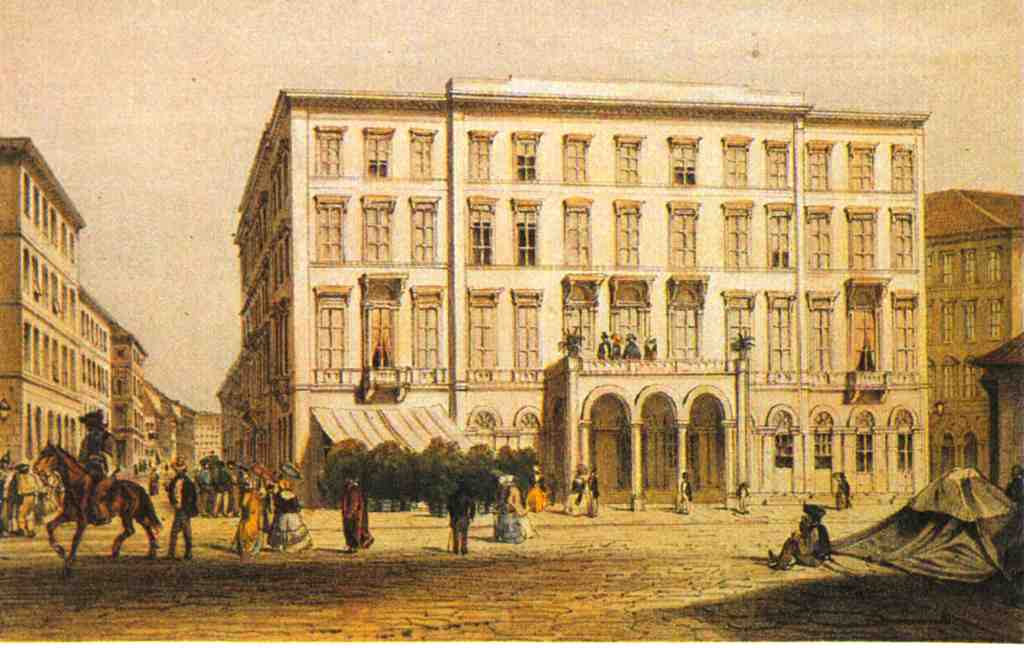
Look ahead for a grand, pale rectangular building standing proudly at a corner, with rows of tall windows and graceful arches out front; it’s easy to spot because it holds a strong presence on the street, just begging for a little royal attention.
Welcome to the site of the legendary Queen of England Hotel-a place where the echoes of laughter, gossip, and perhaps the clink of billiard balls still linger in the air, even though the building itself has long been replaced. Close your eyes for a moment and let’s step back all the way to 1792, when this place first rose from the ground, courtesy of the ambitious Kemnitzer János. Picture a bustling corner near the old pontoon bridge, where the aroma of rich coffee wafts from the very first Hungarian Grand Café, and in the center, guests marvel at marble arches and sparkling chandeliers. Even a visiting botanist, Count Hoffmannsegg, raved that he’d never seen a more splendid coffee house-four marble columns, glittering Arabesque candleholders, and stylish mahogany walls that must’ve made every visitor feel just a little bit fancier.
The hotel grew with the city, and in the 1830s, after a devastating flood, it was reborn in time to honor none other than Queen Victoria herself. The place became known as the Queen of England Hotel, with a garden planned in the courtyard and the country’s very first ladies’ salon. Imagine grand society types lounging on those now-iconic Thonet chairs, and, just to add a little color, a flower shop right inside, blooming with fresh arrangements straight from the caretaker’s own garden.
But fate had a way of shaking things up. In the spring of 1849, the hotel found itself caught in the crossfire of war. General Hentzi aimed his cannons from Buda, and the hotel-especially its beautiful roof-suffered a smoky, fiery end. Yet, the Queen of England Hotel would not be defeated. With architect József Hild’s designs, the hotel was soon reborn, sporting a stately terrace toward the Danube, white marble staircases, golden railings, and elegant English furniture.
For decades, this hotel was the beating heart of the city-its grand restaurant and lively café filled with laughter, gossip, and political intrigue. It was here that Deák Ferenc-known as "the Wise Man of the Nation"-made his home for fifteen years. In case you picture a stern, aloof politician, think again! Deák lived modestly on the second floor, carving wood to relax, living with his canary, his blackbird, and his goldfish. No fancy staff for him! He only accepted visitors when his door key hung outside. Otherwise, you’d better come back tomorrow. He wrote mountains of letters here-including eight hundred sent out to help the orphans of his great friend Mihály Vörösmarty, since the newspapers were simply too nosy to publish such an appeal.
If only walls could talk! This was a place where secrets were whispered, alliances were formed, and prestigious guests mingled over steaming plates of chicken paprikash-Deák’s favorite, by the way. For an extra treat, if you stuck around the busy ground floor long enough, you might have glimpsed Budapest's elite or seen someone dash out to buy flowers for a mysterious rendezvous. The hotel, alas, lost its shine by the turn of the century, outshone by the flashier restaurants and cafés along the new Danube promenade.
After closing its doors in 1916 and serving for a while as offices, the Queen of England Hotel was eventually demolished in 1940. Plans for a grand new office block were interrupted by war-so in its place, the UVATERV headquarters arose in the 1950s, this time in a sleek avant-garde style. Today, all that remains is memory, and perhaps somewhere, faintly, the ghost of Deák Ferenc still sits whittling away at a block of wood.
So as you stand here, let yourself drift back just for a moment, and imagine the hum of a busy café morning or the ring of a bell as important news arrives. The Queen of England Hotel may be gone, but its stories are very much alive! Would you like to continue to our next stop?
To expand your understanding of the history, deák ferenc or the the later fate of the hotel, feel free to engage with me in the chat section below.




