
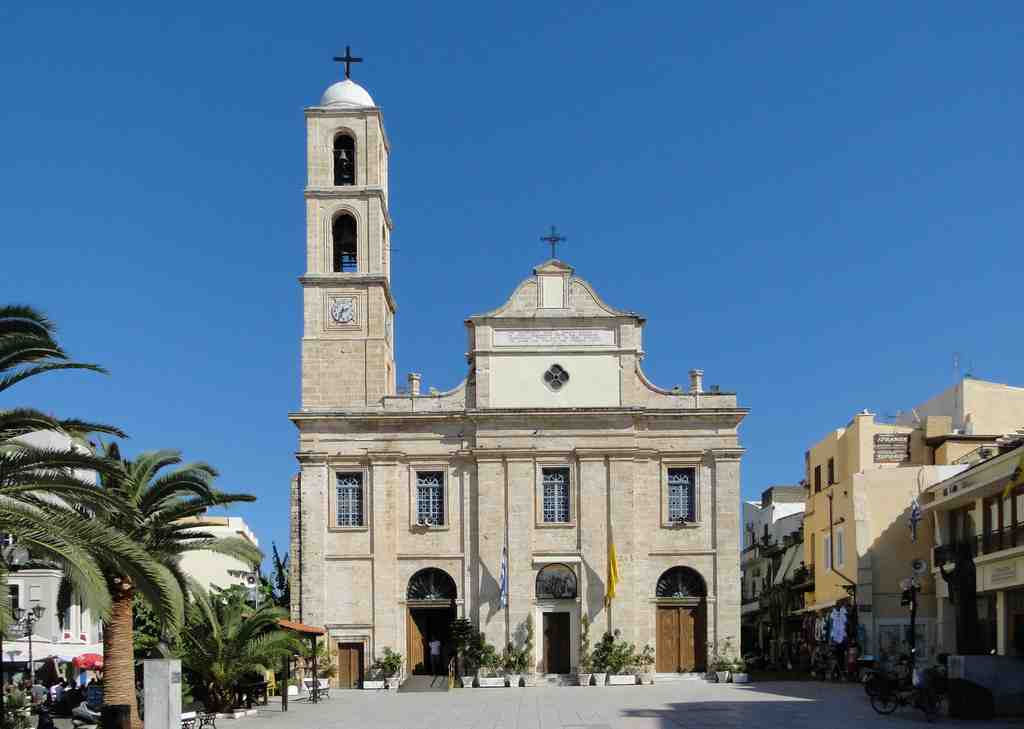
To spot the Presentation of the Virgin Mary Holy Metropolitan Church, look for a grand, light-stone building with a tall bell tower on the left side and three large doorways, right in the heart of Athinagora Square-if you see a church with flags out front and a clock on its tower, you’re in the right spot!
Now, imagine you’re standing here not just in the present, but with centuries of history swirling around you like the gentle Mediterranean breeze. This isn’t just any church; it’s the survivor of soap and storms, of saints and sultans! If these stones could talk, they’d start with a whisper about a tiny church here in the 11th century. Then came the Venetians, who traded in piety for practicality and built a warehouse right on top. Fast-forward to the Ottoman era; the warehouse transformed yet again-this time into a soap factory! You could say the building got a “clean” start, though probably not the sort of lathering the faithful had in mind.
But the real twist came in 1850, when the Turkish authorities handed the building over to the Christians of Chania. Suddenly, walls that once stored soap bells echoed with hymns instead. By 1861, the bishop was here to bless the opening, and a rescued icon from the original church-kept safe like a family heirloom-was placed in the narthex, where you can still see it today. The new church’s north aisle honors Saint Nicholas, a tribute to his lost church in Splantzia, which had been turned into a mosque.
Inside, marvel at the shimmering silver covers glinting among the icons, all masterpieces by Cretan artists like Revelakis, Vivilakis, and others. Glance up-see how the dome’s fresco of the Virgin Mary stretches “wider than the heavens,” as painted by Giannakakis? Above the entrance, an epigram in Greek greets visitors: “Ye who walk here see the church of the Mother of God, built by faithful children of the Church finding refuge … like frightened birds in the middle of a storm under the wing of the heavenly protecting veil.”
And as if this place hadn’t faced enough drama, it was damaged in the 1897 war-but, like a scene from a fairy tale, Tsar Nicholas II of Russia swooped in to pay for repairs and donated that beautiful bell you see today. So next time November 21 rolls around and the people of Chania celebrate the Presentation of the Virgin, remember you’re standing in a place that has seen it all-from soap bubbles to sacred bells-under the watchful eye of the Virgin Mary herself.




