
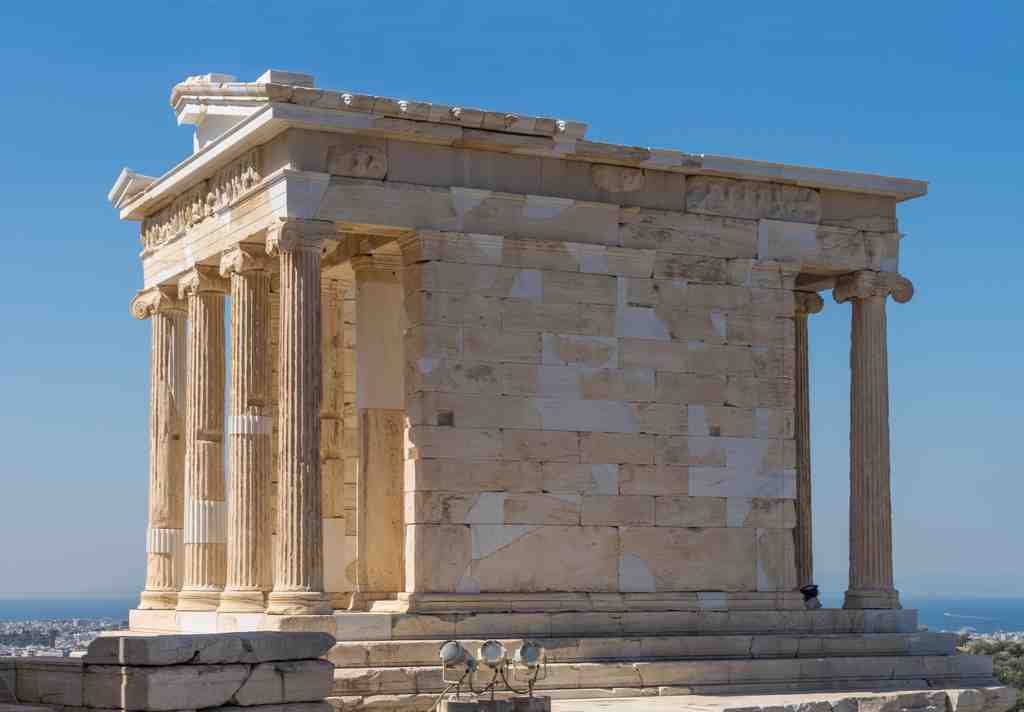
Just ahead and up on the stone bastion, you’ll spot a small, elegant white-marble temple with four columns at both the front and the back-it stands like a jewel on the edge, with the sky and city as its backdrop.
Now, picture the year is around 420 BC, and this compact temple was brand new-its marble gleaming under the same brilliant sunlight you feel now, perched on this steep outcrop right as visitors entered the Acropolis. Welcome to the Temple of Athena Nike, a shrine honoring not just one, but two powerful goddesses: Athena, famous for her wisdom, and Nike, the winged goddess of victory. Imagine Athenian citizens rushing up these very steps, their sandals slapping the stone--their hearts filled with hope for triumph in the long and brutal Peloponnesian War.
Unlike the massive Parthenon, this temple feels almost like a precious little trophy, which is fitting because it was built to celebrate victories, especially the mighty ones over the Persians at battles like Plataea. The rich marble, quarried from Mt. Penteli, carries stories of glory and war, recounted in remarkable friezes that run along the top. These reliefs would’ve been vivid, carved with cavalry charges, scenes of armored warriors, and feasts of the gods. Up close, you’d have seen a dramatic assembly of Athena, Zeus, and Poseidon themselves, essentially the ancient Greek version of a “who’s who in Olympus.”
Early in its history, this site held only a humble statue: Athena seated, pomegranate in one hand, helmet in the other-a bit like she was saying, “here you go, victory and abundance, but let’s keep it smart, shall we?” Over time, the Persians came, their boots thundering up the hill, destroying the old sanctuary. But Athens rebuilt, as it always did, and by 420 BC, the architects completed this petite wonder-four Ionic columns in front, another four in back, and dazzling white marble all around.
Every detail spoke of hope. The citizens would have seen the famous Nike Parapet-protecting people from falling, but also carved with lively scenes of Nikes setting up trophies and sacrificing to their patroness. Atop the temple was a statue of Nike-but this one was special. She had no wings. The Athenians decided their victory shouldn’t ever fly away, so they kept their Nike grounded-a victory here to stay! Some say they even called her Apteros Nike, or “wingless victory,” just to make sure there were no surprises.
The cult of Athena Nike was always in the hands of a priestess chosen by lottery, probably one of the earliest examples of equal opportunity employment. Through the centuries, the temple endured a wild ride-first ruined by Persians, then rebuilt by hopeful Athenians, untouched for hundreds of years, only for its marble to be pinched by Ottomans in 1686 to build new defenses. The poor little temple was completely torn down and only put back together, like a huge ancient jigsaw puzzle, when Greece gained independence. In the 1800s, archaeologists raced about, collecting blocks of marble buried under centuries of dust.
Even today, the temple changes, with restoration work ongoing-some of its most beautiful friezes live happily ever after in the Acropolis Museum nearby. The Nike Parapet, with its wet-drapery carvers that rival the best fabric designers of any era, once showed Nike bending down to remove her sandal-a mysterious gesture likely meant for those about to enter and worship, a tradition of respect.
Now, as you stand here, feel the marble beneath you and the wind swirling up from the city. Imagine ceremonies, frantic chisel tapping and hammer strikes, the hopes of a city poured into every block. The Temple of Athena Nike is proof that even the smallest triumphs can stand larger than life on the edge of history.
If you're curious about the architecture, friezes and parapets or the cornice and cyma, the chat section below is the perfect place to seek clarification.


