
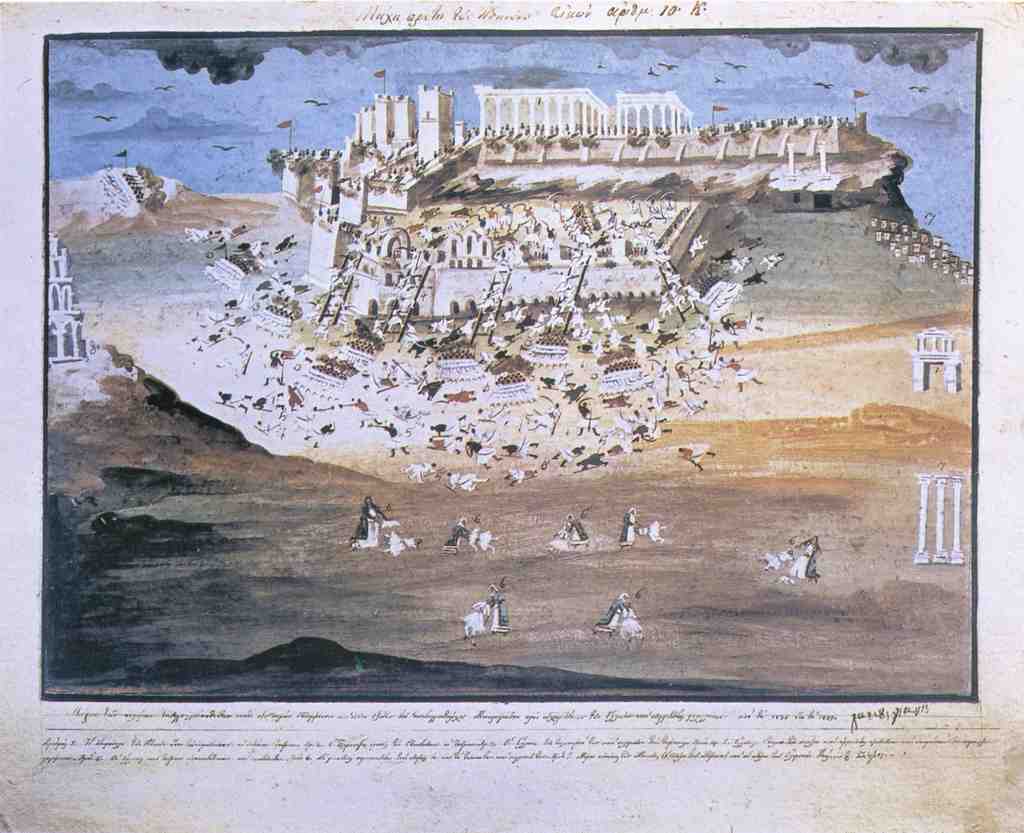
To spot the site of the Fall of the Acropolis, look up at the mighty hill crowned with stone walls and the iconic ruined temples-right at the heart of Athens’ skyline, towering over the city just as it did in 1822.
Now, let’s dive into one of the most dramatic moments in Athens’ story-a scene full of grit, desperation, and just a little dark comedy. Imagine the Acropolis looming before you, not only as a breathtaking backdrop, but as a fortress under siege. The year was 1822. For nearly four centuries, since 1456, the Turks had ruled this ancient stronghold, and their flag flew atop its sacred stones for generations.
But that year, change was in the air. Just months earlier, most of the Turkish garrison had been called away, leaving only a handful to defend the city. Sensing an opportunity, Greeks spread throughout the islands stormed into Attica and, like a surprise pop quiz, caught the city off guard. By early November 1821, revolutionaries liberated Athens itself. But-a big “but”-the Turks had retreated to the Acropolis, fortified themselves, and slammed the gates shut, like kids clutching the last cookie in a jar. The Greeks tried to storm the citadel, but it was a tough nut to crack, and so began the great siege.
It wasn’t long before the Greeks tightened their grip, especially after they captured a nearby position called Serpentzé, choking off almost every Turkish supply route. The days grew hotter, water grew scarce, and desperation seeped into every corner of the Acropolis, along with the smell of gunpowder and-let’s be honest-a lot of very thirsty soldiers.
By 1822, the siege had turned into a staring contest, with the Greeks getting reinforcements-fierce islanders, relentless locals, even a French philhellene named Olivier Voutier and a troop of thirty Germans. Voutier aimed his cannons from the Pnyx hill, ready to rattle the fortress (though, rumor has it, his aim wasn’t exactly Olympic). Meanwhile, beneath the ground, the crafty engineer Konstantinos Chormovas began to dig, targeting the third gate with a secret tunnel. You know you’re in trouble when your enemy starts borrowing tactics from cartoons-tunneling under your feet!
In April, they finally blew up the third gate. The explosion shook the fortress and both sides hurled themselves into a fierce, chaotic battle, hand-to-hand in the shadow of ancient columns. Philhellenes-and their wild mustaches-won respect for their bravery. After brutal losses, the Greeks stormed through the breach, pressing the defenders deeper into the heart of the Acropolis.
Inside, the Turks faced misery: food they had, but water had run out, all wells poisoned or sealed off until only the strongest could endure. Sickness and starvation spread, and at last, with fear-mixed with exhaustion and a bit of hope-the Turks sought to end their ordeal. Negotiations crept forward, with French and Austrian consuls brokering the terms. On June 9th, 1822, the commanders gathered-the city’s leaders, the generals, a bishop in solemn robes. With a handshake and scribbled signatures, the fortress was surrendered.
Imagine standing here on the morning of June 10th. After months of tension, a triumphant procession marched in, led by the Metropolitan of Athens and shadowed by a troop of grinning soldiers. The Turkish commander handed the keys over, not to some stern general, but to the bishop himself. An awkward pause, a sigh of relief, and almost as an afterthought, someone remembered-somebody fetch them water! The exhausted Turks, parched and defeated, were at last saved from thirst.
Yet, the day wasn’t without one last twist. As the Greek commander Panagiotis Ktenas tried to fire a salute cannon, disaster struck-he fell from the wall and was killed, cutting the celebration short. His brother took command, and life, with all its strangeness, went on. Of the original 2,500 Turks trapped inside, fewer than half survived those grim months. Some remained, choosing to stay in their homes-a testament to the complex ties of this ancient hill.
So, right where you stand, the fate of Athens changed hands after 366 years. Today, the Acropolis watches over a free city, and its battered stones remember a siege of courage, cunning, and just a dash of chaos.
Yearning to grasp further insights on the the liberation of athens - the beginning of the siege of the acropolis, the evolution of the siege in 1822 or the the fall of the acropolis? Dive into the chat section below and ask away.


