
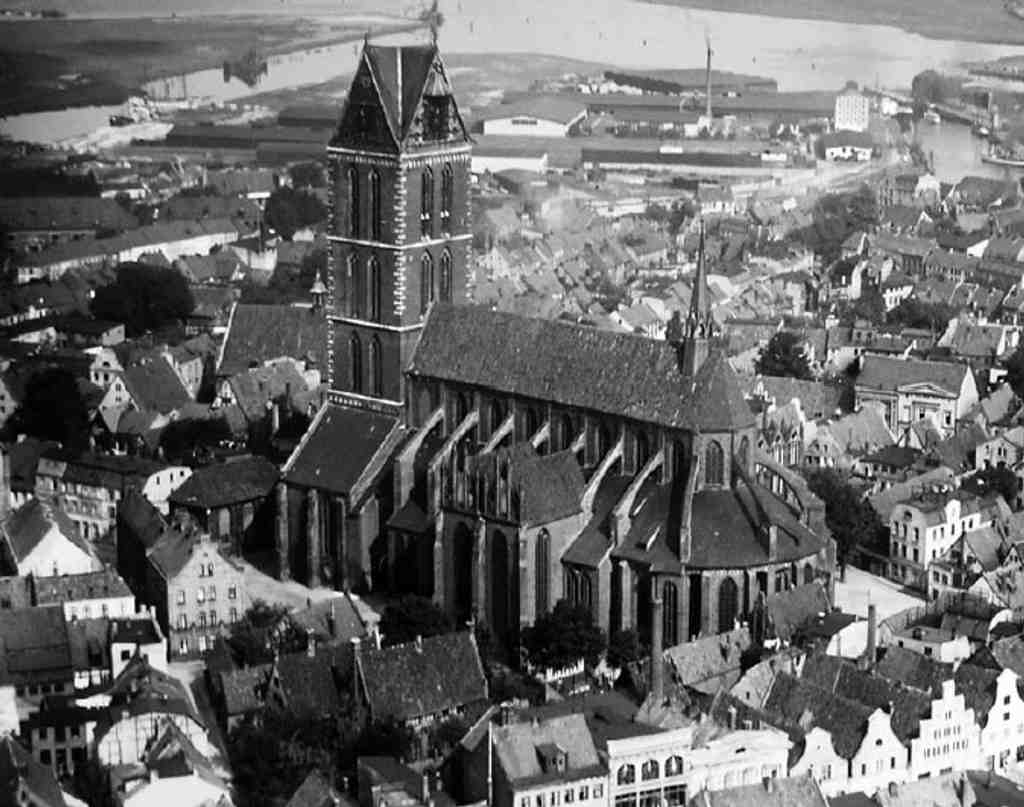
Right in front of you, rising high above the rooftops, you'll spot the lone and towering brick structure of the Marienkirche’s west tower-just look up for a massive rectangular spire of red brick, trimmed with pale stone at the corners, dominating the heart of Wismar’s old town.
Now, picture yourself just outside this monumental tower, surrounded by the echoes of nearly eight centuries of Wismar’s bustling life. The story of Marienkirche is one of drama, resilience, and a little bit of ghostly glamour, so take a deep breath and let’s step back in time together.
Imagine it’s the 13th century. The townsfolk are hard at work, and the smell of fresh-baked bread mingles with the salty breeze from the Baltic Sea. Wismar is booming, and the people decide they need a church-well, not just any church, but a grand one. The first Marienkirche might’ve been a simple wooden building, quietly standing by the market, already welcoming its flock by the 1220s, even before Wismar was officially a town. By around 1260, the community’s ambition really takes flight, replacing wood with reddish brick and vaulting into the sky with a massive hall church. You can picture the original nave-so wide, you could have hosted a medieval dance party with room for everyone’s pointy shoes.
That era’s drive for “bigger and better” means the Marienkirche doesn’t stay still. Over a century, piece by piece, the church grows: new chapels, tall vaults, a beautiful choir, and, to top it all off, a west tower that eventually soars to 120 meters! Imagine the clang of hammers and laughter of workers, stone and brick flying up to the heavens. But all that grandeur had its share of mishaps-lightning strikes, storms, and even the occasional falling spire. The steeple fell more than once; the wind here is a fierce decorator!
Inside, it was a treasure trove: colorful stained glass, paintings, and altars, gifts from rich merchants, hardworking guilds, and entire families hoping to buy some peace for their souls. They even hired Lübeck’s top artists, like the sculptor Tönnies Evers, to carve intricate pulpits and retables. The church bells? One of the largest collections in Northern Germany, tolling together to mark every feast and festival, and still, some ring out today.
Oh, and if you’ve ever watched a vampire movie with your popcorn, here’s a fun twist: In the 1920s, Marienkirche was a star, appearing in the legendary silent film “Nosferatu - A Symphony of Horror.” I like to think the church’s stone gargoyles got a bit nervous with all those camera flashes.
Yet, the 20th century brought shadows. As World War II swept across Europe, Marienkirche suffered; bombs tore through the nave and the southern walls, leaving it battered and exposed to the elements. For years, townspeople dreamed of restoring their beloved church. But in 1960, the remaining shell of the nave and choir was demolished, despite the protest of those who loved it-not out of danger, but simply to clear the ruins. Only the iconic tower was spared, standing as a lonely watchman over Wismar-because sailors still depended on it as a landmark to find their way home.
But this isn’t a ghost story. With grit and grit alone, the people of Wismar and supporters far and wide rallied to save what remained. Over the years, the tower has been restored, made safe, and today, it’s alive with new possibilities-hosting concerts, exhibitions, and even imaginative installations that help everyone remember the church that once proudly filled this square. On the ground, you’ll spot low walls tracing where the giant church nave once stood. Step inside the marked outline, close your eyes, and you might just hear echoes of singing, prayers, and laughter.
Marienkirche was always the people’s church-center of their spiritual life, the stage for their joys and sorrows, even a final resting place for many of their loved ones. Rich guilds had lavish private chapels, the organ thundered overhead, and children ran through the pews, perhaps hoping not to meet any of Nosferatu’s friends in the crypt!
So as you gaze up at the solitary tower, remember-this isn’t just a ruin. It’s a survivor, a memory-keeper, and a symbol that, like the people of Wismar, it refuses to fade away. If those old bricks could talk, I bet they’d have some tales to tell… maybe even a vampire joke or two!
To delve deeper into the equipment, tower or the parish church, simply drop your query in the chat section and I'll provide more information.




