
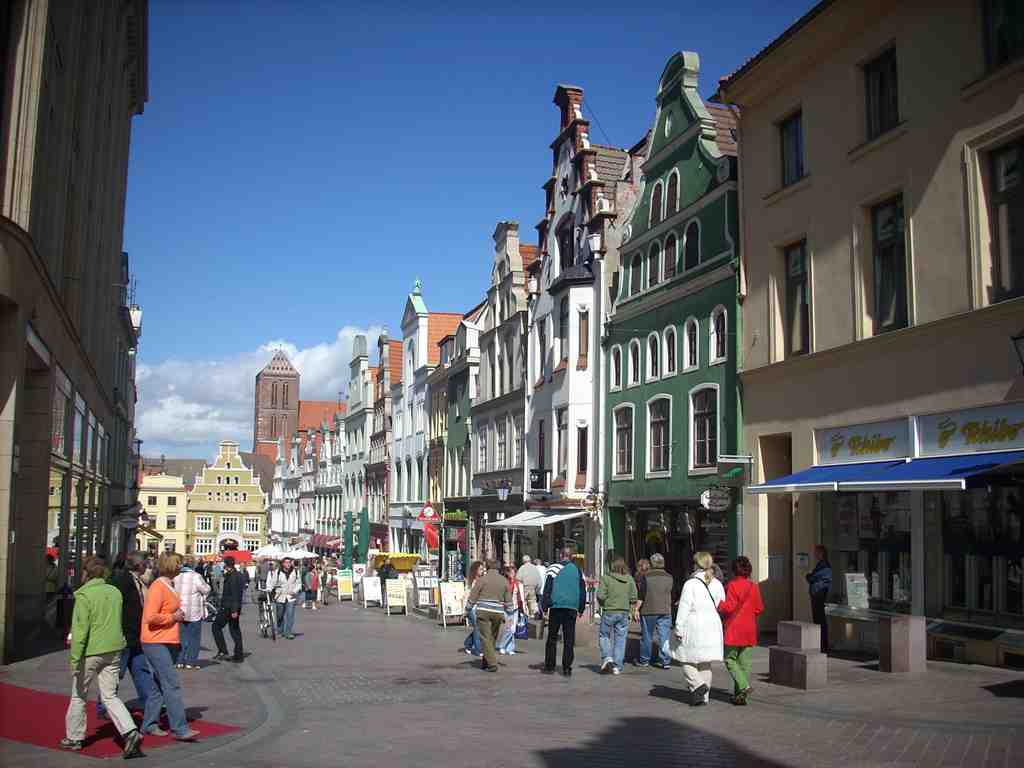
Right in front of you stretches Krämerstraße, a picturesque pedestrian street lined with colorful, gabled townhouses-look slightly to your right where the buildings' ornate rooftops, especially the patina-green and pastel facades, make the street stand out against the open sky.
Ah, you’ve reached Krämerstraße, right in the living, breathing heart of Wismar’s Old Town! Take a deep breath-there’s something magical about this street, as if the cobblestones beneath your feet are humming with stories from centuries past. The bright facades you see, with their whimsical gables and patina greens, creamy yellows, and blushing pinks, tell tales far older than the latest café menu. This whole area is protected by UNESCO, so you’re walking through a world heritage site-basically, VIP status in the world of streets.
Picture it: the year is 1229. Wismar is freshly minted as a city. Krämerstraße is alive with the sounds of traders-called “Krämer”-hawking their spices, dazzling cloths, glittering cutlery, and the kind of mysterious gadgets you only ever find at medieval markets or, these days, online shopping sites that deliver from 'far-away lands.' Back then, though, if you wanted a handful of cinnamon or a bolt of fancy fabric, this was your hotspot. Try to imagine the scents: spice-laden breezes, the tang of brewed coffee centuries later, the sweetness of fresh bread from a nearby bakery, and just a hint of adventure.
As you stroll along, you’ll notice that Krämerstraße isn’t just a street, it’s a network-a little like a medieval mixer-connected by lanes with curious names. There’s the Hegede, which in old Low German meant a hedge or a border, a reminder of marketplaces with picket boundaries and maybe a little bickering about whose stall went where. Lübsche Straße salutes the nearby Hanseatic titan, Lübeck, while Böttcherstraße still whispers stories of the barrel-makers, the ones responsible for every last beer barrel and shipping crate. And who could forget Bademutterstraße? Don’t worry, despite the name, it’s not dedicated to mothers in bathtubs! Way back, it honored the midwives of Wismar, with “Bademömen” being a nickname for those amazing women.
Now, keep your eyes peeled for the houses with their proud gables-a whole parade of architectural characters standing shoulder to shoulder. At number 1, you’ll spot a four-story emporium built in 1907 in a style unique to Wismar, once the flagship for Karstadt, the famous store whose founder Rudolph Karstadt opened his first textile and manufacturing shop right next door in 1881. Move along and you’ll see elegant baroque numbers, like number 3, a gabled house with elaborate swirls, and number 8, showing off its bay window and, just recently, some sprucing up to keep everything standing tall.
If you want a splash of color, look for the pastel-green corner gable or the rose-hued number 15. A Dutch architect called Philipp Brandin once called number 15 home, back around 1577. Who knows? Maybe he stood exactly where you are, shaking his head at the noisy traders and dodging runaway wagons. Or perhaps he admired the street’s very own fountain, still bubbling today, and the lively scene of people darting between market stalls.
The street has changed with the times, of course. In the 1970s, during the days of the German Democratic Republic, Krämerstraße became a pedestrian paradise, paved in smooth asphalt-perhaps not the stuff of medieval legend, but great for a modern shopping trip without splashing mud on your shoes. In 1999, it was given a facelift, with patterns of granite stones laid in neat rows, brick formats for a touch of tradition, and mosaic patches for those who like a bit of surprise underfoot.
Not every story here is laughter and business deals. Number 17 once housed a bookshop that belonged to Johann Heinrich Sievers, who ran afoul of the law for offending the monarchy and wound up fleeing to England. Add to that the three-century-old Löwenapotheke (Lion Pharmacy) on Bademutterstraße, complete with a lion’s-head portal and some classic Art Nouveau glass, now reborn as a cheerful café.
And if you’re looking for a touch of whimsy, don’t miss the sculpture of a wolf and a crane or the stamp issued in 2003-yes, this street is so photogenic, it even landed on German postage.
So as you explore, remember-each step you take in Krämerstraße is a little journey across eight centuries of shopping, laughter, whispers, and wonder. If those gables could talk, they'd probably say, "Careful with the cobblestones-and do stop for a pastry!"




