
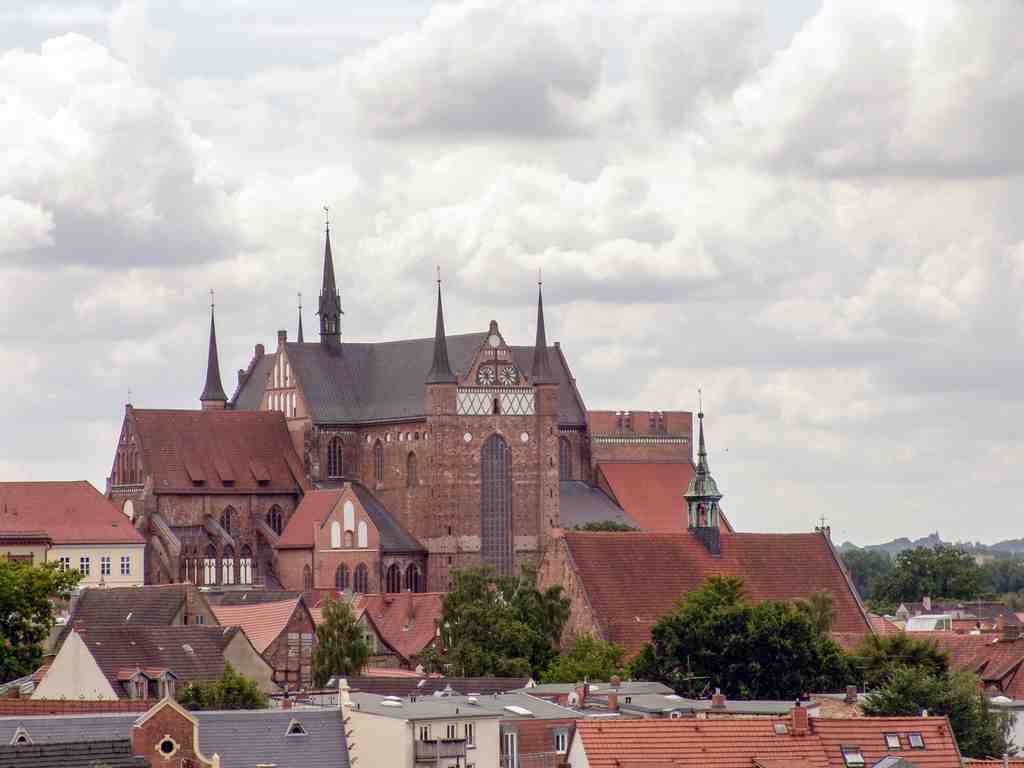
Look for a gigantic brick church with striking gothic arches and tall spires towering high above the red rooftops-if you spot something that looks like a medieval fortress but prettier, you’ve found the Georgenkirche!
Now, let me whisk you back through the centuries to a time when Wismar was bustling with merchants, craftspeople, and more than a few ambitious city planners! The Georgenkirche, or St. George’s Church, is not only the largest church in Wismar but also its youngest-imagine a little sibling determined to outgrow all the others! Construction started around 1295, and from the very beginning, everyone aimed high: this was to be the people’s and princes’ very own house of worship, with soaring columns and a choir so grand that even the town’s ghosts (if they exist!) would be inspired to sing.
But like every great story, this one isn’t without drama. Imagine the clang of hammers and the scraping of bricks being hoisted into place as the church slowly took shape over generations. Records mention an earlier church here, but no one is quite sure where it stood-maybe right under your feet, or maybe out there beyond the old city wall! By the turn of the 14th century, a brand-new basilica was rising, crowned with chapels, a bold choir, and architects forever changing their plans to make things even bigger.
As the years ticked by, the church became an inescapable part of daily life-home to booming services, epic celebrations, and, if you were really lucky, a juicy bit of medieval gossip whispered under the arches. By 1404, an ambitious third phase started: new chapels, a west tower (which, admittedly, was never finished, but hey, show me a perfect builder!), and a grand west entrance decked with ornate brickwork. Some say that St. George’s became a symbol for the city’s ups and downs-every brick hiding stories of triumph and, occasionally, defeat.
Fast forward to the 20th century, and the Georgenkirche’s luck seemed to run out. Near the end of World War II, in April 1945, bombs tore through the heart of the building, flames licking at its ancient beams. The massive walls survived, but the mighty roof and tower collapsed, organ and altars destroyed or lost to the chaos. For decades after, the church stood like a wounded giant-exposed to the elements, with grass growing through cracks once filled with prayer.
But like all good heroes, St. George’s never gave up. The people of Wismar, passionate preservationists, and even a mighty round of applause from the rest of Germany worked miracles-literally known as “the Wonder of Wismar.” Imagine workers high on scaffolding, voices echoing, as beams and bricks once again found their places. It took millions of euros, storms that tried to undo their work, and even a dash of political intrigue during the reunification of Germany (because hey, why not add a little more drama?), but by 2010, the Georgenkirche stood proud again, restored and ready for new stories.
Step inside, and you might feel the space echoing a thousand years of footsteps, from lords in silk to townsfolk in humble leather. Its interior is a triumph of North German brick gothic-broad, bright, and full of silent witnesses. While many treasures were lost to war and history, legends live on: there were over 30 altars here at one time, can you believe it? And a mighty high altar, 10.5 meters wide, once the grandest in all the Baltic lands. Even the walls, stripped and beautiful, seem to whisper, “You ain’t seen nothing yet…”
Today, the Georgenkirche is not just a church, but a survivor and a stage for music, art, and the odd festival or two. In 2014, a viewing platform opened, letting you gaze out over Wismar as if you were the town’s medieval guardian. So, whether you’re here to marvel at its sheer size, trace the scars and triumphs of history, or simply enjoy a quiet moment, just remember: you’re standing in the shadow of a true architectural phoenix.
Just watch out for falling medieval mysteries-and maybe a ghost or two who’s never quite left their favorite seat!
Fascinated by the architecture, preserved equipment or the former altars? Let's chat about it




