
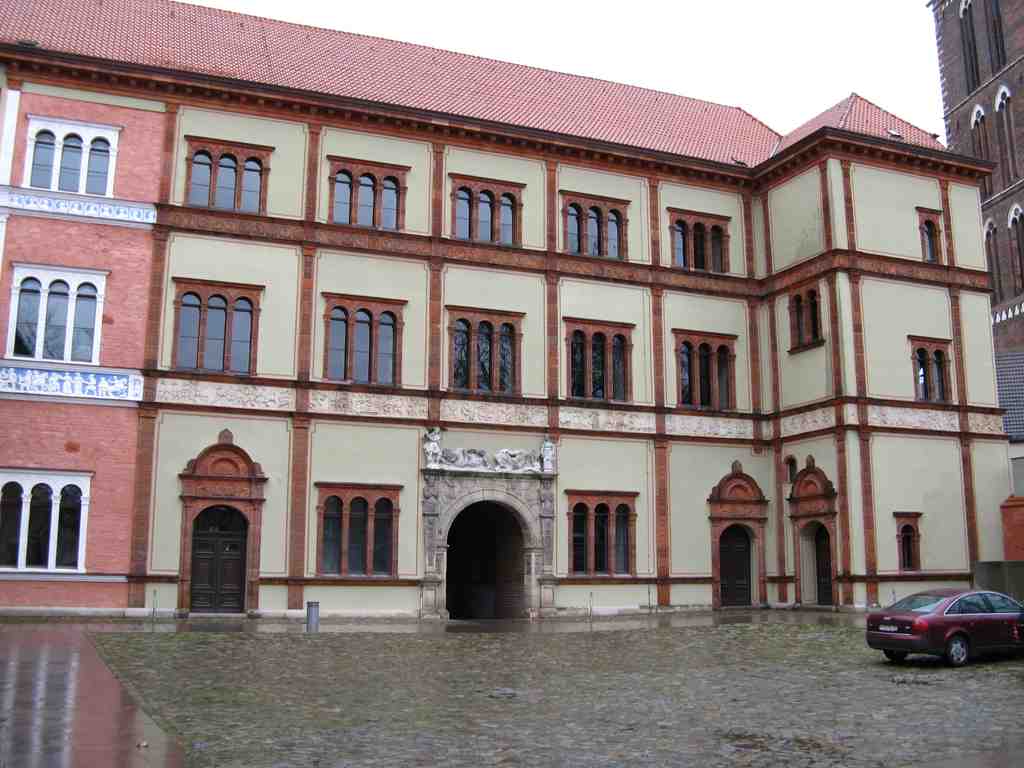
To spot the Fürstenhof, just look ahead for a grand, three-story Renaissance building with pale yellow walls, deep terra-cotta red window frames, richly decorated friezes, and a dramatic arched entrance right in the middle.
Alright, take a nice deep breath of that North German air and let’s head back in time! You’re standing before the Fürstenhof - Wismar’s original Renaissance showstopper, where dukes planned their fairy-tale weddings, and justice thundered through the halls. Picture the year 1512, when Heinrich V, the Duke of Mecklenburg, decided to build a palace fit for his second royal wedding to Helene of the Palatinate. The first part of this building, called the Old Court, had the latest trends of the late Gothic world - think fancy vaulted ceilings and curtain-arched windows. The place was covered in a red lime wash, the terracotta sculptures shining white, and the blue backgrounds making every detail pop. If you catch a glimpse of the reconstructed color scheme in the courtyard, you’re getting a peek at Fürstenhof’s former glory.
But Fürstenhof was not a one-wedding wonder! Fast forward about 40 years and there’s a fresh party in town. Duke Johann Albrecht I wanted nothing less than a Renaissance marvel for his own wedding to Anna Sophie of Prussia. So, they tore down an old Gothic festival hall and replaced it with what you see towering in front of you - the New Court, built in 1553. Imagine builders and artists hustling about, inspired by the cool palaces of Ferrara in Italy. The outside walls sing with friezes carved in limestone and terracotta, featuring biblical tales and legendary myths. Every window along the street is topped with a triangle-shaped gable, while the big arched gate in the center looks like it’s daring you to march in just like a duke.
Yet, just like a good plot twist, time changed everything. For centuries, the Fürstenhof switched jobs more often than a medieval jester! When Wismar came under Swedish rule, the dukes were out and the lawyers were in. The grand halls echoed with the voices of judges during the 1600s and 1700s, as the feared and respected Wismar Tribunal made its home right here, handing down important decisions for all of Swedish Germany. You can almost imagine Swedish uniforms flapping in the sea breeze and horse hooves clapping as lawyers hurried in for another day of courtroom drama.
The outside of the building changed, too. In the 19th century, restoration work by Carl Luckow gave the Fürstenhof a fresh look - sometimes sticking closely to the original plans, sometimes getting a little creative. Windows were replaced, doors standardized, and terracotta sculptures restored. The whole building got a new coat of plaster, and even the relief panels had to be replaced, sometimes copied to keep the beauty alive.
But one thing never changed: the Fürstenhof’s knack for reinvention. During the DDR times, this building housed a court, a geodesy office, and even the city archives. These days, if you ever need to sort out a parking ticket or something a bit more dramatic, the district court of Wismar is waiting inside!
So, as you stand here, look up at those decorated friezes - some original, some painstakingly copied - and imagine the centuries of stories whirling through these walls: noble weddings, astonishing art, legal showdowns, and whispered secrets swirling through candle-lit corridors. Not bad for a building that started as a honeymoon suite, right? And if you hear the echo of fancy shoes or the soft shuffle of court papers, don’t worry - that’s just the past poking its head out to say hello.




