
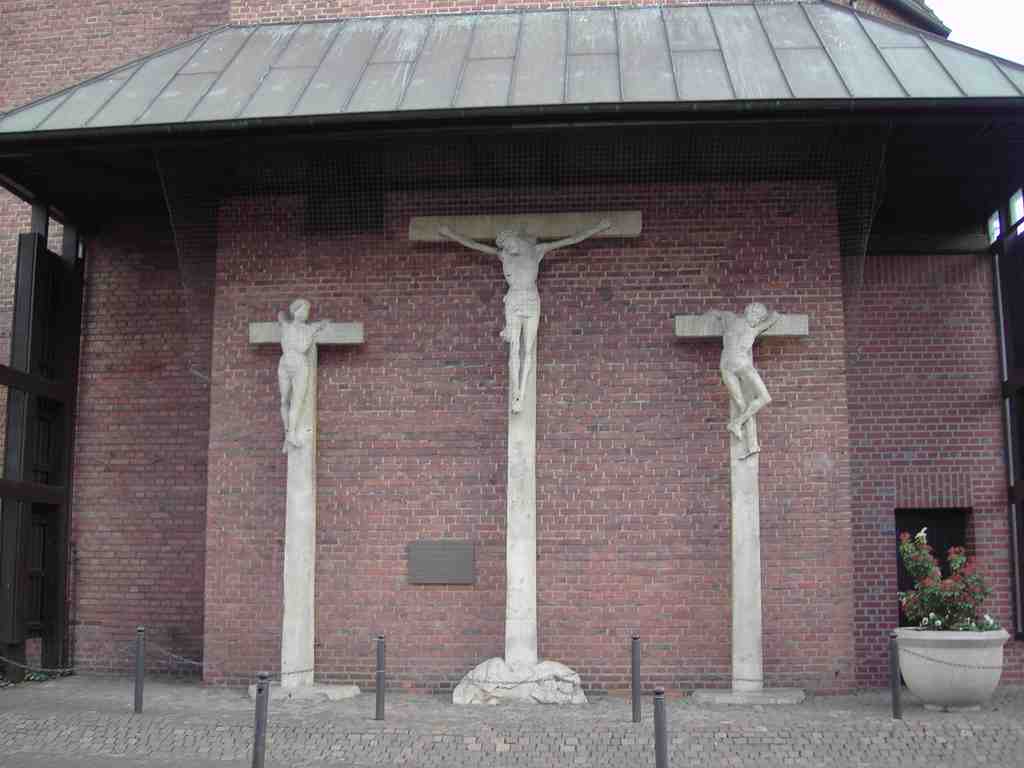
Directly in front of you, you'll spot three large, pale stone crosses standing majestically against a red brick wall-just look for the life-sized figures upon each cross, with the central one raised slightly higher than the others and capped by a sheltering roof.
Now that you’ve found the Crucifixion Group-also known by locals as “The Three Crosses”-let’s unfold its dramatic and emotional tale. Picture the year 1501. Artists from a bustling workshop in Wesel have just finished carving these striking sculptures from sturdy Baumberg sandstone. The crosses are impressively tall-almost five meters high-and each figure looks about the size of a real person, so don’t worry, you’re not suddenly shrinking! Take a moment to see the artistry: T-shaped crosses, the central one holding the sculpted figure of Christ, rising out of a rock decorated with a skull and bones-a little medieval detail to remind you, in case you forgot, that life back then could be pretty intense.
To Christ’s left and right, you’ll find the two thieves-each with a different pose, one turning toward Christ in hope, the other turning sadly away. This isn’t just good drama-it’s top-quality medieval storytelling! These crosses originally stood not in Dinslaken but just outside the city walls of Wesel, where they completed a path meant to echo the steps of weary pilgrims who’d trekked to the Holy Land. Imagine the footsteps-muddy, tired, hopeful-filing past this very scene.
But then, the Eighty Years’ War rages in the late 1500s. Spain, Parma, sieges, cannons-a bit more excitement than a quiet town usually wants! The small chapel that housed these crosses was torn down in 1588, with city defenders fearing a siege and looking to prevent enemies from getting too comfy. The crosses, not wanting to become war loot, were whisked away to Dinslaken and placed near the city gate, where they became a signpost for locals and travelers alike.
Since then, the stones have endured-weather, wars, the odd renovation (like a new French limestone head for Christ in the early 1900s-talk about a long wait for a makeover!), even being lovingly relocated and protected as the city grew. The middle cross still bears an inscription from their first big restoration in 1652. Today, you see replicas here at their historic spot, while the originals are preserved nearby and finally safe from the chaos of history. So, as you stand before these three weathered but resolute crosses, remember the journeys, battles, and peaceful moments they’ve witnessed. And hey, at least now, they don’t have to worry about unexpected sieges-just the occasional curious visitor like you.


