
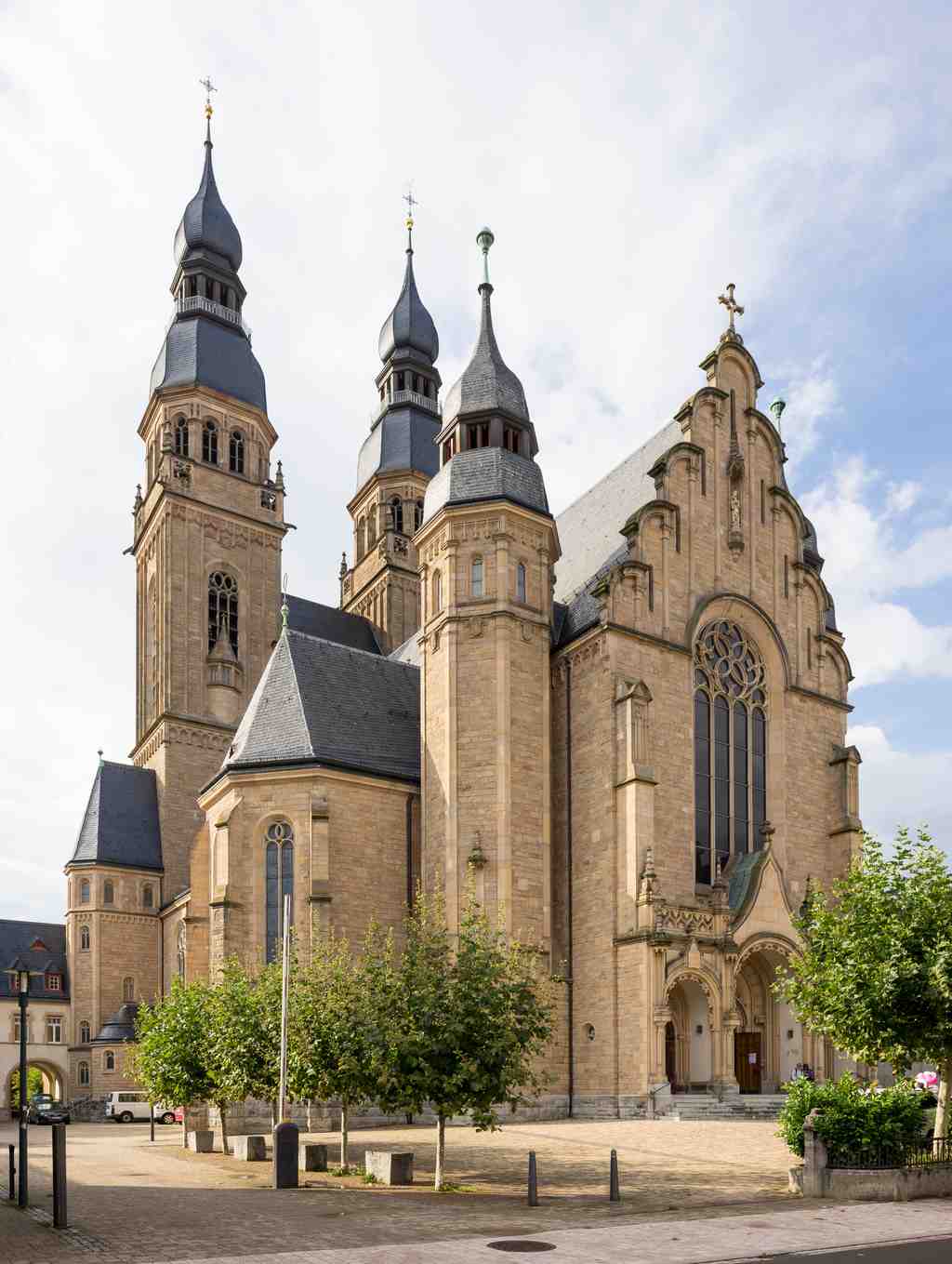
To spot St. Joseph (Speyer), just look for a colossal church with two towering spires topped by curvy, pointed roofs and a grand arched entrance flanked by detailed stonework, right ahead of you-trust me, it’s hard to miss!
Now, get ready, because standing here means you’re about to hear one of Speyer's liveliest tales of friendly rivalry, musical masterpieces, and community spirit! Let’s wind the clock back to the late 19th century. Picture Speyer as a town bubbling with excitement, drawn into a sort of friendly arms race between its Protestant and Catholic communities. Right after the Protestants launched a massive fundraiser to build their Gedächtniskirche-a monumental church just over the way-the Catholics said, “Well, two can play at this game!” and started up their very own church-building club back in 1887. Where to put such a magnificent new church? The Protestants snapped up land right at the city’s edge for their church, so the Catholics sought a plot just across, bargaining and trading till they settled on the site you see before you. The St. Magdalena monastery even chipped in some precious land!
The dream was a church to match the Protestants’-grand, inspiring, and undeniably eye-catching. But dreams take money, and here’s where things got bumpy. The Catholic community had big plans to finish by the turn of the century. Instead, they hit delay after delay. Opening their wallets only to find moths, construction kept being postponed for years. But hope refused to die. On June 9th, 1912, they finally gathered for the laying of the foundation stone, with Bishop Michael von Faulhaber himself in attendance, and the scene was nothing short of electric-a feast of faith, tradition, and anticipation.
Just two years later, in 1914, the church was ready enough to be dedicated to Saint Joseph-the patron of workers and the region. Yet, even as the congregation cheered, a twist was on the wind: war broke out. Suddenly, the grand, sweeping staircase intended to welcome crowds became a humble set of steep concrete steps; other details, like some of the stonework above the entrance, were left jutting out, rough and unfinished. The east side? Imagine a half-finished puzzle-there should have been a building mirroring the parish house on the west, but the project remained incomplete. Instead, remnants of the St. Ägidius monastery now form the base of the so-called Ägidienhaus.
Despite these hiccups and hardships, the church grew into a symbol-first of rivalry, then of love. This was a place of Catholic pride, a shoutout to their Bavarian roots and loyalty to the king. Yet over time, something wonderful happened: old competition mellowed into genuine friendship. When St. Joseph recently needed months of renovation, guess where the parish held their services? Right in the Gedächtniskirche, with their once-rivals turned gracious hosts.
That spirit of diversity is woven straight into the church’s architecture. St. Joseph looks nothing like the Gedächtniskirche or the majestic cathedral. Ludwig Becker, the architect, tossed strict rules out the window, mixing Art Nouveau with late Gothic, Baroque flourishes, and a touch of Renaissance flair. Even the twin towers are special-their swooping shapes are inspired by Heidelberg’s Church of the Holy Spirit. At nearly 90 meters, they rise just 2.5 meters shorter than Kaiserslautern’s Marienkirche’s tower, and only 10 meters shy of their Protestant neighbor-a friendly game of “mine’s almost as tall as yours!”
Step inside, and the sense of grandeur continues. Imagine nearly 4,000 organ pipes swelling with music-built by master Heinz Wilbrand in 1990, these pipes help fill every corner with soaring sound. The windows? Each brilliantly colored pane was designed by Bernhard Kraus and crafted in Munich. They weren’t paid for by a faceless committee, but donated by locals and community groups-a patchwork of generosity. Bells ring out from the towers-four, harmonizing in a sequence that dings right into your bones. The largest, cast in 1960, weighs nearly 4 tons!
As you look around, you’ll see that St. Joseph is more than just a church-it’s a beating heart for the whole area. To the north is the Ägidienhaus, home to parish gatherings, a library, and meeting rooms; the south holds the parish office, kindergarten, and youth rooms; and to the west, gathering halls, a garden, and even a care home.
In the end, St. Joseph’s story is about much more than stone and glass. It’s about neighbors outdoing one another in kindness, music ringing through unfinished towers, and a city skyline shaped not just by rivalry, but by a community coming together-one sturdy step, beautiful window, and shared hymn at a time. So go ahead, let your eyes and imagination wander up those towers, and see if you can spot the spots still waiting to be finished-it’s all part of the charm!
Yearning to grasp further insights on the architecture, equipment or the complex? Dive into the chat section below and ask away.




