
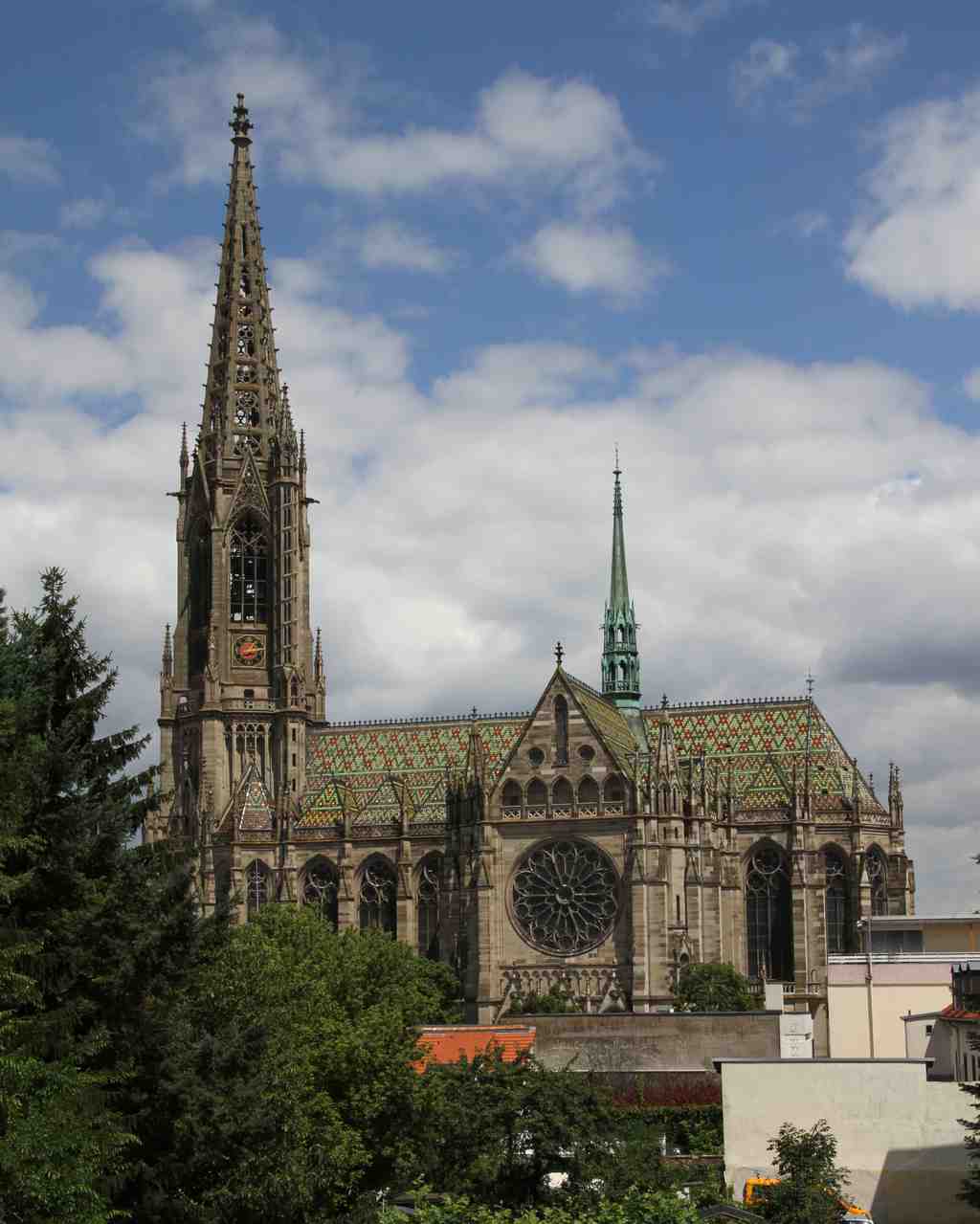
Look ahead for a tall, needle-like spire decorated with intricate stonework and a huge rose window-this awe-inspiring Gothic church towers above its surroundings and you really can’t miss it!
Now, as you stand right here, let’s step back in time-imagine the late 1800s, the city of Speyer buzzing with plans, arguments, and a dash of competition. This enormous church in front of you is the Memorial Church of the Protestation, or as the locals call it, the Protestationskirche. It was built between 1893 and 1904, and trust me, its story is as dramatic as its architecture!
It all started with a splash of defiance. Jump back to 1529: a rowdy parliament, the Reichstag, was held right here in Speyer. Picture a grand hall filled with powerful princes-some fiercely loyal to Luther’s new ideas, others determined to keep things as they were. When it was proposed to vote on what people should believe, those “protesting” princes simply refused. Their stand gave birth to the very word “Protestant” and changed the course of Christian history forever!
Now, centuries later-cue the dramatic music-tensions still simmered between Catholics and Protestants, especially after new declarations from Rome and Germany’s new Protestant emperor. Protestant Speyer dreamed of a church that would rival even the mighty cathedral nearby. But the dreamers didn’t agree with each other right away-it took more than 35 years of lively debates and fundraising (with a few sharp elbows among friends) before a single stone was laid!
Imagine builders and stonemasons testing rocks from one quarry after another, looking for just the right stones. Red sandstone looked good at first, but “too many pebbles!” someone cried. In the end, glowing white-gray sandstone from the Vosges gave the church its bright look, with glazed roof tiles sparkling like a giant, soup-ladle-shaped checkerboard. When they finally finished, the tower soared 100 meters high-the tallest in all the Palatinate-almost sticking its tongue out at the cathedral across town!
The inside is just as impressive: three great halls, ribbed vaults, and bright stained-glass windows everywhere. Forget stuffy academic art-these windows burst with stories, colors, and even portraits of the German Emperor’s children as cherubs. The best seat in the house is the emperor’s own “Kaiser choir,” but no, Kaiser Wilhelm II actually snubbed the church’s opening-political drama kept him away. He did stop by for a peek years later, though.
As you step into the tower’s ground floor, you’ll find a bronze statue of Luther himself, fist raised, standing on Swedish granite. That’s no accident-this spot, called the Memorial Hall, was designed to parade the heroes of the Protestant stand right before your eyes. Look for statues of the six protesting princes, and the floor beneath Luther carved with his legendary words: “Here I stand, I can do no other.” It’s powerful stuff!
The church’s doors are guarded by a stone King David, strumming his harp, welcoming you with a psalm. And inside, look for peculiar fish carved into the lectern-one fat fish holds a book (it’s Martin Luther), and another fish with braids is his wife. You don’t see that at every church, do you?
And if you’re lucky enough to be here when the organ plays, you’re in for a treat. The Protestationskirche has not one but two gigantic organs-the main one with nearly a hundred registers is among the largest in southwest Germany. When they fire up, it’s like the church itself comes alive.
But, not everyone cheered for this place. There was plenty of rivalry-nearby Catholics soon built their own grand church as a sort of architectural thumb-your-nose, right next door. Even today, the Memorial Church keeps on ringing out, not just as a beacon for Protestants, but as a historic symbol of standing up for your beliefs-even if you have to debate about it for decades and haul tons of the finest stone halfway across Germany.
So, take a long look at that spire breaking the sky, and imagine the legacy of courage, argument, and artistry that it celebrates. After all, where else can you find an argument carved in stone and sung out with organ pipes? Onward to the next stop!
Eager to learn more about the reason for commemoration: protestation 1529, place of construction, architectural style, architects or the financing and architecture? Simply drop your inquiries in the chat section and I'll provide the details you need.




