
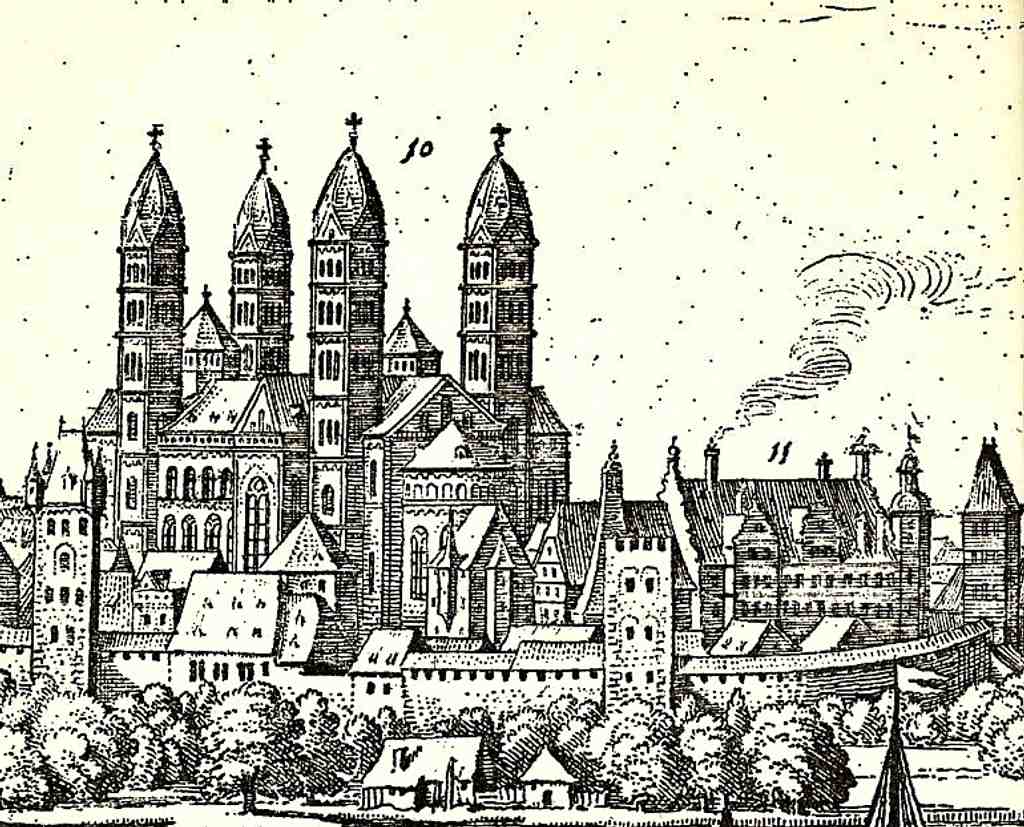
Take a look just to the north side of the mighty cathedral, where you’ll spot the remains of a grand structure-what’s left of the Episcopal Palatinate is a graceful arcade and ancient stonework, tucked near the towering silhouette of the Dom.
Alright, now stand still for a second and picture this scene: Mist rolls in off the river, and towering above you is not only the cathedral’s mighty spires, but an impressive bishop’s palace-the Episcopal Palatinate. Don’t let the quiet today fool you, because this place was once the nerve center for medieval power moves, secret plots, and more than a little bit of holy drama!
Way back in the mists of time, nobody really knows exactly where the first bishop’s house stood, but logic says it had to be right here, close to the spiritual heart of Speyer. By 1270, the bishop’s palace was already important enough to make the history books-though don’t you imagine it just popped into existence overnight. It probably had seen a lot of years (and probably a lot of bishops’ arguments) before it ever got mentioned!
Once, the palatinate stood proud on the cathedral’s north side, glancing down on daily life like a wise old uncle. The cathedral’s south side, meanwhile, was all monks and silence in the cloister. Over the centuries, great builders-like Hans von Mingolfsheim in the 1400s-spruced up the palace, adding new rooms and splendid touches. Fast forward to Abraham Saur’s time in 1658, and he wrote that it was a cheerful place filled with gorgeous chambers, columns, and, my personal favorite, “artful carpentry.” Can’t you just picture those creaky wooden floors and glittering windows?
But alas, everything has its stormy night: Wars swept through, and after terrible destruction, Prince-Bishop Johann Hugo von Orsbeck tried to revive it with fancy Baroque flair, hiring master builders to work wonders on the old stones. They gave it new arches, an impressive gateway, and made it richer than ever. But with shifting times and the lure of a comfier palace in Bruchsal, the grand old Palatinate slowly faded -finally, by 1806, it was taken down completely, leaving behind only a whisper of its greatness.
Yet, as you stand here, if you listen closely to the wind, you might just hear the echo of bishops’ footsteps, the clink of goblets in grand feasts, and the stories that linger in these ancient stones. Now that’s a palace with secrets!




