
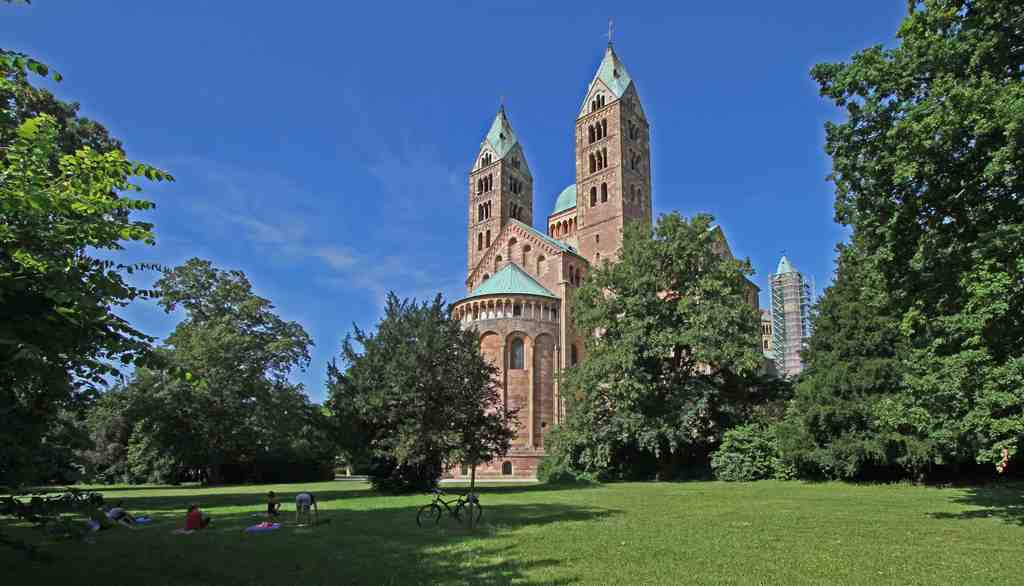
Look ahead and you’ll spot the great cathedral rising above a vast, sunlit lawn, surrounded by broad emerald trees-just follow where the towers peek above the leaves and you’ll find yourself in the heart of the Cathedral Garden Speyer.
Welcome to the Cathedral Garden-known locally as the “Dummgaade”! Here, you’re not just wandering a patch of grass but traveling through over a thousand years of history, legends, and a bit of town drama. Imagine stepping back to the days when the Rhine River flowed close by, almost lapping at the feet of the cathedral. Now, after some 19th-century river engineering, there’s this wide-open green, sandwiched between the mighty cathedral and the river, with more memories than it has blades of grass.
Long before this peaceful park was filled with picnicking locals and playful kids, officials dreamed of transforming the cathedral’s surroundings into a grand public space. Napoleon’s wars slowed things down, but by 1821, under the keen eye of Carl Albert Leopold von Stengel, the ruins were cleared for a park that’s seen both the glory of kings and the mystery of murder most foul-yes, even murder! In 1277, poor Albert von Mußbach, a head churchman with a knack for making tax enemies, met a very sticky end. Backstabbing, a missing hand, and a city maybe too eager to look the other way-if these trees could talk!
Stroll a bit and you’re walking through two gardens-east and west-spanning an impressive 124,300 square meters all the way to the Rhine. If you listen, you may hear the rustle of the oldest trees in Speyer overhead-some planted as far back as 1816. The platanes, maples, and hornbeams are veteran witnesses to everything from royal visits to raucous festivals, though sadly, even centuries-old trees can’t escape the summer heat.
Now, keep your ears open--the park is a haven for 15 species of birds (and apparently, owls with a dislike for drones). And as you wander, sculptures pop out in the most unexpected places. Close to the cathedral’s southern wall, kids and grownups alike touch a gigantic tactile model-a sand-colored miniature of the cathedral, made for blind and sighted visitors to trace history with their fingers. Go ahead, it’s at wheelchair height too!
There’s even more art tucked among the shrubs: an ancient “Ölberg” sculpture spattered with drama and an angel at the top, a bronze bust of Helmut Kohl-designed to grin mischievously at passersby-plus a steel “Speyer Head” seemingly pondering eternity, and the curious “Giro Porta,” a “twisted door” by a local artist, just in case you wondered if doors could dream.
See that big fancy fountain? In the 1880s, it reached over 20 meters high, nearly visible from the Rhine. Sadly, there’s no more high-flying water, but there’s still plenty of splashing on warm days. Speaking of controversial splashes, there used to be a giant bronze statue called “Filia Rheni”-the daughter of the Rhine-striking a pose that scandalized some folks until its artist and the city had a tug-of-war and she vanished, leaving only whispers behind.
But not all is glitter. Some art, like the “salische Kaiser”-statues of spearing-eyed medieval rulers-came to the garden via the fevered dreams of 1930s Germany and have sparked debate ever since.
Look for little touches of quirky legend, too, like the “Heidentürmchen”-one of the last medieval towers-called “heathen’s turret” after an odd misunderstanding about its ancient, stony roots. One legend had giants building it (but separate bedrooms led to serious marital problems). In truth, that giant bone once shown at Town Hall? Sorry, not a giant-just a whale vertebra (or maybe a mammoth!).
And let’s not forget the “Fährmann hol’ über!” statue, evoking an old tale: in 1813, it’s said, the emperors from the cathedral’s tombs rose from their graves and called the ferryman to cross the river and save the empire-talk about making a splashy comeback!
Modern touches, too: in 2018, they added the Stauferstele-tall, octagonal, trimmed in gold to honor medieval rulers, glinting in the sun. And somewhere nearby, you might find the climbing web, the “Speyer Spider,” a playground for kids, or the trio of abstract sculptures called “Trifolium,” connecting nature and art like a giant cloverleaf.
So as you finish your stroll, take in the sounds: laughter, birds, a distant bell-or maybe the whisper of emperors and spirits from centuries past. Here, in the Cathedral Garden, every shadow, every sculpture, every rustle tells a story-sometimes wild, sometimes touching, occasionally ridiculous, but always uniquely Speyer. And remember: every garden is a little wild beneath its neat paths, so keep your eyes open-who knows what, or whom, you might meet!




