
Lübeck Audio Tour: Stories and Spires of the Historic Heart
Beneath Lübeck’s pointed spires, secrets linger in the shadows where merchants schemed and cathedrals echoed with forbidden whispers. Ancient walls conceal more than stunning architecture. This self-guided audio tour leads through narrow alleys and bustling squares, unlocking stories hidden behind the Town Hall’s grand façade and inside the solemn halls of St. Mary’s Church. Listen closely—discover corners most visitors barely glimpse. What deadly plot once threatened the very fabric of Lübeck’s freedom from within its own Town Hall? Why are centuries-old bells inside St. Mary's shattered but never removed? Which daily habit of Nobel Prize-winner Günter Grass set local tongues wagging for decades? Trace the city’s pulse as you move from political intrigues to artistic rebellions. Each step reveals drama, scandal, and mysterious moments left out of guidebooks. Hear Lübeck’s true heartbeat. Begin the journey and let its secrets unfold beneath your feet.
Tour preview
About this tour
- scheduleDuration 40–60 minsGo at your own pace
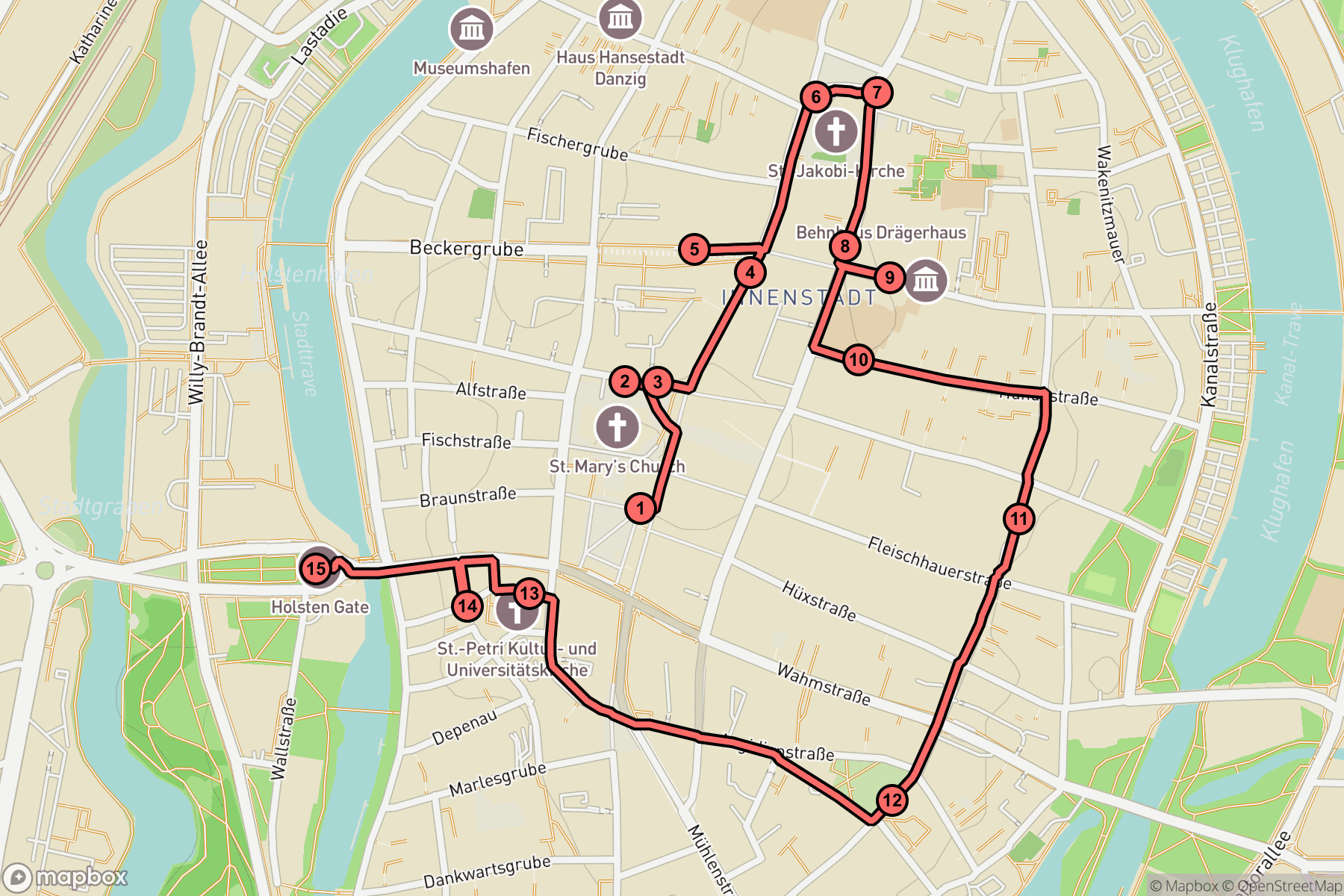
- straighten3.3 km walking routeFollow the guided path
- location_on
- wifi_offWorks offlineDownload once, use anywhere
- all_inclusiveLifetime accessReplay anytime, forever
- location_onStarts at Lübeck Town Hall
Stops on this tour
If you’re searching for Lübeck Town Hall, just look for the grand, dark-brick building with dozens of round holes and colorful disks in its dramatic façade, crowned by slender…Read moreShow less
If you’re searching for Lübeck Town Hall, just look for the grand, dark-brick building with dozens of round holes and colorful disks in its dramatic façade, crowned by slender towers pointing skyward-all facing onto the lively marketplace. Now, take a deep breath: you’re standing before one of Germany’s most famous Gothic brick masterpieces-a place where the past doesn’t just whisper, it practically yells out its stories! Imagine Lübeck centuries ago, alive with merchants, city guards, and maybe even the odd pickpocket or two sneaking through the arches. The very first town hall here was a humble house, mentioned in a dusty old book of Lübeck law nearly 800 years ago. But that’s ancient history-by 1240, the city had bigger ambitions. Soon, a complex of three gabled houses stood right here, their Romanesque outlines echoing with the voices of early Lübeckers. Let’s say the neighbors weren’t too pleased when, just a decade later, fire swept through--leaving only traces of the old structure in the walls you can still spot today. But Lübeck didn’t give up. The city rebuilt, this time going full-on Gothic. As you gaze up, see how the massive shield walls are pierced with decorative windows and round holes? They were designed not just for style, but even to break the wind-because nothing ruins a medieval council meeting quite like a stiff Baltic breeze. You’re literally looking at Lübeck’s storm-proof solution. Fast forward to the late 1200s-imagine goldsmiths selling trinkets in the open halls under your feet, and the grand “Langes Haus” (Long House) stretching out in brick splendor. You’d have heard the clang of the merchant's scales and the bustle of townsfolk trading cloth and, later, after a hard day’s bargaining, sampling a cheeky glass of wine from the cellars below. By the 1300s and 1400s, Lübeck’s Town Hall was showing off-new towers popped up thanks to master builder Peck, the façade along Breite Straße (that’s where you’re standing now!) became an early preview of styles that wouldn’t appear for centuries, and the building kept growing. Each new addition told the tale of Lübeck's rising power, where the Hanseatic League’s decisions on war, peace, and trade echoed through long halls. On market days it must have been quite a show-imagine the Senate appearing on the high balcony above the entrance, laws and proclamations booming down to the crowds below:. Now, peek at some quirky details: see those two oddly sized doors to the former courtroom? If you were found innocent here, you got to stride out head high through the tall door. But if you were guilty-uh oh!-you had to shuffle backwards, head bowed, through the tiny one, so you wouldn’t “turn your back on justice.” Even the holes in the façade have secrets: the biggest break the wind, but the little ones? Pure decoration, showing Lübeck’s love of flair. Inside, if you could slip past the city clerks, you’d find grand halls decked with paintings of long-lost mayors and councils making serious faces, and a dazzling Renaissance staircase leading to the Kriegsstube-the legendary “war room,” once decorated by Lübeck’s finest artists before the bombs of World War II left little but memories. In the Rococo audience hall, gilded allegories of justice, love, and, of course, secrecy gaze down on proceedings. Legend has it, only the “Virtue of Secrecy” couldn’t be painted as a woman-because apparently even Lübeck’s town fathers knew some secrets are best kept by men! And beneath your feet, the famous Ratskeller is still open for business-after all, city officials need somewhere to ponder deep questions, like “red or white?” while surrounded by the smells of roasted meat and old, oaky barrels. Before you wander on, take in the building’s many layers-Romanesque bones, Gothic body, Renaissance and Baroque trimmings. It’s a living puzzle-box, a monument to Lübeck’s stubborn survival through fire, war, and even architectural fashion faux-pas. And when the wind whistles through the arches, just remember: even the bricks here know how to tell a good story. To delve deeper into the interior design, functions or the special features, simply drop your query in the chat section and I'll provide more information.
Open dedicated page →To spot St. Mary’s Church, look up to see two sky-high copper-green spires towering above you-they’re impossible to miss among the red-brick rooftops. You’re standing before the…Read moreShow less
To spot St. Mary’s Church, look up to see two sky-high copper-green spires towering above you-they’re impossible to miss among the red-brick rooftops. You’re standing before the mighty St. Mary’s Church, the “mother of brick Gothic”-and trust me, your neck might get stiff from staring up! Imagine this: in the 1200s, the merchants of Lübeck wanted a church so magnificent, it would outshine the bishop’s old cathedral and declare their independence to the whole Hanseatic League. They didn’t just dream big-they built big, using brick instead of stone, reaching so high that today, you’re looking at the tallest brick vault in the world, a dizzying 38.5 meters overhead. Wander closer and let your imagination travel back to medieval Lübeck. This street pulsed with ships unloading spices, wool, and herring-so many future donors, all eager to make their mark on the city’s new heart. At first, this spot held a humble wooden church. As Lübeck’s confidence (and wallet) swelled, they upgraded to stone, then to the grand Gothic basilica you see now, with its twin towers-each nearly 125 meters tall, their foundations thick as a small house! St. Mary’s didn’t just lead in height; it led in style. French cathedrals taught Lübeck’s builders the art of soaring vaults and flying buttresses, but local ingenuity turned brick-the “Hanseatic cement”-into Gothic poetry. Not only did this make St. Mary’s a local wonder, it became the blueprint for 70 other Baltic churches. If these walls could talk, they’d gossip about builders changing plans mid-way, swapping a single-tower idea for the twin towers, sneaking in chapels named after powerful families, and adding secret strongrooms where Lübeck’s most important documents sat under heavy lock and key. As impressive as St. Mary’s triumphs are, its history has dark shadows, too. On a quiet night in March 1942, an air raid set Lübeck ablaze, and this church-like much of the old town-suffered terribly. Flames shattered stained glass, melted bells, and sent centuries of art and music up in smoke, including the famous organ played by none other than Johann Sebastian Bach. For a moment, it looked like St. Mary’s would only be a ghost of its former self. But Lübeck’s spirit, just like its bricks, is hard to destroy. Even before the last bombs fell, people scrambled to save what they could. Rebuilding began in 1947, led by practical minds who replaced charred wood with clever lightweight concrete. In the postwar years, debates raged-how much should be restored, how much left as a witness to war? By 1959, a new altar stood where the destroyed baroque masterpiece had been. In a moving gesture, the shattered bells now rest in the south tower, a memorial to the folly of war. Step inside-if you get the chance soon-and you’ll notice the blend of past and present. The dazzling Antwerp Retable, spared by luck, gleams with gold and intricate carvings, while nearby are statues lovingly restored from piles of singed splinters. Bronze plaques, marble reliefs, even the occasional mysterious mouse-legend says those who touch it will one day return to Lübeck! (It’s like a magical GPS for travelers.) And listen: at every hour, the air fills with the chiming of 37 bells, some rescued all the way from Danzig, singing songs that change with the seasons or sometimes, if it’s a special day, played by the organist’s own hands. So as you stand here, remember that St. Mary’s is not just bricks and mortar. She’s a prideful statement, a survivor of flames, a museum of faith, and a living concert hall. She’s watched Lübeck’s fortunes rise and fall, and still keeps her best secrets hidden among the arches. And if you’re lucky, maybe the little stone mouse will work its magic-and bring you back to this special place someday! To delve deeper into the equipment, st. mary's churchyard or the pastors, simply drop your query in the chat section and I'll provide more information.
Open dedicated page →To spot the Buddenbrook House, just look for the wide, elegant white Baroque facade with its curved gable, rows of large windows, and two statues perched on each rooftop corner,…Read moreShow less
To spot the Buddenbrook House, just look for the wide, elegant white Baroque facade with its curved gable, rows of large windows, and two statues perched on each rooftop corner, right across from St. Mary’s Church. Now, as you stand in front of the Buddenbrook House, you’re looking at much more than just a finely decorated building - you’re standing at the threshold of a story that leaps off the page and straight into Lübeck’s living history. If you listen closely, you might almost hear the rustle of nineteenth-century skirts or the distant echo of literary debate drifting out from inside. This house has seen a parade of powerful figures ever since the first documented owner - a man called Arnoldus Calvus - lived here in 1289. Back then, Lübeck was bustling with merchants and mayors, and this spot was prime real estate. For centuries, the address passed from one influential Lübecker to another. Picture a time when each new owner dreamed of trading riches and influencing the city - perhaps even throwing a few grand dinners in these grand rooms, just for good measure. Fast forward to 1758, and Johann Michael Croll arrives, fresh from trips to Nowgorod, clutching enough money to build the splendid mansion you see today. If you gaze up, you’ll spot the year “1758” inscribed right over the front door, along with the Latin motto “Dominus providebit,” which means “The Lord will provide.” It’s a motto that must have brought comfort through many ups and downs. But what really makes this house magic is that it's the inspiration for one of the greatest novels of the twentieth century, “Buddenbrooks,” and the stomping grounds of the Mann family - basically the German literary equivalent of the Kardashians, but with more Nobel Prizes and fewer reality TV shows. The Mann family moved in during the 1840s. Imagine little Thomas and Heinrich Mann, not yet world-famous writers, peeking out of these very windows as horse-drawn carts rumble past. Their grandmother presided over the home like a proper literary matriarch, and the house hummed with intellectual conversation, laughter, and perhaps even the odd slam of a door from an adolescent genius-in-the-making. But time moved on, and so did the business: Thomas’s father would eventually relocate the family firm, leaving these walls to hold only memories. The house changed hands again and again - at one point hosting the local infantry brigade, then filling with police and a lottery drawing hall (imagine the suspense: “And the winning ticket is... right here at Buddenbrook House!”). During World War II, the house suffered terrible damage - it was nearly destroyed in the bombing of Lübeck in 1942. Only the elegant white facade and the sturdy old cellar survived. You can almost picture a lone wall standing, soot-stained but defiant, while all around it the city smoldered. After the war, the citizens of Lübeck rallied for its restoration, meticulously rebuilding the famous front. And just in case you’re wondering - yes, the new house is a little shorter than before, as if someone decided to give it a subtle, architectural haircut. In the 1990s, the city transformed this spot into the Heinrich-and-Thomas-Mann Centre. Today, even though the main exhibition is temporarily at the nearby Behnhaus-Drägerhaus (renovations, you know - even literary museums need their beauty sleep), Buddenbrook House remains the sacred heart of Lübeck’s literary culture. If you stepped inside, you’d find rooms echoing with the drama of the Buddenbrook family just as Thomas Mann described them - wandering from the stately bel étage, into a recreated dining room, or hearing the voices of the Mann family come alive on special listening stations. But there’s more: this house is home to literary societies, exhibits on everything from Kafka to seafaring tales, and a shop where you just might lose yourself among books, art, and Lübeck-y souvenirs. Every detail here, from the statues of “Time” and “Fortune” that guard the roof, to the bustling exhibitions below, tells a story of reinvention, resilience, and of course - the enduring power of words. So next time someone asks where reality and fiction meet, you can confidently say: right here at the Buddenbrook House. And isn’t it funny how a simple front door can open straight into the heart of literary history? To delve deeper into the family man, after the manns or the heinrich and thomas mann centre, simply drop your query in the chat section and I'll provide more information.
Open dedicated page →
Show 11 more stopsShow fewer stopsexpand_moreexpand_less
- location_on4
St.-Jakobi-Kirche Lübeck - Ev.-Luth. Kirchengemeinde St. Jakobi Lübeck
Buy tour to unlock all 18 tracksYou’re looking for Jakobikirche directly ahead-spot the dazzling red-brick facade with its tall, green-copper spire and a grand gothic tower reaching into the Lübeck sky, just off…Read moreShow less
You’re looking for Jakobikirche directly ahead-spot the dazzling red-brick facade with its tall, green-copper spire and a grand gothic tower reaching into the Lübeck sky, just off the bustling street. Now, as you stand in front of this beautiful old church, let’s step into the world of Lübeck’s seafarers, stormy nights, and some of the city’s most tenacious brickwork. The Jakobikirche, or St. Jacob’s Church, has been the steadfast heart of the neighborhood since 1334-back when sailors’ beards were longer than your grocery list and fishermen swapped stories thicker than the morning fog. This church was built especially for those who braved the cold Baltic Sea. Its patron, Saint James the Elder, was thought to have a particularly soft spot for travelers, which makes sense-if your daily commute involved pirates and waves taller than a house, you’d want some extra heavenly backup too! Imagine the air heavy with salt and hope as the church first rose from the ashes-literally! A great fire swept through Lübeck in 1276, and what you see now replaced an older Romanesque church, some arches of which may still be tucked away in the tower’s walls. Just look up at that spire! Originally, they couldn’t quite make up their mind-should it have twin towers like St. Mary’s, a basilica form, or perhaps something else entirely? Generations of builders switched plans mid-construction more often than a sailor changes his socks, but each change shaped this extraordinary hall-church with three naves and five choir bays. And if you want drama, this tower’s seen plenty. In 1375, a wild storm ripped off a quarter of the roof and flung it all the way to the Heiligen-Geist-Hospital. Even the bell tower has lived a perilous life, its roof being repaired and reinvented so many times, with copper documents tucked in the rafters, it’s almost an ancient Lübecker game of “pin the spire on the church.” The crowning touch was added in the 17th century: four golden balls at the corners of the gleaming roof, like a sailor’s lucky coins-each one a little wink toward its sister church, St. Petri. Step inside, and the echoes of Lübeck’s seafaring souls are impossible to miss. This is one of the very few churches in Lübeck that survived World War II almost untouched, sparing inside it the last two historic organs left in the city-a true treat for anyone who loves music, or just a rousing sea shanty. The larger organ’s gallery is wide enough for a proper choir and orchestra; the smaller organ, rebuilt in the 1600s by master builder Friedrich Stellwagen, is a European treasure. Fancy listening in? Whether it’s a concert or a simple vesper, the walls here still pulse with music and history. But listen! That’s not just any clock ticking above your head-it’s the rare one-handed Turmuhr, showing only the hours, so there’s no chance you’ll lose track of time listening to yet another fisherman’s tale. Just watch out for flying clock hands-they do have a habit of launching themselves onto the square below (but only every few centuries, promise). Look around the chapels, and you’ll find the Brömsen-Kapelle and Vellin- or Warendorp-Kapelle, founded by proud Lübeck families, each with a story as layered as the church’s bricks. The Brömsen altar is a masterpiece, as finely carved as a captain’s wooden pipe, and full of family portraits that look like they could step right out and ask you for a good herring recipe. Don’t miss the northern tower chapel: it’s the Pamir Chapel, a national memorial for merchant seafarers. A battered lifeboat from the sunken Pamir stands as a haunting reminder that not all voyages end safely in Lübeck’s harbor-80 young lives were lost in 1957 when the mighty four-mast barque was claimed by a storm at sea. And here’s a fun twist-even the church’s wooden benches hide secrets: old prayer cards discovered in locked book compartments, left untouched since the 17th century. It seems this church is full of forgotten stories, quietly waiting to be found. If you listen carefully, the creaking floor and the organ’s pipe might just whisper a few secrets as you wander by. So, as you gaze up at Jakobikirche, remember: it’s not just bricks and bells-it’s seafarers’ prayers, stormy nights, and centuries of Lübeckers hoping and dreaming under this gothic roof. And if you hear a distant bell, don’t worry-you’re not late. Time moves gently in Jakobikirche, and your adventure has only just begun. Interested in knowing more about the equipment, church music or the pastors (selection)
Open dedicated page → - location_on5
Heiligen-Geist-Hospital
Buy tour to unlock all 18 tracksTake a look ahead-you’ll spot the Heiligen-Geist-Hospital by its striking red brick facade, topped with slender, pointy towers and a tall, green copper spire that looks ready to…Read moreShow less
Take a look ahead-you’ll spot the Heiligen-Geist-Hospital by its striking red brick facade, topped with slender, pointy towers and a tall, green copper spire that looks ready to launch itself into the Lübeck sky. Now that you’re standing right in front of this extraordinary building, let’s travel back in time together. Imagine it’s the late 1200s, and Lübeck is a bustling Hanseatic hub. Where you stand now, the Heiligen-Geist-Hospital has just been finished-way back in 1286! This place isn’t merely old; it’s one of the oldest social institutions in the world, and it’s seen more drama than a whole season of medieval soap operas. Picture medieval Lübeck: cobblestone streets, merchants from far-flung cities, and right here, an impressive building rising in red brick, all zigzags and spires-each one so slender, they look like a chorus of pointy hats. But don’t be fooled: these towers, while perfect for winning a tallest-hat competition, are purely for show. You can’t climb them, and you definitely can’t store anything up there, unless you have a collection of very tiny, very optimistic pigeons. The story begins in 1227, when a group of wealthy Lübeck merchants-including the enterprising Bertram Morneweg, fresh from trading over in Riga-decided to use their riches for something special. They founded this hospital following the model of the famous Santo Spirito in Rome, to care for Lübeck’s poor, sick, and elderly. The building arose in the beloved style of Brick Gothic, a look so fashionable in northern Europe that even the town hall borrowed the design, especially those decorative little spires. But the Heiligen-Geist-Hospital was more than just a building; it was a lifeline. The foundation didn’t just own this grand structure-it also held farmlands, meadows, and entire villages, stretching as far as Mecklenburg and Holstein. The rents and profits from this land paid for food, care, and, get this-according to the rules from the 17th century, every resident here got eight warm baths a year. Now, that might not sound like spa luxury to us, but back then, it was downright decadent. Imagine lining up, towel in hand, for bath day-so exciting, you’d mark it in your medieval planner. Life inside was a bit like living in a very quiet, very orderly monastery. Residents followed strict rules: no parties after dark, but plenty of bread, soup, and spiritual comfort. By the Reformation in the 1500s, the hospital shifted from a religious institution to a secular old-age home. The giant hall originally filled with beds gave way, in the 1800s, to neat little wooden chambers-each just four square meters, all together like a tiny, quiet village under one vast roof. The halls rang with the quiet shuffles and stories of generations who lived and died here, surrounded by care, books, and even a tiny in-house pharmacy. If you peek at the doors of the chambers today, you can still spot the names and numbers of the long-gone occupants, like ghostly name-tags from another age. Over the centuries, the property lines shuffled with the rest of Lübeck. There were land swaps, epic real-estate deals, and a touch of ecological flair when the city decided the foundation’s fields should be managed organically. And through it all, the hospital never stopped caring for people-even when threatened with closure as recently as 2023, the community rallied, ensuring the tradition lived on. Step inside, and you’d find wonders: medieval murals, rediscovered after centuries of being painted over. These enormous paintings, dating from around 1320, show scenes like King Solomon’s magical throne-surrounded by regal lions and, above, Christ sharing power with his mother, Mary. In a nearby arch, you’ll see the grand Christ enthroned, ringed by religious founders and the symbols of the four evangelists. Some of the artwork was nearly lost forever, only to be revived by determined restorers (and, yes, a few well-meaning but disastrous paint jobs over the centuries). The hospital’s halls are also home to magnificent altars from the late 1400s, including a statue of Mary as a majestic, sheltering figure, keeping watch over all beneath her flowing cloak, and a detailed altar of All Saints. There’s even a series of fascinating Elizabeth panels, so intricate there’s no chance your average medieval visitor would ever get bored waiting for that annual bath. And finally-every winter, if you come back during Advent, you’ll find one of Lübeck’s jolliest Christmas markets filling up the hospital. For eleven days, the air buzzes with the sound of trumpets and the scent of holiday treats. Over 150 craftworkers from all over the world set up their stalls under these grand arches, and for a few magical days, the old hospital is alive with laughter, music, and festive lights-proof that after more than 700 years, the Heiligen-Geist-Hospital still stands right at the beating heart of Lübeck. Now, onward with our tour-let’s see what timeless tales the next stop has to reveal!
Open dedicated page → - location_on6
Reformed Church
Buy tour to unlock all 18 tracksTo spot the Reformed Church in Lübeck, just look for a strikingly broad, bright white building with a strong, classical façade, large arched windows, and a grand central…Read moreShow less
To spot the Reformed Church in Lübeck, just look for a strikingly broad, bright white building with a strong, classical façade, large arched windows, and a grand central doorway-it’s like an elegant fortress of faith wedged into the old city street. Now, take a breath and let me whisk you back in time-because, trust me, this building’s history is more gripping than a Sunday afternoon thriller, and no, I’m not just saying that to compete with Netflix! You’re standing before Lübeck’s Reformed Church, a fine slice of neoclassical architecture from the early 1800s that’s not only the first post-Gothic sacred building in Lübeck's UNESCO-listed Altstadt but also one with a story that starts with peril, adventure, and a whole lot of stubbornness. Picture this: It’s 1553, and a group of about 200 believers, followers of the reformer Johannes a Lasco, escape London, where Queen Mary I had made life a bit too, let’s say, “hot” for Protestants. They try their luck in Copenhagen-no dice. Finally, worn and weary, they wash up in Travemünde near Lübeck, only to be met with a wary Lübecker church official who was anything but welcoming. I imagine his welcome speech included, “Don’t let the Hanseatic door hit you on the way out.” So, these early reformers land outside the city walls (no VIP treatment here), eventually finding a home somewhere along the Rhine. Fast-forward to the 1600s, when Dutch merchants bring a fresh wave of reformers, buoyed by Lübeck’s business interests rather than a sudden attack of religious tolerance. You see, sometimes, God works in mysterious ways-like trade agreements! In 1613, the town mayor struck a deal with the Dutch Republic, and suddenly, the reformers began to inch toward acceptance. In 1666, they even celebrated their first public service in the private home of a member. Still, suspicion and obstacles abounded. For years they worshipped in a councilman’s summer house by the Holstentor or even outside the walls, forever dodging the all-seeing eye of Lübeck’s city council. The reformers even had to rely on the support of powerful friends like Hedwig Sophie, Landgravine of Hessen-Kassel, though her help and her brother’s pressure didn’t move Lübeck much. By 1736, at last, they managed to snag a building-again, outside the city bastions. Barriers broke when European tides shifted. French Huguenots-now refugees themselves-were welcomed in, and the reformers’ Dutch and French congregations eventually merged in 1781, forming a true Lübecker melting pot of Protestantism. Fast forward a few decades, where Enlightenment breezes and the liberal spirit of the short-lived French occupation let the congregation dream bigger. Enter Johannes Geibel, the charismatic preacher who seized the moment, gathering enough support to finally build a church right in the heart of medieval Lübeck. And what a church it became! The site here, in Königstraße, stretches across three medieval parcels-almost luxury-sized in old Lübeck standards-and reconstructed behind a rigorous neoclassical façade. In plain English, it’s big, bold, and not at all shy about being different from the surrounding Gothic and Baroque buildings. In fact, while it looks like a palace fit for a count hiding in plain sight, what you see is actually a Baroque house disguised by Lübeck’s clever city architect Börm with its current powerful frontage. The church’s simple, almost austere hall inside quickly became Lübeck’s go-to venue for gatherings, debates, and-brace yourself-a legendary German studies convention led by none other than Jacob Grimm in 1847. That’s right, one half of the Brothers Grimm, the fairy-tale masters, actually sat right in these halls! But this church also knew tense times: In 1937, during the dark years of National Socialism, the doors swung open to shield Lutheran Christians being persecuted. Almost 1,800 defiant worshippers crowded this very space for a service of solidarity. Even teenagers getting confirmed had to be stealthily prepared for “emergency confirmations” elsewhere! And then there’s the library-oh, the Butendach Library! The pastor whose name it bears was not only a big fan of Enlightenment literature but left behind some 6,000 books, a treasure trove of wisdom. Though war scattered them far and wide, with some even ending up as war booty in the Soviet Union, many precious titles have found their way home, and the surviving collection now lives in the church’s graceful Rococo wing. Nowadays, about 800 souls call this community home, and the grand organ inside-twice rebuilt, proudly boasting a romantic sound-has had its keys worked for nearly 75 years straight by the talented Franziska Bräck, a living symphony in herself. So there you have it-a building that wears its scars and victories on its crisp white sleeve. A place woven with tales of flight and hope, outsiders and insiders, resilience and reconciliation, music and memory. If these walls could talk, I’m sure they’d have some excellent stories-or at least a few good jokes about stubborn Lübeck officials and miracle trade deals! Eager to learn more about the construction of today's reformed church, use or the organ? Simply drop your inquiries in the chat section and I'll provide the details you need.
Open dedicated page → - location_on7
Günter Grass House
Buy tour to unlock all 18 tracksTo spot the Günter Grass House, look for two narrow pastel-colored townhouses just below the stepped red rooftops, standing side by side with a big blue sign stretched above the…Read moreShow less
To spot the Günter Grass House, look for two narrow pastel-colored townhouses just below the stepped red rooftops, standing side by side with a big blue sign stretched above the street reading “Günter Grass - Haus”; it’s right on your left as you walk down the cobbled lane. Now, let’s dive into the world of one of Lübeck’s most creative spirits! Imagine you’re standing in front of this unassuming building on Glockengießerstraße, but just behind these doors lies a treasure trove dedicated to Günter Grass-the Nobel Prize winner who could wield a pen, a paintbrush, and a chisel with equal genius. Grass was born in Danzig in 1927 but found his heart’s home near Lübeck, just a hop away in Behlendorf. By the 1990s, this house didn’t just hold his secretarial team and archive-oh no, it became a genuine stage for literary and artistic adventures. In 2002, the city said, “Why not open it for everyone?” And voilà-the Günter Grass House was born. There’s an air of mystery inside-each exhibition is like a detective story, asking you to peer into the tangle where literature meets visual art. Did you know Günter Grass was not only a groundbreaking writer but also a passionate sculptor and painter? He sculpted, he painted, he even doodled in between Nobel lectures. Walk through these doors and you’ll find dazzling collections: more than 1,400 original drawings, watercolors, prints, and manuscripts make up the heart of the museum. Every year to celebrate Grass’s birthday, a special part of the exhibition is swapped out and visitors-like you-can vote on what comes next. Think of it as Lübeck’s very own literary X-Factor, but with a little less singing, and perhaps more sketching. The museum isn’t just about looking back. It’s a living, breathing hub. Step into the backyard-yes, there’s a secret medieval courtyard!-and you’ll find a sculpture garden dotted with works by Grass, like the whimsical “Der Butt im Griff.” In summer, this garden fills with laughter as a massive children’s festival takes flight, and every year light spills out for Lübeck’s Museum Night, when the old walls buzz with music and chatter. Now, here’s a riddle for you: What do a stonemason, a novelist, a cook, and a football fan have in common? Why, Günter Grass, of course! The exhibition covers every quirky corner of his life, from his time as a soldier, to his culinary passions, right through to his intense friendship with former Chancellor Willy Brandt. It even explores his famous scandals-because what’s a Nobel Prize without a little controversy, eh? Past exhibition themes have hopped from “Grass and the Baltic Sea” to “Grass and Cookery” and-believe it or not-his fascination with religion and forests. Digital magic is alive here too. Grab a headset for a virtual reality adventure inside “The Tin Drum,” Grass’s legendary debut novel. Suddenly, you’re seeing the world through the eyes of Oskar, his pint-sized protagonist. Or, try the augmented reality “crime scene tour,” where you help solve a mystery from the third volume of the trilogy, weaving through museum exhibits like a literary detective with a smartphone instead of a magnifying glass. But wait, the excitement doesn’t stop at Grass’s own art. The museum celebrates other “multi-talented” giants-Goethe, Hermann Hesse, John Lennon, even Winston Churchill, who apparently found time between speeches to paint and paint some more. Some of Grass’s early sketches were discovered here by accident and displayed for the very first time-imagine being the person who finds vanished drawings of a Nobel Prize winner in a dusty corner. Big names support this place, from actors to chancellors-all united in their fondness for the bearded bard of Behlendorf. And each visit promises something unexpected, whether it’s a special show about football passions or a jaw-dropping haul of photographs from writers like Orhan Pamuk. So, as you look up at these historic facades, imagine Grass himself wandering these halls, scribbling ideas, sculpting clay, or planning a children’s festival while the bells of Lübeck rang out just overhead. Just like his novels, the Günter Grass House is a place where stories twist and tumble, art and politics collide, and laughter always finds a home alongside serious thought. Ready for a peek inside, or shall we next explore what secrets Lübeck’s ancient streets still have in store? For further insights on the furnishings, location or the exhibition, feel free to navigate to the chat section below and inquire.
Open dedicated page → - location_on8
Breite Straße 29
Buy tour to unlock all 18 tracksTo spot Breite Straße 29, look for a stately and tall Rococo townhouse with a striking broad gabled façade, standing right in the middle of the street-just above some modern…Read moreShow less
To spot Breite Straße 29, look for a stately and tall Rococo townhouse with a striking broad gabled façade, standing right in the middle of the street-just above some modern shopfronts and crowned by an ornate stone crest at the very top. Now, let’s step into a story that’s part music, part mystery, and all Lübeck. Imagine it’s the 18th century: you’re on Lübeck’s bustling Breite Straße, and this elegant house stands before you-its refined curves and decorative details gleaming in the sunlight, showing off that classic Rococo style. But hold on-if these walls could talk, they’d have a tale to tell that stretches back hundreds of years! Long before boutique shops and passing cyclists, this plot traded hands among Lübeck’s VIP families-early owners included Segebode Crispin and not one, but two mayors named Pape. By the late Middle Ages, the address was like Lübeck’s own Monopoly square, with city councilmen swapping deeds: Constin, von Calven, Cornelius, Diman, Köhler… Everyone who was anyone in Lübeck seemed to want a turn at living here. And they weren’t just buying a house-they were investing in status. But the real magic truly began in the 1700s. In 1762, the house was snapped up by Berend Lorenz Groot, a councilor and merchant whose family had a flair for both business and style. Picture Mr. Groot weighing anchor in the Baltic, then returning home to this proud façade. And speaking of facades-have a close look at the creamy portal, flanked by majestic Ionic pilasters, and crowned with a spectacular crest of stone. Right at the top, the Groot family coat of arms comes alive: three carnations and three acorns on leafy stalks. Why both? Well, there’s still a bit of debate-was it Hans or Berend Lorenz who commissioned the Rococo makeover? Some say even Hans had a hand, probably discussing it over dinner with his wife Dorothea Elisabeth-adding a splash of marital armory for style points. Now, things weren’t always polished and pretty. The house survived rain, wars, and some questionable fashion choices. By the 19th century, parts of its sandstone cladding were weathered almost beyond recognition, patched with everything from white Weser sandstone to muddy-brown Postelwitzer, and even a rare green Gotland stone-imagine the local masons muttering as they tried to make it all match! Try picturing the chaos in 1923, as restorers discovered sandstones of different textures and ages mingling like an awkward party. And speaking of parties-this building saw its share. Throughout the centuries, its grand halls housed well-to-do Lübeckers entertaining guests by candlelight, while its larder and cellars groaned with supplies for feasts. The mighty oak roof trusses above your head were here since the 1500s, and if you were to slip inside (don’t worry, we won’t), you’d find wall paintings from every era: echoes of family dramas, business deals, and even some musical jams. Ah yes, music! You see, by the early 20th century, the house found a new rhythm. It became the Musikhaus Ernst Robert, the city’s go-to spot for anything from sheet music to grand pianos. Ernst Robert himself was something of Lübeck’s musical Santa, and after his passing, his stepson Erwin Lüddeke kept the store-and the music-alive. During World War II, fate gave this house a twist worthy of a symphony. When incendiary bombs rained down in 1942, two simply refused to explode. While the house immediately next door was gutted, Breite Straße 29 was left standing-charred and battered, yes, but miraculously alive. Later, when a fire in 1975 consumed the sumptuous interiors, Erwin and his architect Peter Kiefer painstakingly rebuilt them, mixing old charm with new hope. Wander to the side and you might glimpse the rear wing’s glass-roofed courtyard, or maybe the sturdy old stable-home not to Beethoven’s piano, but to two honest horses, and a washing house complete with running water and a handy pump. For many years, music floated through these rooms, mixing with the hum of shoppers outside. A final twist: when shopkeepers and investors arrived in the 2000s, adding new layers to the house’s story, they peeled back layers of paint to reveal authentic brickwork: small, Dutch-style bricks rare for Lübeck, exposed in all their quirky elegance-reminding everyone that in this city, surprise and beauty aren’t just found in museums. So, pause here for a moment and listen carefully. Hear the footsteps of Lübeck’s merchants, the laughter of party guests, the clatter of shopkeepers, and-if you really stretch your imagination-the distant sound of a piano. At Breite Straße 29, history isn’t just behind a door or under a layer of stone: it’s right here, breathing alongside the pulse of the present. And no, you don’t have to buy a piano to appreciate it! Shall we waltz on to our next stop?
Open dedicated page → - location_on9
Lübeck City Library
Buy tour to unlock all 18 tracksTo spot the Lübeck City Library, look ahead for a striking collection of buildings that mix medieval brickwork and modern design, stretching along Hundestraße-the entrance is set…Read moreShow less
To spot the Lübeck City Library, look ahead for a striking collection of buildings that mix medieval brickwork and modern design, stretching along Hundestraße-the entrance is set back from the street, framed by red bricks and hints of ancient monastery stones. Welcome to the Lübeck City Library-where stories aren’t just found in books, but in the very walls themselves! Picture yourself not just stepping up to a library, but entering a kind of time machine built with ancient stones and more mystery than you’d find in a whole shelf of thrillers. Here’s a secret to get you started: beneath all these modern library vibes, you’re also standing where monks once dozed off in the old Katharinenkloster dormitory. If you listened carefully, maybe you’d hear a ghostly snore or two. Let’s rewind to 1616. Lübeck was bustling with political turmoil, religious debates, and probably more powdered wigs than sense. The city’s wise men-mayors, priests, and teachers-joined forces to turn old monastic rooms into a place that would shelter “good and bad books” alike for every curious mind. The mayor, Alexander Lüneburg, and his colleagues even had their names carved into oak shelves, so no one would forget who footed the bill! But it wasn’t just about showing off giant, carved bookshelves. This library matched Lübeck’s independent Hanseatic spirit. Here, Lutherans and Calvinists squabbled wildly about the need for religious tolerance, until one bold superintendent pushed for peace and knowledge. The result? A library with a mission to unite, offering wisdom to both sides-and to everyone ever after. At first, visitors could only come twice a week for three hours-but imagine the excitement! There were treasures to discover: medieval manuscripts, rare bibles, and even globes from Willem Blaeu, a Dutch mapmaker with an eye for detail. These globes-one of stars, one of earth-were so precious, the town commissioned special paintings to honor them. Today, many of those gems still survive as part of Lübeck’s most valuable historic collection. The library’s halls grew to swallow up the treasures of Lübeck’s old churches, monasteries and even an apothecary’s Egyptian mummy-although sadly, the mummy moved on to the city’s museum long ago. By 1821, there were already 35,000 volumes, and by the end of the 1800s, you’d need more than a wheelbarrow (and very strong arms) to carry away all the books. During the 20th century, the collection survived wars, Nazi censorship, and dramatic bomb raids. In 1942, as English bombers threatened Lübeck’s Altstadt, librarians hurriedly packed up thousands of irreplaceable manuscripts, spiriting them off to dark, echoing salt mines for safekeeping. Sadly, many of these treasures took a world tour, landing in the old USSR-though thousands have made their way home since. After the war, rebuilding was tough, but the old spirit of determination remained. By 1979, modern renovations had opened the doors wide for everyone. And when the library united with the public library, it became a champion of free access-whether you want to borrow e-books, listen to music, or simply browse old newspapers (including every Lübecker Nachrichten issue since the 18th century-talk about catching up on the news!). Peek inside and you’ll see a truly odd blend-a medieval monastery, a Gothic revival hall called the Mantelssaal, and then 1920s brick expressionism with more personality than your average detective novel. The reading room even had its frescoes painted over by the Nazis for being "degenerate art," only for them to be uncovered decades later, battered but proud. Want music? The library’s got the largest public music collection in all Schleswig-Holstein, some works stretching back to the twelfth century. A little poetry? Original manuscripts from Dietrich Buxtehude and autographs from ages past whisper secrets on their shelves. Oh, and remember those old school debates? The library stores nearly 40,000 old school programs-proof that homework has always been serious business in Lübeck. So as you stand here, imagine Lübeck’s legendary thinkers, feuding priests, and sleepy monks, all crossing paths beneath these roofs. If you like your libraries with a dash of drama and more layers than a baker’s finest cake, you’ve come to the right place. Maybe, if you wander the halls, you’ll hear a librarian whisper: “Please be quiet-knowledge is dreaming here.” If you're curious about the building, stocks or the art and painting holdings, the chat section below is the perfect place to seek clarification.
Open dedicated page → - location_on10
St. John's Monastery
Buy tour to unlock all 18 tracksStraight ahead, you’ll spot St. John's Monastery by its tall, pointed windows and the striking little tower with a lantern-like roof sitting above the main hall-just look for a…Read moreShow less
Straight ahead, you’ll spot St. John's Monastery by its tall, pointed windows and the striking little tower with a lantern-like roof sitting above the main hall-just look for a sturdy stone building nestled among rooftops and a line of trees along the old wall. Now that you’ve found St. John’s Monastery, let’s step back into a world where Lübeck was still finding its voice and identity. Imagine the year is 1173. The city is filled with the scent of fresh timber and the sound of church bells. Bischof Heinrich, hand-picked by none other than the powerful Duke Henry the Lion, arrives ready to make his mark. Lübeck is ambitious and bustling, but at that time, there’s not a single monastery in sight-unthinkable for a city on the rise! Heinrich, missing his old friends from Braunschweig, calls for monks to follow him north, and together they start building the first stones of St. John’s Monastery. Here, the original monks didn’t just bring their prayers; they even packed books, robes, and their most sacred stories in their luggage. Their new home was a grand basilica-a 53-meter-long sanctuary with three aisles, stone arches, and a cool, echoing air. For almost forty years, the first abbot, Arnold of Lübeck (a bit of a celebrity monk, by the way), led prayers, scribbled down the earliest chronicles, and watched the monastery grow richer and grander. With land gifts from nobles and papal protection, the place soon thrummed with activity. But things never stay simple for long-welcome to the medieval version of roommate drama. After a time, the monastery welcomed nuns as well, officially making it a “double monastery.” A recipe for trouble, you might imagine! The discipline of the monks wavered, and tales of their antics started swirling through Lübeck. Townsfolk would gossip about monks wandering around town or chatting with the nuns beyond what was strictly “monastic.” Let’s just say, the walls may not always have contained just sacred silence… and the bishop quickly realized that’s not quite the holy vibe he wanted. So, in 1245, a decisive move: the monks were sent packing to Cismar, a more peaceful spot out in the countryside, while the nuns-now Cistercian sisters-took over here in Lübeck. The new abbess, Clementina, began ruling with a gentle but firm hand. The building got some upgrades, too-the rounded Romanesque ends became a new, trapezoidal choir and the roof rose to cover everything under one sturdy structure. But still, the most unique thing: no grand spire, but a lantern-roof bell turret, forever changing the Lübeck skyline. For centuries, the monastery thrived, sometimes rich, sometimes scandalous, always at the heart of Lübeck’s story. It owned land all over the region-villages, forests, even fishery rights in the city. But by the time the Reformation rolled in, everything shifted once again. The monastery was transformed into a home for unwed noblewomen, clinging fiercely to its independence. One feisty abbess, Taleke Brömse, daughter of the Lübeck mayor, argued with city officials, claiming her little kingdom was answerable only to the emperor. That’s what you call “girl power” in the 1500s! When secularization arrived in 1803, the city swept in and, like a child who can’t quite decide what to do with a beloved old toy, split the property up. The main church was taken down; the treasures dispersed. Yet one medieval hall, the refectory, still lives on-you’ll find students of the Johanneum Gymnasium practicing music there, their voices echoing where monks and nuns once whispered prayers. Across the street, a stately old people’s home picked up the thread, carrying on the tradition of shelter and care. So as you look at this quiet remnant, imagine centuries of ritual, drama, and daily life: monks trading jokes with nuns, abbesses arguing with rulers, and the cool stone floors echoing with every footstep. And if you happen to hear the distant sound of choral singing-or maybe just someone’s phone ringtone-well, perhaps that’s just a little bit of St. John’s Monastery, still making its presence known today.
Open dedicated page → - location_on11
St.-Aegidien-Kirche Lübeck - Ev.-Luth. Kirchengemeinde St. Aegidien zu Lübeck
Buy tour to unlock all 18 tracksTo spot the Aegidienkirche, look up and slightly to your left-the church rises above the rooftops as a tall, narrow Gothic hall with a reddish-brown brick tower and a steep…Read moreShow less
To spot the Aegidienkirche, look up and slightly to your left-the church rises above the rooftops as a tall, narrow Gothic hall with a reddish-brown brick tower and a steep greenish copper spire that pierces the sky like a wizard’s hat among the shorter, humbler houses. Welcome to Lübeck’s smallest, most “neighborly” church-the Aegidienkirche, or Church of St. Giles! As you stand before its slender brick walls, imagine that you’re stepping into a story that stretches back almost 800 years-much longer than your average sourdough starter. This church, named after the compassionate Saint Giles, has always been the heart of the craftspeople’s quarter-a place buzzing with the clatter of workbenches, the laughter of children, and the hope of those in need. Even today, the old surrounding convents have become cozy homes, and the neighborhood is known as the Aegidien Quarter, still carrying that spirit of community. The first time someone scribbled “St. Aegidien” into a document was all the way back in 1227. But locals think there might have been a wooden church here even earlier, built by a bishop who, rumor has it, couldn’t get enough of Saint Giles after being abbot at the St. Giles Monastery in Braunschweig. This connection might explain the church’s nickname in the plattdeutsch (Low German) dialect: Tilgenkark, which sounds almost as friendly as a neighbor waving from across the fence. This church wasn’t built for Lübeck’s rich and powerful-it was always for the working-class folks and those who needed support, which meant it didn’t attract much money or the attention of church bigwigs. But here’s a twist: when the winds of the Reformation swept through Lübeck, Aegidienkirche was quick to sail along. Its pastors were brave enough to embrace the new teachings, and in 1530, the very first Reformation-style communion was served right in this building. It was so groundbreaking that, not long after, the church’s pastor was the first in town to get married-scandalous at the time! If these old bricks could talk, I think they’d be blushing. Let’s take a look at the architecture-it’s a classic piece of North German Brick Gothic. Originally, it was a one-aisle hall, but ambitious expansions added side chapels, making it into a three-aisle church that squeezes charmingly into its awkward, sloping plot. Try to picture medieval builders scratching their heads, trying to fit the last chapel in before running into the street behind! And then there’s the tower, which stands 92 meters tall-impressive for the church’s humble beginnings. The lower part of the tower is super old, with Romanesque echoes, while the upper parts were tacked on later. You can almost hear medieval hammers echoing as stone blocks are stacked higher and higher. Of course, Aegidienkirche hasn’t had an easy ride through history. In wartime it had some very close calls-a cannonball once crashed into the vault, but thankfully didn’t explode. If anyone tells you churches are boring, just show them the dented outer wall next to the north entrance, where that near-miss is still on display. During the heavy bombing in World War II, the neighboring streets were shattered, but the church itself stood firm, losing its windows but little else. Picture bits of glass tinkling to the stone floors as the shockwave burst through. Inside, the treasures are just as lively: from the oldest piece-a late Romanesque relief of Christ from the 13th century-to the heroic baroque altar and the famed organ, whose case dates to the 1600s and pipes are made from top-quality tin. And oh, the bells! In its wooden belfry, Aegidienkirche houses four bells, one so old and important that it gets decorated with city emblems and only rings for the most special moments: like the sound of history itself calling across the centuries. The church still hosts Lübeck’s famous nativity play, performed every Advent season in Low German by the local schoolkids. But my favorite bit of trivia? Director F.W. Murnau wanted to film scenes for “Nosferatu” here. The city said no, so the spookiest vampire movie ever missed out on this atmospheric setting-maybe for the best, since our bats are definitely camera shy. So, as you look up at the tall, vibrant tower and run your hand along the warm, rough brick, you’re not just seeing a church-you’re feeling nearly eight centuries of courage, community, resilience, music, and local legend. And keep your ears open-on Saturdays and Sundays, you can hear those ancient bells, each one a note in the ongoing song of Lübeck. Curious about the equipment, persons or the municipality? Don't hesitate to reach out in the chat section for additional details.
Open dedicated page → - location_on12
St. Peter's Church
Buy tour to unlock all 18 tracksTo spot St. Peter’s Church, look for a towering, red-brick Gothic hall church with a strikingly high green copper spire rising dramatically above the rooftops-just follow the tall…Read moreShow less
To spot St. Peter’s Church, look for a towering, red-brick Gothic hall church with a strikingly high green copper spire rising dramatically above the rooftops-just follow the tall pointed tower, and you can’t miss it! So here you are, standing before the mighty St. Peter’s Church of Lübeck-a building that looks like it’s reaching for the sky with its needle-sharp spire! But don’t let its peaceful face fool you; behind these thick brick walls lies a story filled with fire, rivalry, reinvention, and a dash of academic flair. Picture this: The year is 1170, and Lübeck is buzzing. The original St. Petri is just a humble wooden church-probably nothing more than a cozy spot for the locals to warm their frozen toes and hear the latest medieval news. Over time, though, brick by sturdy brick, it’s transformed into the grand structure before you, boasting five naves-almost like a Gothic cathedral showing off in a brick-built tuxedo. Now, by the 15th century, Lübeck is getting richer, its churches in a competitive arms race. Each wants to be bigger, fancier, and taller. St. Mary’s next door already has two towers, so St. Peter’s says, “Fine, I want two too!”-and if you look at the extraordinarily broad western front, you can almost hear the church clearing its throat, ready to grow those twin towers. But here’s the twist: cash runs out and maybe the bishop’s eyebrows go a bit too high. In the end, St. Petri settles for one marvelous tower, but with the wide footprint of a dream twice as large. Talk about ambitions! Inside, this hall church kept growing-adapting to the needs of the people and even playing host to emperors for secret meetings. Imagine medieval whispers floating between these pillars, with talks that could change the fate of Lübeck. Now, fast-forward to 1530-the Reformation rolls in like a cold North Sea wind. St. Petri officially becomes Protestant, trading incense for the robust choruses of Martin Luther’s hymns. Years pass, the population grows, and dramatic renovations sweep through in 1880. The floors are sunk deeper, the columns get a stylish makeover with brick trim, the once-white interior is washed in colors. The church is always evolving-by turns grand and humble, sacred yet practical. But nothing would test St. Peter’s mettle like the night in March 1942. An air raid strikes Lübeck, and flames swallow the church’s treasures-roof, tower spire, glorious organ, and its rich medieval furnishings. Only charred walls and a battered baroque baptismal font remain. In the eerie silence afterward, the church becomes a lapidarium, safeguarding broken art from other destroyed churches, its stones whispering stories of loss and hope. Rebuilding takes decades. Architects, artists, and dreamers all have their say until, finally, in the 1980s, St. Petri is lovingly restored. But by then, its congregation has scattered. What do you do with a beautiful but now congregation-less church? Some wanted to turn it into a department store or a parking garage-imagine trying to park your car in a nave-but cooler heads prevailed. St. Petri became the city’s cultural and university church, a place where anyone-student, artist, thinker, or wanderer-could enter. It now hosts wild art exhibits, thoughtful performances, graduation ceremonies, and the famous late-night “Petrivisionen” events, which are part church service, part stage show, and all Lübeck. Step inside today, and you’ll find a bright, almost empty hall, with sunlight streaming through the high windows, bouncing off the whitewashed walls. Modern art installations surprise you-a crazy neon cross, a bold wooden crucifix with a rough-hewn look, and if you listen closely, you might just hear the gentle hum of creativity in the air. And for the best view in Lübeck? Ride the elevator-yes, St. Petri has one!-up to the 50-meter-high observation deck on the 108-meter tower. From there, the whole medieval city spreads out beneath you like a tangle of red roofs and secrets, with the Baltic winds brushing your cheeks. Sometimes, if you’re really lucky, you’ll catch the faint echo of the church’s one surviving ancient bell-a relic that escaped war, melting pots, and history’s sometimes clumsy hands. So, from medieval whispers to modern art, from apocalypse to rebirth, St. Peter’s has stood through thick, thin, and everything in between-reminding us that in Lübeck, the past and future shake hands right here beneath this soaring spire. Fascinated by the reconstruction after 1945, new use or the tower? Let's chat about it
Open dedicated page → - location_on13
Lübeck Museum of Theatre Puppets
Buy tour to unlock all 18 tracksYou’ll know you’ve reached the KOLK 17 Puppet Theatre & Museum when you see the bold magenta sign with “KOLK 17” stretched vertically and abstract geometric shapes pointing you…Read moreShow less
You’ll know you’ve reached the KOLK 17 Puppet Theatre & Museum when you see the bold magenta sign with “KOLK 17” stretched vertically and abstract geometric shapes pointing you toward the entrance - just scan the historical brick Gothic facades along Kolk street, not far from St. Peter’s Church, and you’re in the right spot! Now, take a deep breath-because as you stand before KOLK 17, you are about to tumble headfirst down a rabbit hole of imagination that spans continents, centuries, and just maybe, a few puppet strings! Picture five narrow, grand old merchants’ houses, each whispering secrets from the days of Lübeck’s Hanseatic heyday. But instead of baskets of grain and barrels of herring, these walls now hold over 20,000 treasures: not gold coins, but characters, carved and painted, from every corner of the puppet-playing world. It all began with a man named Fritz Fey Junior, whose heart was stolen-ironically-by the very things that often don’t have hearts at all. Fritz grew up surrounded by the magical world of puppet theatre, thanks to his father (who, by the way, opened his own marionette theater just steps away from where you stand in the late 1970s-talk about a family tradition!). But Fritz’s passion became an obsession as he traveled the world, not as a puppeteer but as a cameraman for North German Broadcasting. Every trip, every foreign street, became a quest: a market in Asia, a shadowy theatre in Africa, a back-room collection in Prague, all ripe for the picking-if you had a keen eye and a childlike sense of wonder. His efforts weren’t in vain. What started as a humble collection soon ballooned to 25,000 items, filling lofts, storage boxes, and-thank the puppet gods-eventually the grand halls of Kolk. There are marionettes whose joints have danced for generations, shadow play figures from Indonesia that flicker with mystery, hand puppets who have punched, pleaded, and delighted children from London to Lübeck. Don’t miss the “Opera dei Pupi,” straight from Sicily’s legendary puppet stages, or the fabulous “Metamorphoses”-puppets with more costume changes than a pop star on tour. But the museum is more than a cabinet of curiosities. Thanks to the help of the city, devoted supporters like the Possehl Foundation, and the creative magic of Fritz’s wife, Saraswathi-a classical Indian dancer with just as much flair for the dramatic-the collection transformed Kolk into Lübeck’s must-see destination for anyone with a sense of play. Take a look at the exhibits through the windows (and maybe peek through any open door), and imagine tiny theatres, whole fairgrounds on wheels, shadow screens, music boxes, crank organs, posters, costumes, and even the odd dog clown puppet (no, seriously-some even performed with real dogs!). As the years rolled along and the world changed, so did KOLK 17. Rising rents threatened to close the curtain, but the museum transformed into a limited company and continued to thrive, always inventing new ways to enchant. In recent years, a historic partnership was formed-pairing the puppet museum with the Kobalt Puppet Theatre, making Kolk 17 a powerhouse for live performances and dazzling exhibitions. After a sweeping restoration, with architects bringing fresh imagination while honoring every brick and gable, the revamped KOLK 17 re-opened its doors in March 2025. Now, modern theatre spaces, cozy cafés, and hands-on activities fill the complex. (Pro tip: if you hear a distant giggle or a faint tune, maybe a puppet is pulling the strings.) Here’s the kicker: KOLK 17 isn’t just about nostalgia or fairy tales. Its collection is officially part of the world’s Intangible Cultural Heritage, as recognized by UNESCO. You’ll find treasures representing the best in global puppet art: Indonesian Wayang, Japanese Bunraku heads, and Chinese shadow play. And thanks to a recent digitization project, you can dive into the catalogue of over 35,000 pieces from anywhere in the world-even your own couch (but visiting in person is far more enchanting, trust me). So as you stand here, close your eyes and imagine the clatter of marionette feet on a wooden stage, the hush before a curtain rises, the gasp of a child seeing a dragon or a princess suddenly spring to life. Here at Kolk 17, magic is very real-it just sometimes comes with a few strings attached. And now, the only real mystery left: who’s inside today, the fearless pirate Eberhard, the clever Kasper, or maybe that clownish dog, ready for his encore? Don’t be afraid to step in and find out. Puppets love an audience! For further insights on the museum, puppet theatre or the a new cultural institution is emerging, feel free to navigate to the chat section below and inquire.
Open dedicated page → - location_on14
Museum Holstentor
Buy tour to unlock all 18 tracksStraight ahead, you’ll spot the Holsten Gate by its two massive round brick towers with conical roofs and a pointed gable, standing boldly at the edge of the old city-just try not…Read moreShow less
Straight ahead, you’ll spot the Holsten Gate by its two massive round brick towers with conical roofs and a pointed gable, standing boldly at the edge of the old city-just try not to walk THROUGH it before we’re finished, or I’ll have to charge you a toll! Take a deep breath and let your imagination carry you back in time. Before you stands Lübeck’s most iconic landmark, a late Gothic giant completed in 1478-a gate sturdy enough to keep out invaders, but picturesque enough for a postcard (or, at the very least, a German banknote). Its thick red-brick walls might seem peaceful now, but picture yourself in the 15th century, as uneasy winds sweep across the marshes, and rumors of rival armies hung heavier than Marzipan after Christmas. The Holsten Gate was one of four mighty portals guarding Lübeck, but it’s the survivor-the timeless bouncer that outlasted the rest. Only the Burgtor remains as its sibling, while the others, like so many overzealous party guests, were eventually shown the door. Try to count the windows-the city side is sprinkled with them, proudly facing Lübeck like a smile with plenty of teeth. But turn around and check out the westward face, known as the “Field Side.” It’s another game entirely: barely any windows, just rows of arrow slits and thick, stepped masonry, 3.5 meters deep. That’s thick enough to make even a battering ram call in sick. Back in the day, if you were hoping to sneak in under cover of darkness, watch out for the murder holes: defenders could pour boiling water, pitch, or-if they were feeling particularly creative-old spoiled soup right down onto attackers. That’s one historic hot shower you didn’t want. If you look up, you’ll see stone bands circling the building, like a knight’s decorative belt. These “terracotta bands” are decorated with whimsical shields-heraldic eagles, stylized trees, and proud figures frozen in time. Some tiles are originals from the 1400s, while others are lovingly restored, because even medieval buildings needed a makeover now and then. The gables and towers have changed through the ages-one old picture even shows five towers, but let’s be honest, artists back then sometimes liked to exaggerate. After all, they didn’t have Instagram filters. Now, listen carefully and imagine this: Once upon a time, people didn’t recognize the Holsten Gate’s beauty-they thought it was an outdated relic, sinking slowly into the earth, a curiosity to older citizens and an annoyance to rail planners. In fact, by the 1800s, locals wanted to tear it down for better railway access, and a petition made the rounds, gathering 683 signatures. The poor Holsten Gate was inches from becoming a footnote, when King Friedrich Wilhelm IV intervened, sending experts to save and restore the gate. It was finally rescued in the nick of time, a decision made by just one vote. Those medieval bricks sighed with relief! The rescue wasn’t just about sentiment-the gate was literally tilting, the south tower sagging into the marshy ground. Restoration took until 1871, stabilizing the whole structure, but the patchwork of old and new can still be spotted by sharp eyes. Step a bit closer to the archway-look for the inscriptions. On the city side, S.P.Q.L. is carved into the stone, a Lübeck twist on the ancient Roman SPQR, linking Lübeck’s proud merchants to the grandeur of Rome. Above the field side, another inscription reads “Concordia domi foris pax”-“unity at home, peace outside.” Wise words for a city that relied on both trade and teamwork. Speaking of teamwork, imagine the gate in action: behind those arrow loops, defenders aimed cannons, crossbows, and muskets-on three different floors! The top levels are now filled with echoes, but you can almost feel the ghosts loading their artillery, ready to defend the proud Hanseatic city. If invaders managed to survive boiling water and arrows, they faced another innovation: a portcullis-installed a little late (in 1934) but inspired by the originals-and even a mechanism that let defenders lower metal bars one by one. The idea? Let friends in, block enemies, and maybe give anyone in the middle a jump scare they’d never forget. Inside, today’s gate is a museum-no torture chambers (that was a later legend), but rooms filled with models of Lübeck’s ships, the laws that shaped half the Baltic, and-believe it or not-the world’s oldest model ship in a bottle, from 1784. Picture a tiny warship inside a long, egg-shaped bottle, masts soaring, and seven minuscule sailors lined up in review, all sealed in by a show-off craftsman who signed his work right on the sail. Stroll behind the gate, where a green park and two massive iron lions recline majestically. One sleeps; the other eyes you warily. They’ve moved around Lübeck since 1823-perhaps waiting for you to finally admire them. Over time, the Holsten Gate has become more than a stubborn pile of bricks. It has stared out from stamps, coins, and even a pink Andy Warhol painting (talk about a glow-up). Its towers have survived rain and restoration, war and peace-so when you look up at those ancient stones and arches, remember that the Holsten Gate is not just the city’s guardian, but its toughest survivor, keeping watch on Lübeck’s dreams and dramas for more than 500 years. And if you feel like someone’s watching from one of those arrow slits-well, maybe you’re right. After all, this gate never really sleeps. Ready to delve deeper into the location and surroundings, appearance or the holsten gate museum? Join me in the chat section for an enriching discussion.
Open dedicated page →
Frequently asked questions
How do I start the tour?
After purchase, download the AudaTours app and enter your redemption code. The tour will be ready to start immediately - just tap play and follow the GPS-guided route.
Do I need internet during the tour?
No! Download the tour before you start and enjoy it fully offline. Only the chat feature requires internet. We recommend downloading on WiFi to save mobile data.
Is this a guided group tour?
No - this is a self-guided audio tour. You explore independently at your own pace, with audio narration playing through your phone. No tour guide, no group, no schedule.
How long does the tour take?
Most tours take 60–90 minutes to complete, but you control the pace entirely. Pause, skip stops, or take breaks whenever you want.
What if I can't finish the tour today?
No problem! Tours have lifetime access. Pause and resume whenever you like - tomorrow, next week, or next year. Your progress is saved.
What languages are available?
All tours are available in 50+ languages. Select your preferred language when redeeming your code. Note: language cannot be changed after tour generation.
Where do I access the tour after purchase?
Download the free AudaTours app from the App Store or Google Play. Enter your redemption code (sent via email) and the tour will appear in your library, ready to download and start.
If you don't enjoy the tour, we'll refund your purchase. Contact us at [email protected]
Checkout securely with 


