
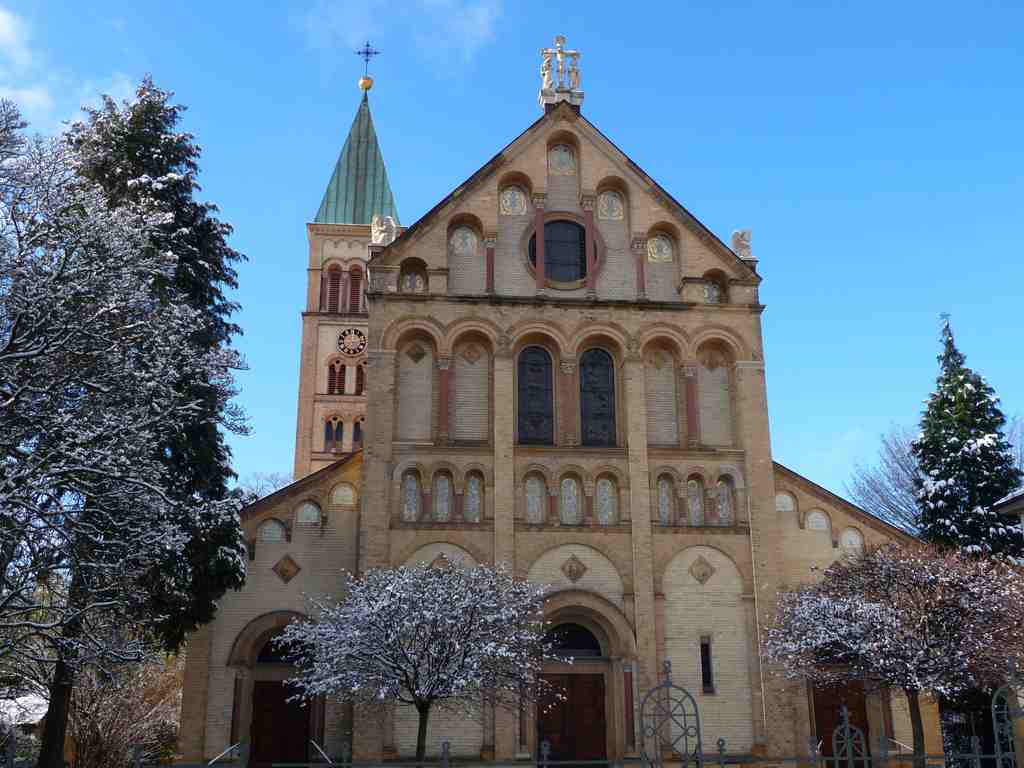
To spot St. Raphael in front of you, look for a large yellow-brick church with a grand, symmetrical facade crowned by statues, a striking green-topped bell tower with a clock, and rows of elegant arches-right in line with the trees and Werderstraße.
Now, let’s step into the story of St. Raphael, a church with roots as deep as its stones and bells are resonant. Imagine the end of the 19th century: the Neuenheim neighborhood of Heidelberg is bustling, swelling with people, and-plot twist-the old local church belongs to the Protestants! But the Catholics kept multiplying until they simply needed a home of their own. This is how St. Raphael was born, not out of thin air, but out of a pressing need and a wave of new arrivals.
Take a moment to soak in the facade. Those yellowish bricks, the round arches reaching for the sky, and that ornate facade-well, they’re straight out of Italy’s architectural playbook. If you squint, you might almost feel the spirit of Pisa’s grand cathedral peeking through the arches. The pyramid-roofed tower to your left channels Venice, too, and on top, a group of statues keep watch; if you're thinking, “That looks kind of heavenly,” you’re onto something!
But here’s where the story takes a turn for the touching-St. Raphael isn’t just named after any angel. The church was built in part thanks to the generosity of a grieving family, who donated a large sum to honor their son, Raphael Slidell von Erlanger, a zoology professor who left this world too soon. His memory, and even his epitaph, live on here. The parish inherited its unusual name in his honor, so you’re not just looking at any St. Whatever-this is a St. Raphael with a very personal backstory.
Now, travel back to the first Christmas in the nearly finished church, in 1904, with excitement shimmering through the chilly winter air. A year later, Archbishop Thomas Nörber made it official with a blessing-and probably a very grand hat.
Through wars, reforms, and changing times, the church has adapted. The original grand altars are gone, and the interior has seen modern touches-keeping the faith but ditching some of the furniture. During the 1960s, St. Raphael was remodeled in line with new traditions, and the latest renovations just two decades ago brought a deep blue ceiling, inspired by old medieval dreams.
Look inside if you can-the north-side stained-glass windows have survived from the early days, showing saints in glowing color. On the south side, you’ll see windows that replaced those lost in World War II; they now tell Angel Raphael’s story from the Old Testament. Oh, and if you hear music, it might be the mighty organ, installed in 2016 with a whopping 32 registers-imagine the sound shaking the pews!
And finally, don’t miss the five bells above. The oldest-the proud survivor of two World Wars-weighs over a ton. When it rings, it echoes with the hope and gratitude, loss and love, woven into the story of St. Raphael, the church with a heart as big as its bells are loud.


