
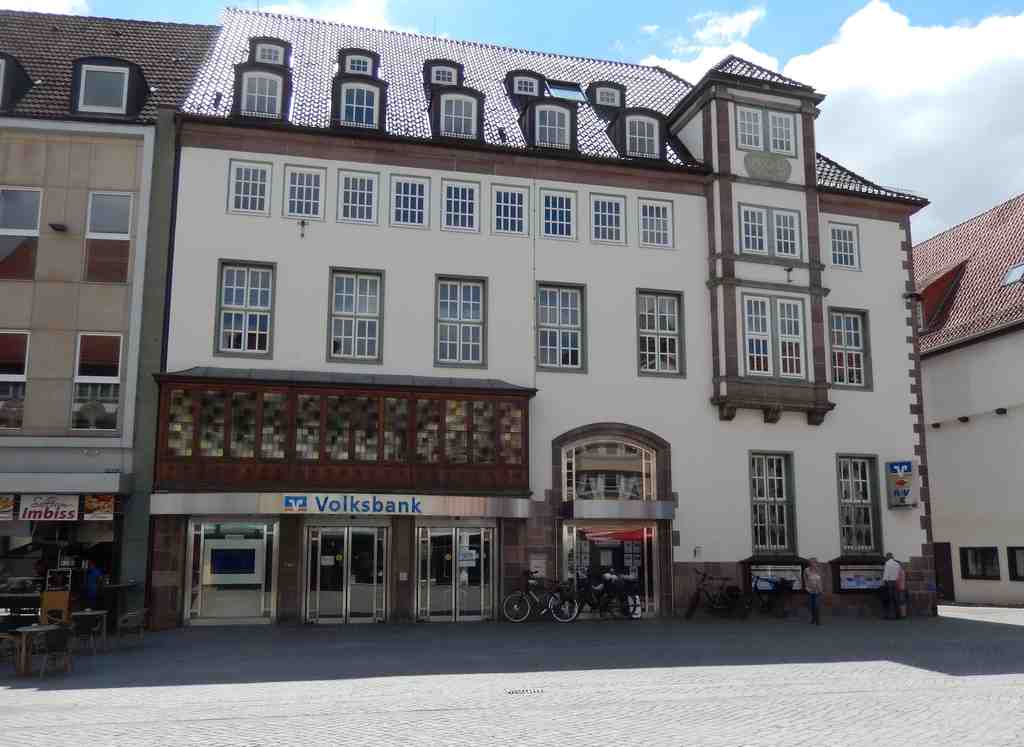
On your left stands a pale stone and glass corner building with broad rectangular windows and the red Volksbank emblem set into the facade.
This stop tells a Hamelin story that does not wear carved beams or medieval ornaments... but it matters just as much. A cooperative bank is not simply a place that handles money. It is a shared institution, owned by its members, where local people pool confidence as well as capital. That is civic trust in practical clothes: neighbors backing a structure that can outlast any one bad year, one shaky market, or one strong personality.
Here in Hameln, that idea took shape on the twenty-fifth of February, nineteen twenty-five. Thirty-three citizens founded the Hamelner Bankverein, a cooperative created for the town’s middle-class residents. Not dukes, not industrial barons... just people deciding that if they organized trust together, they stood a better chance of weathering uncertainty. It is not flashy, I know, but whole towns survive on decisions exactly this plain.
The first office was modest, just a small room at the Pferdemarkt. One year later, the bank moved into the new Handwerkerhaus at Kastanienwall, and it stayed there until March of nineteen fifty-one. Then it moved again, into a new main branch on Osterstrasse. In nineteen forty, the Hamelner Bankverein changed its name to Volksbank Hameln. By nineteen fifty, it already counted more than nine hundred members holding over one thousand shares. That word, member, matters here. In a cooperative, members are not just customers. They are part-owners of the institution.
You may hear terms like board, supervisory board, and representatives’ assembly. Here is the plain-English version. The board runs the bank day to day. The supervisory board oversees it, a bit like a watchful balcony above the stage. And the representatives’ assembly is the body that speaks for the wider membership when the cooperative makes big decisions.
Those decisions kept reshaping the bank as the region changed. It merged with Volksbank Bodenwerder in nineteen seventy, joined with Oldendorfer Volksbank in nineteen eighty-seven, merged again in nineteen ninety-eight to form Volksbank Hameln-Pyrmont, then in two thousand and four joined with Volksbank Stadthagen to become Volksbank Hameln-Stadthagen. In two thousand and sixteen, it merged with Volksbank Bad Münder, gaining another main office there. So this building stands for a very modern kind of local memory: not one grand founding, but layer upon layer of agreements.
And those layers are still shifting. In two thousand and twenty-four, when the branch in Bodenwerder closed, advisers stayed available nearby for customers in Emmerthal. That is the human side of an institution like this. Branches may move, merge, or close, but people still look for the familiar voice across the desk.
Today the bank serves tens of thousands of customers and members, employs hundreds of staff and trainees, and gives back to the region in practical ways. Not every important Hameln story is carved into old stone; some of it lives in systems people build to steady one another.
So here is the question to carry with you: what kind of future does a town create when its strength rests not on one powerful figure, but on dozens, then thousands, choosing to trust together? Hameln endures through places like this as much as through its famous landmarks... and in about two minutes, Museum Hameln will show how the city turns lived experience into shared memory. If you need practical timing, this branch opens on weekday mornings, adds Tuesday and Thursday afternoon hours, and stays closed on weekends.




