
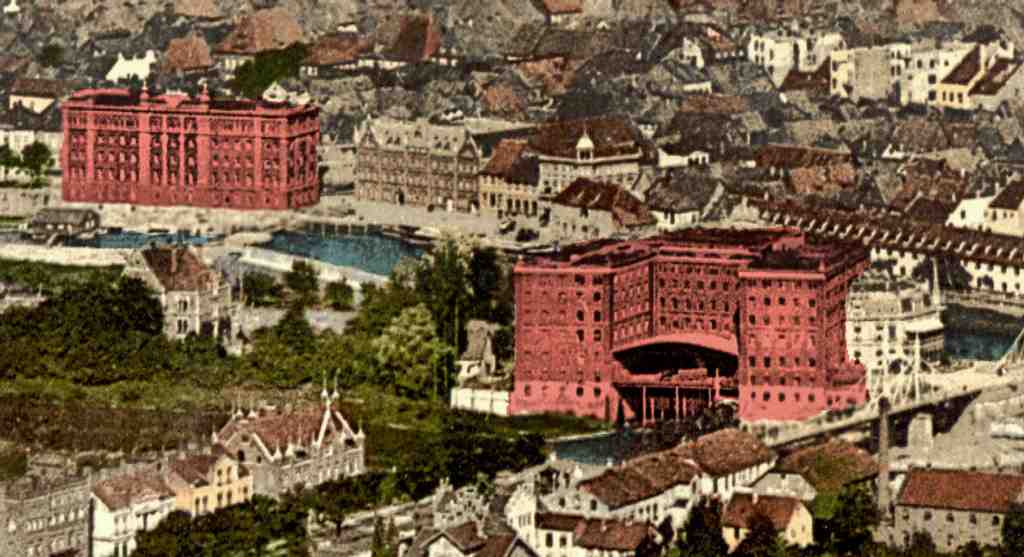
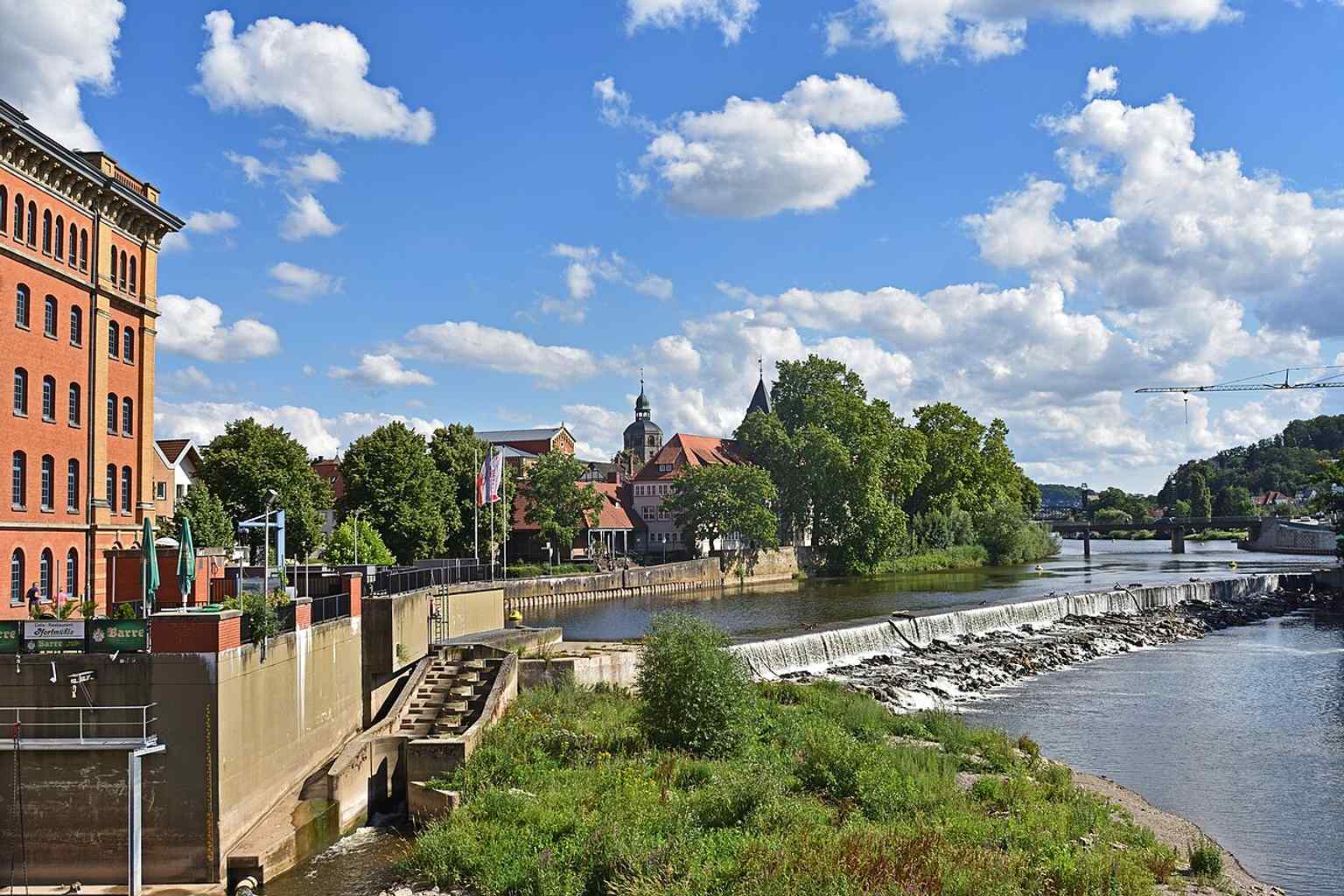
On your left, look for a tall red-brick mill building with a broad gabled front, stacked rows of narrow windows, and the solid, almost castle-like mass of an old industrial house.
This is the surviving Pfortmühle, the last standing witness of Hameln’s Wesermühlen, a whole family of watermills that worked here from the late thirteenth century onward. The Weser gave the city muscle, food, and wages; it also brought flood, fire, and ruin. Around here, the river was both paycheck and menace... a business partner with a very bad temper.
The mill likely began near the end of the thirteenth century and first turns up in records in the year thirteen forty-five. Back then people called it the Weser Mill, or the Fish Gate Mill. In seventeen forty-five, floodwater from the Weser hit so hard that part of the mill collapsed. Hameln rebuilt it larger that same year, and in seventeen forty-six they raised a memorial stone to mark the disaster and to thank the king of Hanover for helping pay for the recovery. Most visitors never notice where that memory ended up. The stone, about three meters high, no longer stands out here by the mills at all. It waits in the entrance area of the city archive inside the Pfortmühle, as if the city quietly tucked the old wound into its filing cabinet.
Then came fire. In eighteen seventy-two, grain inside the mill heated up on its own and burned the interior out, leaving the place a ruin for years. Friedrich Wilhelm Meyer stepped into that wreckage. He bought the site, rebuilt it in eighteen seventy-eight as a five-story giant with twelve grinding units, and made it one of the largest milling works in the region. If you want a sense of the building’s stubborn presence, take a look at the image in the app. It helps you read this façade not as a quaint old building, but as a machine-house with civic pride.
Meyer pushed further. He also owned the Werdermühle on the river island, the other big player in the milling story. In eighteen eighty-six he enlarged that works, and almost immediately disaster struck again. On the morning of the seventh of November, eighteen eighty-seven, the whole city heard a dull blast like thunder. A dust explosion tore through the mill, one wing collapsed, and eleven workers died. Even nearby villages heard it. The river kept moving, indifferent as ever.
This building burned again in eighteen ninety-three, and the structure you see now rose between eighteen ninety-three and eighteen ninety-five. In nineteen twelve, the mill switched to electric power, though a turbine and generator from that change still survive. Later, after the city bought the building in nineteen seventy-five and restored it in nineteen ninety-two, the old mill found a new life with public uses, including the archive.
That may be the real Hameln trick: water knocked things down, people built them back, and then memory found a room inside the rebuilt walls. So let me leave you with this... if your livelihood depended on this river, would you feel gratitude first, or fear?
In about three minutes, we’ll reach the District Court of Hamelin, where the city answers another hard question: once you cannot control every force around you, how do you at least try to govern people?





