
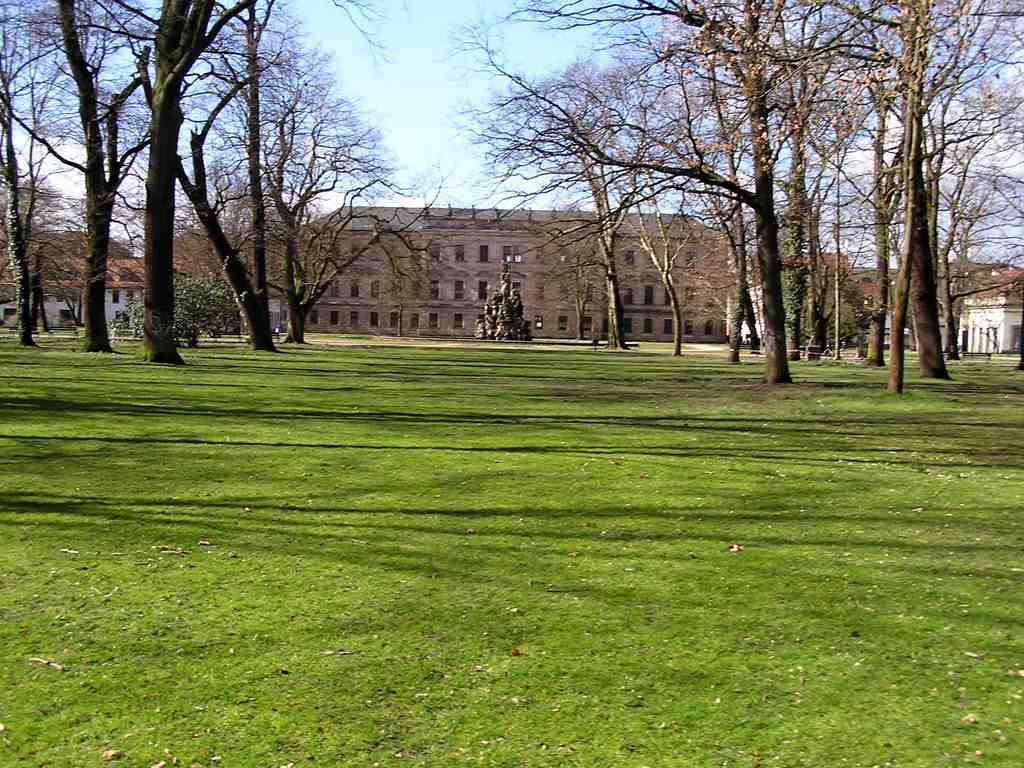
Ahead of you is a wide, open expanse of green lawn dotted with tall trees, framing a grand stone building at the far end-if you look straight ahead, you’ll spot the gardens stretching out before the magnificent Schloss.
Welcome to the Schlossgarten, one of the first great baroque gardens in all of Franconia, and today, an oasis for Erlangen’s locals, students, and visitors alike. Picture it: the year is 1700, and behind the newly built palace, only a modest garden was planned. But sometimes-even in the best-laid blueprints-margraves and margravines dream bigger! Thanks to Margravine Elisabeth Sophie, the garden exploded in size and extravagance, stretching nearly as far as the eye could see: 280 meters across and 550 meters long, with grand avenues, elegant flowerbeds, mighty clusters of trees, and velvety lawns.
The garden’s heart was built on perfect symmetry, marked by dazzling sights. To one side, the Orangerie, home once to exotic citrus trees, gleamed with Baroque flair, its façade sprinkled with the playful edge of Rococo design. To the other, the Konkordienkirche was planned as a twin, but only its central rectangle got built. Over time, this would morph into a stately university house, but that’s a drama for later.
Where you’re standing, lively garden parties once graced these lawns, with noble guests swirling around marble statues and cooling their hands at sculpted fountains. Take a moment and imagine the gentle chattering of silk dresses, the echo of boots on gravel walkways, and the distant splash of water from the fountains. But this was no static paradise! There were kitchen gardens fragrant with herbs, fruit orchards, a wild pheasantry, and even an ancient medicinal garden-a real supermarket of the 18th century, just add a powdered wig.
As you pass through the garden, look for the grand Hugenottenbrunnen in its oval basin-a tiered mountain of stone. At the base, elegant Huguenot families; higher up, ancient gods; and, on the very peak, Margrave Christian Ernst keeping watch. They say if you peer through a hole in the stone, you might just catch a glimpse of his equestrian statue beyond. And speaking of that statue, it’s a heroic sight: the margrave sits astride his steed, armor glinting (imagine it in its original glory, before the centuries wore it down), and beneath him, figures of Envy and a fallen Turk, all carved from a single enormous lump of sandstone! Sadly, years of exposure, rowdy students, and even the occasional act of mischief have left their mark-now the statue stands behind its protective fence, as much legendary as it is real.
The garden’s transformation didn’t stop there. In the late 1700s, botany professor Johann Christian von Schreber waved his academic wand, and the garden changed again, from stern Baroque order to the gentler, wilder English landscape style. He introduced winding paths and natural groves thanks to his passion for plants-a pillar in his honor stands here today. By 1849, the garden flung open its gates to the ordinary folk of Erlangen, and never shut them since.
Look around and you might spy the little Delphinbrünnlein, topped by a cheerful child riding a dolphin. Listen, can you hear the giggle of the water or imagine the children dancing near it on festival days? On special Sundays, music drifts across the lawns-concerts filling the air, and once a year, the entire university descends here for the grand Schlossgartenfest, the biggest garden party in Europe!
Not all memories here are happy: near the garden’s edge you may come across the somber memorial that once showed a weary soldier with broken sword, dedicated to those lost in World War I. Only the stone blocks remain now, their names etched in remembrance-a reminder that gardens, like people, carry stories both joyful and sad.
So stroll these paths, where noble guests, university professors, poets, and the everyday folks of Erlangen have wandered for centuries. You’ll find the Schlossgarten isn’t just a park-it’s a living chronicle, growing wilder, wiser, and ever more welcoming through every age.
For a more comprehensive understanding of the orangery, concord church or the huguenot fountain, engage with me in the chat section below.


