
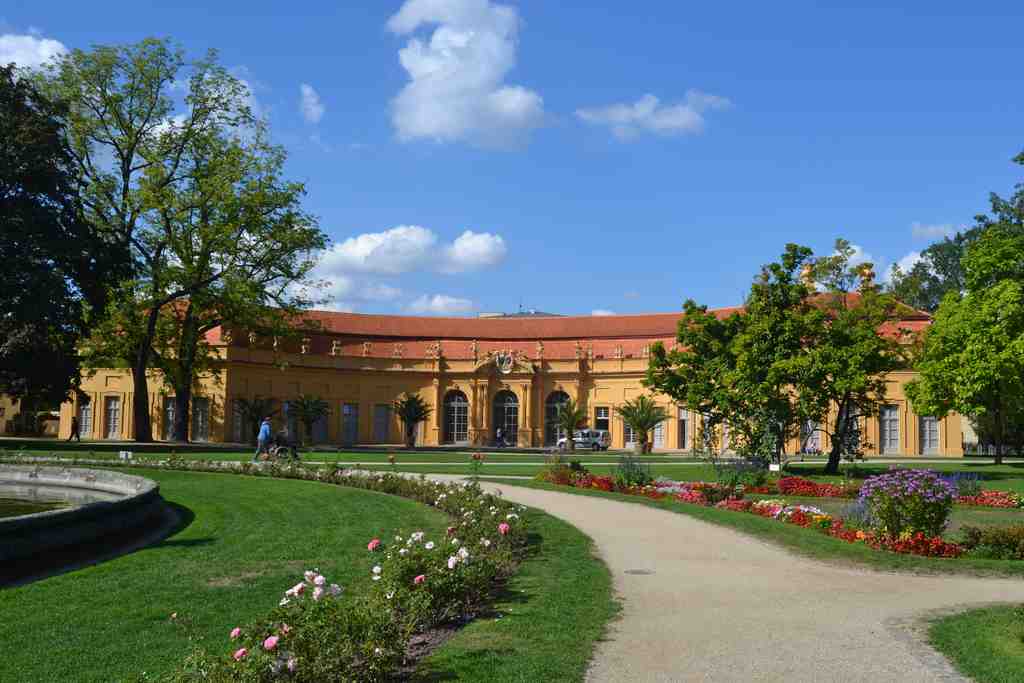
Just ahead, you’ll spot a long, elegant yellow building with gently curving wings, lined by tall windows, statues and decorative vases along its roof-just follow the path between the flowerbeds and look for the three grand arched doors in the center to find the Orangery.
Now, close your eyes for a moment-let’s step back to the early 1700s, when the air was thick with excitement, perfume, and perhaps a faint whiff of orange blossom drifting beside you. Imagine the bustling garden parterre before you was not just a sea of flowers and soft grass, but alive with the shimmering silks and powdered wigs of Erlangen’s noble court. This Orangery, with its striking semi-oval arms reaching outward, was more than just an ornate greenhouse. It was the jewel of Erlangen’s grand palace complex, built as a surprise by Margrave Christian Ernst for his wife, Elisabeth Sophie, in 1704.
Picture the scene as royal carriages rumbled up the path, nobles stepped down, and inside this very building, exotic citrus trees waited out the winter like VIP guests enjoying a warm suite. The Orangery’s design is theatrical, as if the very walls themselves want to applaud! Those elegant wings curve like a stage embracing the parterre, while in the center, a grand rectangular hall, the Wassersaal, holds court with stuccoed ceilings and, once upon a time, real fountains and shimmering water basins installed right in the floor. These fountains weren’t just for show-when they were restored in the 2000s, centuries-old waterworks and fountains reappeared beneath the tiles, as if the room was whispering its secrets.
Now look up at the southern façade-those three majestic portals at the center! The middle arch is wrapped in columns and crowned by statues so lively you half-expect them to jump down and offer you a bowl of fruit. Here, the statues of the Four Seasons stand guard, surrounded by vases brimming with acanthus leaves, flowers, and fruit. Heraldic eagles line the building’s corners, broadcasted symbols of the margrave's power, and the family’s crowned coat of arms sits proudly overhead-because even in the garden, every ruler needs a proper throne, right?
In its early days, this place was part greenhouse, part ‘Maison de plaisir’-the ultimate party venue, with festivals and ceremonies that would put any modern wedding planner to shame. Even the apartment wings at the ends of the curves were for special guests. And don’t get me started on the garden outside! The Orangery follows the palace’s central garden axis and faces what was supposed to be its twin-the never-built Concord Church. Between them, the Huguenot Fountain splashes dramatically, marking the heart of the whole palace grounds.
Rumor had it that in the garden’s heyday, sixty marble sculptures stood here-gods, virtues, symbols of continents and elements-each singing the praises of the margrave and his beloved. Speaking of mysteries, notice how the building’s north wall is mostly solid? That was a clever trick to shield the exotic plants from chilly north winds, protecting oranges and lemons from an untimely frost.
But time moves on, and after a century of parties and plenty, the Orangery changed roles. In 1818 it became part of the university, and since 1914 it’s echoed with the sound of organ music and art debates rather than court gossip. Yet, if you listen closely, you might still hear a faint chuckle from the seasons overhead-after all, in a building this dramatic, who says history has to be silent?
So as you stand here, breathe in the scent of the present, but listen for the footsteps of the past-this palace of plants, parties, and power remains one of the earliest masterpieces of Baroque garden design in Franconia.
If you're keen on discovering more about the building description, rooms of the orangery or the the main portal to the water hall, head down to the chat section and engage with me.


