
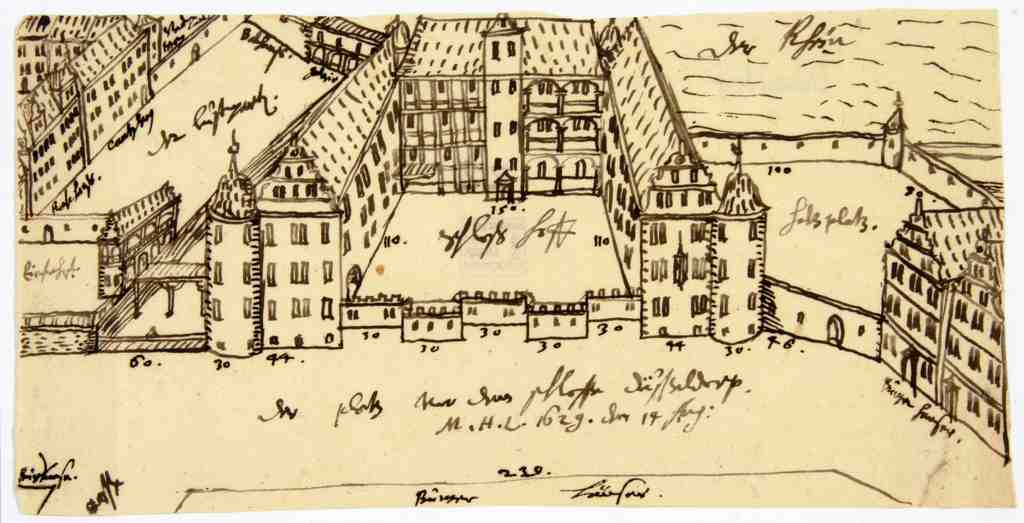
In front of you, you’ll spot the remains of the old Düsseldorf Castle-just look for the tall, round stone tower peeking up by the riverside, standing alone where the castle once proudly stretched across the square.
Now, close your eyes for a moment and imagine it’s the late 1200s. The air is thick with the smell of wood smoke from hearth fires, and the only thing louder than the bustling market is the clanging of blacksmiths next door. Right where your feet stand, a formidable stronghold once rose from a tiny island at the mouth of the Düssel River, built by the Counts of Berg. Picture sturdy sandstone blocks, watchful guards, and a castle that’s seen more battles and parties than your favorite fantasy TV series.
By the mid-1500s, after surviving a couple of blazing infernos-the first in 1492, then another in 1510-Düsseldorf Castle was reborn as a dazzling Renaissance residence under Wilhelm the Rich. Imagine grand halls, gleaming marble, and a shiny new round tower with columns worthy of an Italian palace. Walk through time, and you’d bump into Jan Wellem, the extravagant prince who spruced up the whole place at the end of the 1600s. Thanks to Jan and his love for all things grand, the castle played host to balls, banquets, and even the odd royal tantrum. I’m sure if you listened closely enough you’d hear a ghostly echo of champagne corks popping and classical music drifting over the Rhine at midnight.
Here’s a twist: in the early 1700s, they built Europe’s first stand-alone art gallery right up against the castle’s southern wall. This gallery became a sensation with its stunning collection of Renaissance and Baroque masterpieces; imagine art lovers from around the world flocking here, wide-eyed at works that would inspire artists for centuries.
But it wasn’t all feasts and masterpieces. Siege warfare arrived in 1794, when French troops bombarded the city. As cannonballs rained down, a devastating fire swept through the castle and much of Düsseldorf burned in a single terrifying night. Yet, like a stubborn candle flame, the castle bounced back-Napoleon himself stopped by and ordered part of it restored (although he did forget to leave a bottle of champagne that time).
Throughout the 1800s, the old castle’s jobs list looked like a very ambitious resume: it held the Prussian state mint, the prestigious Düsseldorf Art Academy, and even the local parliament. Artists, politicians, and coin minters all shared these halls-can you imagine the lunchroom conversations?
Sadly, disaster struck once more in 1872. A monstrous fire ripped through the castle overnight, sending everything-collections, studios, and centuries of stories-crashing down in thunder and smoke. Only the round tower, forged by that Renaissance architect with the impressively Italian name, survived. In 1896, the last standing part of the southern wing was finally torn down, leaving this lonely sentinel as the only hint of what had stood here before.
As you look down at the paving stones on Burgplatz, you’ll notice a subtle outline traced in different colors. Those stones quietly whisper the original footprint of the castle, showing just how vast it once spread. Step back and look up at the tower. If you listen carefully, perhaps you’ll catch a flutter of silk-because local legend says the headless Lady in Black roams here at night, her gown rustling in the wind, endlessly searching the ruins for peace.
So, whether you’re feeling the drama of medieval battles, the glamour of royal parties, or just the thrill of a good ghost story, Düsseldorf Castle is proof that, sometimes, what remains says more than what’s gone.


