
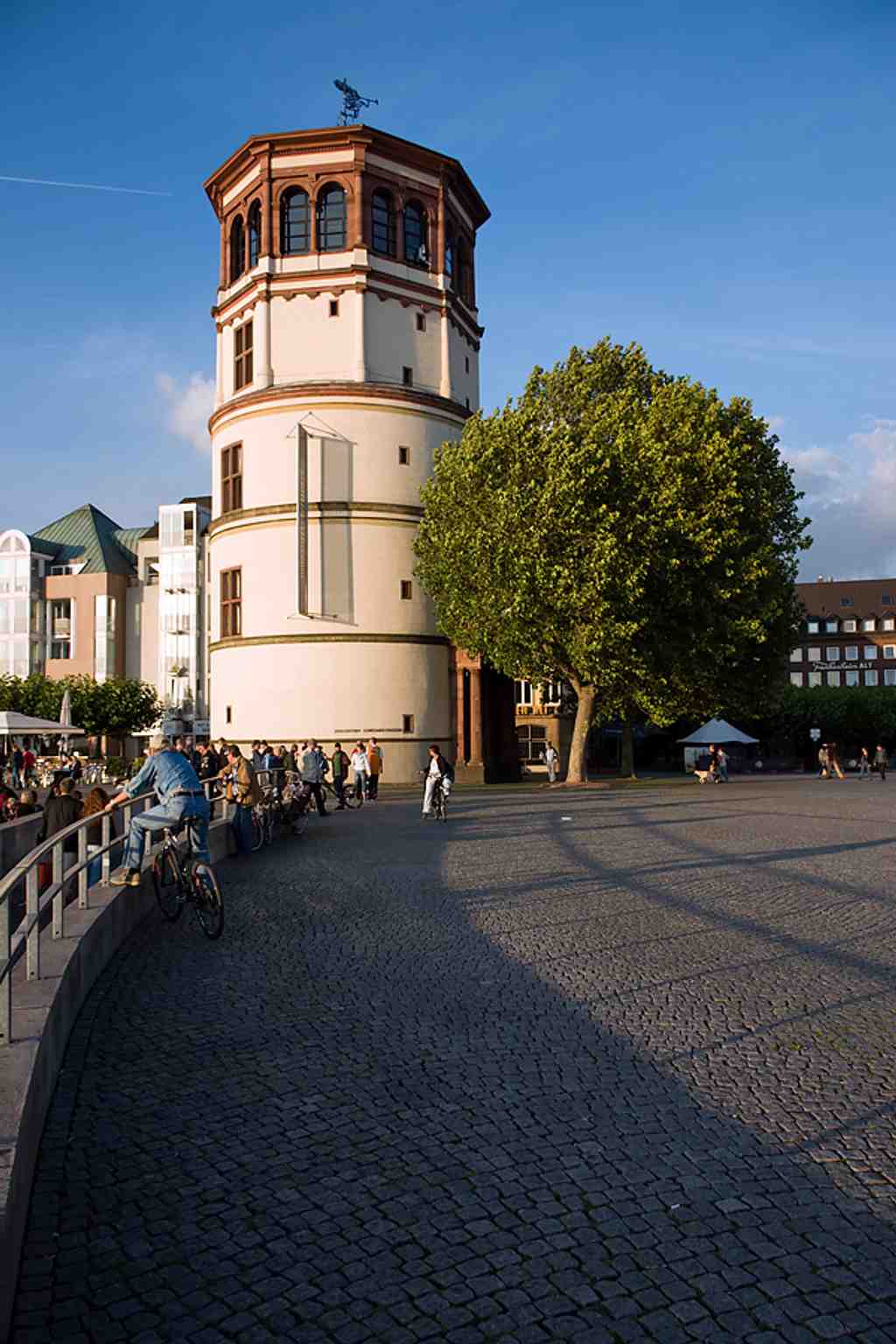
Right ahead of you, you’ll spot an open, cobblestone square stretching toward the river, with a tall, round, white-and-brown tower-the Schlossturm-standing proudly to one side and a generous ring of trees and bustling locals all around.
Welcome to Burgplatz, where Düsseldorf’s story changes shape with every century. Imagine standing here hundreds of years ago when this spot wasn’t an easygoing square, but the heart of a young, fortress-guarded city. Picture the thick air, full of the clatter of market stalls and the shouts of boatmen down by the Rhine. If you listen closely right now, you might hear the distant hum of conversation and the occasional bicycle bell, just as travelers and townsfolk have gathered here for centuries.
This square takes its name from the mighty castle that once stood guard just behind you. Back in the late 1200s, Düsseldorf was only a fishing village, but things took a dramatic turn after the city won its rights in 1288. Imagine the medieval excitement-suddenly, a bustling hub needed protection and taxes had to be collected. “Let’s build a castle right by the river!” someone must have said, and the Burgplatz was born. As the decades rolled on, the modest fort grew into a grand residence. During the grand wedding of Johann Wilhelm and Jakobe von Baden-Baden in 1585, the castle reached new heights of elegance. For a while, this square was the dazzling center of a princely court-think balls, fireworks, extravagant paintings, and maybe a few powdered wigs gone askew after a night of celebration.
But nothing lasts forever. After the death of Düsseldorf’s star prince, Jan Wellem, and his widow’s swift departure for Italy, the excitement faded away faster than a spilled pint at a local pub. The castle suffered not one, not two, but several devastating fires-almost as if it had a suspiciously flammable personality. In 1795, a French army set fire to it. Art students and artists moved in for a while, giving the place a dash of bohemian flair, but a final blaze in 1872 ruined even their ambitions. By 1892, only the sturdy Schlossturm was left-now standing before you as the last quiet witness to this saga.
Here’s where the Rhine decided to join the action. As the old walls disappeared, the square opened wide to the water. Sailors could tie up their boats, cargo unloaded, and, with the flood defenses improved, the locals could enjoy river views without the occasional surprise swim. Burgplatz became more and more a living room for the city. Picture that large stone staircase-wide, welcoming, and now a popular summer hangout-drawing people down toward the water, the sounds of laughter, music, and chatter mixing in the soft evening breeze.
Of course, the square hasn’t always been this friendly. For a while, it was swallowed up by roads and parked cars-up to 40,000 grumpy engines a day. People wondered if the Burgplatz would ever recover its charm. But in the 1990s, a bold plan buried the noisy road underground, giving this space back to walkers, partygoers, and jazz lovers. Suddenly, the city seemed to remember why it loved the river so much.
Take a look around: you’ll notice a lively tree grove to the north, café tables spreading across the square, and, if you hunt for it, the famous Radschlägerbrunnen fountain, which celebrates the city’s tradition of cartwheeling kids (and grown-ups who still think they’re kids). Over on the river’s edge, a great mosaic adorns the wide staircase, while stones with heartfelt engravings quietly honor those lost to AIDS.
With every season, Burgplatz transforms-hosting concerts, sports, the Carnaval, and more. Locals debate everything here: skate nights, alcohol bans, and, I kid you not, even whose bakery made the best bread. The only thing that doesn’t change is the square itself, always waiting for the next chapter, and the next wave of people ready to make memories. So soak it all in-the river, the history, and the spirit of Düsseldorf on full display.


