
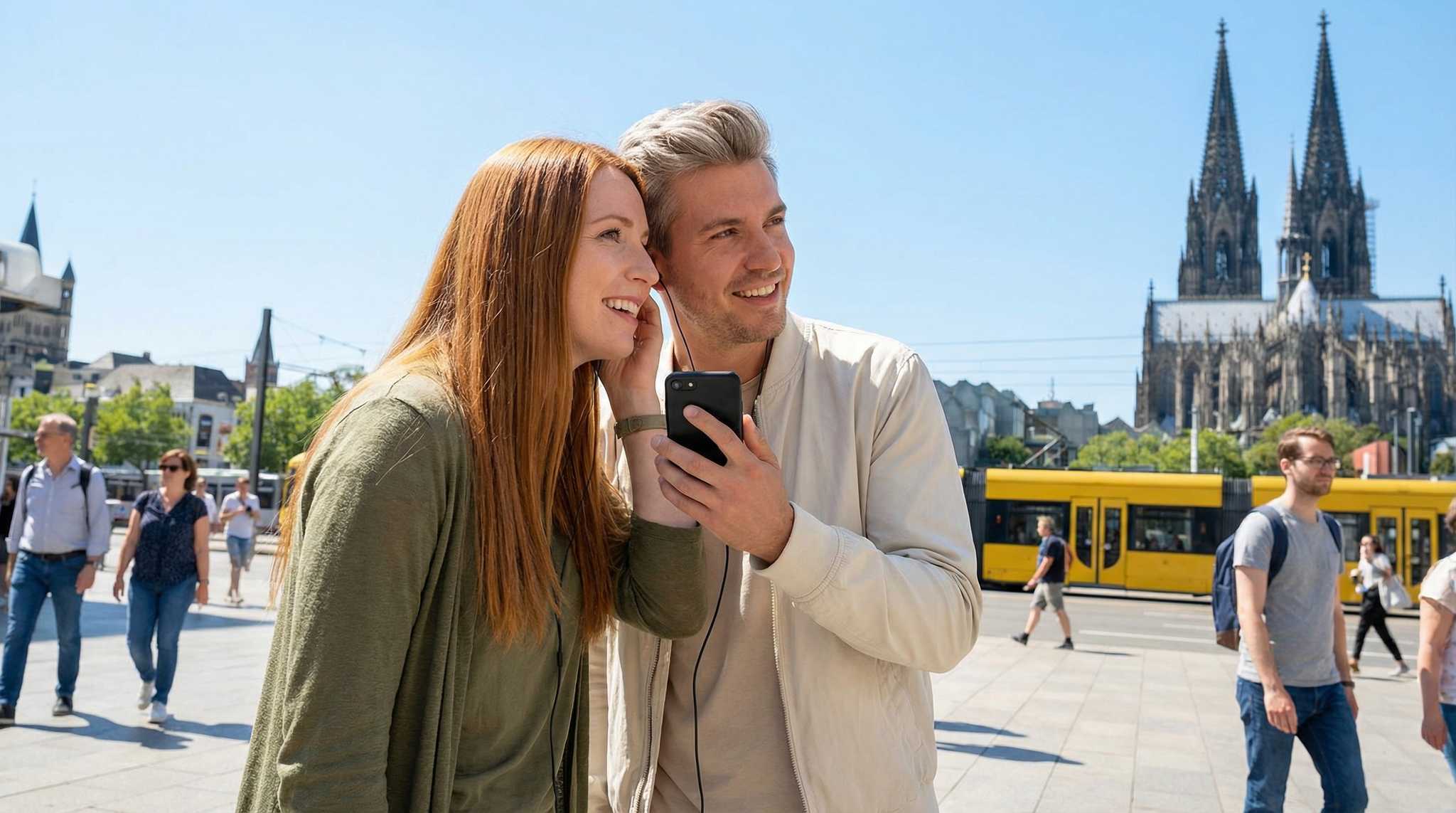
Cologne Audio Tour: Secrets of the Cathedral and Legends of the Old Town
Under the Gothic arches of the Kölner Dom, time seems to flow differently, and the secrets of legends and treacherous destinies echo through the walls of the Old Town. Explore Cologne at your own pace on a unique audio tour. Discover fascinating stories hidden in the side streets and uncover secrets that escape the ordinary eye. Did the famous Shrine of the Three Kings ever provoke political conspiracies and age-old conflicts? What mysteries of an extraordinary scent are hidden in the cellars of Farina's perfumery, where the famous Eau de Cologne was born? Who truly slipped through the shadows of Jülichs-Platz on the eve of rebellions and changes? With every step, you'll immerse yourself in a world of dramatic events, religious passions, and fragrant intrigues. Cologne will open up to you anew, full of emotions and discoveries. Open the door to its lesser-known stories and begin your journey now.
Tour preview
About this tour
- scheduleDuration 70–90 minsGo at your own pace
- straighten2.2 km walking routeFollow the guided path
- location_on
- wifi_offWorks offlineDownload once, use anywhere
- all_inclusiveLifetime accessReplay anytime, forever
- location_onStarts at Shrine of the Three Kings
Stops on this tour
lock_open 3 free previews · 12 unlock with purchase
You are standing before one of the most extraordinary places not only in Cologne but in all of Europe - the Shrine of the Three Kings. Looking at this massive, gilded structure,…Read moreShow less
You are standing before one of the most extraordinary places not only in Cologne but in all of Europe - the Shrine of the Three Kings. Looking at this massive, gilded structure, whose brilliance can be dazzling even on a cloudy day, you can imagine how, over centuries, thousands of pilgrims silently crossed the cathedral's threshold to see this place with their own eyes. The legend begins many centuries ago. It is said that the relics of the biblical Magi - Caspar, Melchior, and Balthazar - initially arrived in Constantinople thanks to Empress Helena, mother of Constantine the Great. From there, via Milan, they were transported by Bishop Eustorgius. This was no easy or safe journey, especially as treasures of such rank attracted the attention of anyone seeking wealth or sanctity. Finally, in 1164, Emperor Frederick Barbarossa gifted the relics to the Archbishop of Cologne, Rainald of Dassel, and shortly thereafter, pilgrims began to arrive in the city in an unbroken stream. To honor this immense gift, the construction of a unique reliquary began - a work unparalleled in its era. Master goldsmith Nicholas of Verdun started his work in 1180, and the reliquary was completed almost half a century later. Imagine layers of gold and silver, hundreds of precious stones, intricate filigree, enamels, and over a thousand pearls, making the whole resemble not so much a tomb as a gateway to Heaven. But the reliquary was not spared drama. In 1574, during a quiet mass, a thief crept into the sanctuary and stole some of the most valuable jewels, including the famous Ptolemy's Cameo - a stone so intricate it had seventeen layers, decorated with portraits of Ptolemy II and his wife. This theft shook all of Europe, and the stone never returned to Cologne - today it is in Viennese collections. However, it survived wars, Renaissance collectors, and fires, and even the necessity of being moved to a safe place during World War II. Today, when you look at this three-tiered structure - taller than an average person, as wide as two adults with outstretched arms - it's hard to decide what is more captivating: the 304 precious stones, or the row of 74 silver figures of apostles, evangelists, and prophets. This is the absolute pinnacle of Mosan art, a style that emerged along the Meuse - in a region offering world-class metalwork and enamel. Each wall tells a different story - here, the Adoration of the Magi, there, Mary enthroned with the Child, next to it, the Baptism of Christ, and higher up, the scene of the Last Judgment. If you had the opportunity to look through the openwork grate, you would see the names Caspar, Melchior, and Balthazar, and their skulls, each crowned. In the nineteenth century, during one of the ceremonial inspections, the reliquary was opened. Inside, remnants of fabrics, resins, and most importantly, the bones of three individuals were found - one young man, one adult, and one old man. These were believed to be the remains of the kings from the East. It is no coincidence that the coat of arms of the city of Cologne features three crowns - even today, they symbolize its history and significance. Without these relics, there would be no Kölner Dom, which was built precisely to provide a worthy place for such precious Christian mementos. You can imagine the procession of pilgrims that came here for centuries, the sound of lit candles, whispered prayers, and the special silence that this place carries. Now, you are a part of it.
Open dedicated page →Before you rises an enormous Gothic cathedral with two soaring, almost identical towers, clearly dominating the surroundings - look straight up, and you'll see their…Read moreShow less
Before you rises an enormous Gothic cathedral with two soaring, almost identical towers, clearly dominating the surroundings - look straight up, and you'll see their characteristic spires and intricate stone decoration. Imagine standing here among pilgrims from all over Europe, drawn by the vision of seeing the relics of the Three Kings - it was for them that the construction of this monumental temple began in the 13th century. The founders dreamed that the cathedral, intended to accommodate crowds and worthily represent the capital of the Roman Empire, would impress with its grandeur and the piercing sound of its bells - even now, you might feel a slight tremor in the square beneath your feet and the buzz of tourists. Construction began in 1248, but for almost 300 years, walls were built here, towers grew slowly, and then work stopped for nearly 400 years, only to revive in the 19th century - with the support of the emperor and residents, with the help of donations and modern techniques, the cathedral was completed exactly according to the medieval plan. When the solemn fanfares and bell sounds rang out in 1880, and both 157-meter-high towers already stood above the Cathedral, it was the tallest building in the world. Its facade - the largest of all churches - attracts both tourists and pilgrims today. However, this place did not always look so magnificent - before the Gothic cathedral stood here, there were earlier temples: first, a modest Christian dwelling from the 4th century, then a Merovingian basilica of the Frankish dynasty where queens were buried, up to the great Carolingian cathedral of Hildebold, which aspired to be a "German Vatican" and housed precious relics. The greatest treasure that elevated the importance of this temple in Europe was the relic of the Three Kings, brought from Milan in 1164 - it was for this that the magnificent golden casket, which you will find inside, was made. Thousands of people flocked here on foot, bringing fame and wealth to Cologne. However, the old walls were too small and cramped - the decision was made to rebuild the temple on an unprecedented scale. Although for centuries the sight of the cathedral was marred by a huge construction crane, which waited for work to resume like a silent witness to unfulfilled dreams, the towers were finally completed. The Cathedral even survived fourteen bomb strikes during World War II, when against the scorched backdrop of the ruined city, its silhouette was the only recognizable point for pilots. The Cathedral continues to change to this day. In 2021, hundreds of thousands of photos were taken with a drone to create a virtual, precise 3D model and monitor ongoing erosion - indeed, it is rarely without scaffolding, and master stonemasons constantly battle time and weather. Even today, the Cathedral poses questions and evokes emotions: alongside old traces of music, bells, and crowds, one can also find controversial works that have recently openly encouraged engagement with topics such as Christian-Jewish relations in art. Today, the Cathedral is a UNESCO World Heritage site, still attracting pilgrims and tourists from all over the world, offering a view from a platform at a height of 100 meters, and its largest bell - the decadent "Dicker Pitter" - rings only on the most important holidays, its powerful voice resonating throughout the entire city. Colonia semper erecta - this cathedral never fell, always remaining the pride of the city and one of the greatest symbols of faith, craftsmanship, and human perseverance against time. If you are curious about previous buildings, ongoing renovations, or architecture, the chat section below is the ideal place to get explanations.
Open dedicated page →To find Museum Ludwig, simply look ahead at the modern building with its distinctively rounded, silver roofs and large windows, standing out from the older architecture with its…Read moreShow less
To find Museum Ludwig, simply look ahead at the modern building with its distinctively rounded, silver roofs and large windows, standing out from the older architecture with its red brick and the clearly visible inscription "MUSEUM LUDWIG" above the entrance. Imagine standing before this characteristic edifice, where glass and metal meet red brick. It is here, right next to the Kölner Dom - one of Europe's largest and most influential museums of contemporary art - that invites you to immerse yourself in the world of the 20th and 21st centuries. Before you enter, try to feel the atmosphere: tourists stroll nearby, cyclists lead their bikes up the stairs… This place truly buzzes with life and modernity. The origins of this museum are a story of passion and dedication from local art collectors. In the post-war period, Josef Haubrich decided to donate his collection of Expressionism to the city of Cologne, and soon Peter and Irene Ludwig joined him - a couple who transformed the city's collections by gifting Cologne over 350 works of art, primarily Pop Art. From that moment, the museum's fate became a fascinating mosaic - the collection of Russian avant-garde grew, a priceless collection of Picasso's works arrived, and spaces for photo history and temporary exhibitions appeared in the building. The construction of the current building is also a story full of determination. Architects Busmann + Haberer created a space that was first tested in a special hall - the Simultanhalle, which remains a venue for contemporary art encounters to this day. Finally, in 1986, the new headquarters was ceremoniously opened - a building designed so that light, material, and openness would guide the viewer through the intricacies of contemporary artistic sensibility. Museum Ludwig holds nearly 9,000 m² of inspiration. Within its spaces, you will find the largest collection of Pop Art in Europe with icons such as Andy Warhol and Roy Lichtenstein. It houses the third-largest collection of Picasso's works in the world, key works of German Expressionism and New Objectivity, Russian avant-garde, as well as thousands of photographs - from historical daguerreotypes to current photographic experiments. Works by major artists such as Dalí, Duchamp, Max Ernst, and for lovers of modernity - Beuys, Kippenberger, Richter, or Polke - also await in its halls. The museum is constantly evolving. Currently directed by Yilmaz Dziewior, it boldly opens new perspectives: the museum analyzes its collection through the lens of postcolonialism and gender equality, and increasingly includes works by artists from outside Europe and North America. This is a place where not only the works of "white, heterosexual, American men" are evaluated, but also the stories of the excluded, the forgotten, courageous women, and creators from distant corners of the globe. You will feel how, in every nook of this building, a debate unfolds about artistic canons, hierarchies, and the future of art. It is worth mentioning that the museum also serves as a striking backdrop for important events: the G8 summit took place here in 1999. Thanks to the involvement of art patrons, foundations, and international competitions such as the Wolfgang-Hahn-Preis, this place continues to enrich and expand. Temporary exhibitions, high-profile events, and competitions for contemporary artists are regularly held here. So, admire not only the original architecture but imagine the sounds, conversations, and excitement that each new exhibition or significant artistic event evokes here. This is not just an ordinary museum - it is a living organism where past and present coexist, provoking the viewer to reflection, emotion, and contemplation on what art means in our times. Do you want to learn more about the management, collections, or exhibitions? Dive into the chat section below and ask.
Open dedicated page →
Show 12 more stopsShow fewer stopsexpand_moreexpand_less
To locate the Römisch-Germanisches Museum, look ahead at the large, low, rectangular gray stone structure, with the inscription "Römisch-Germanisches Museum" above the entrance…Read moreShow less
To locate the Römisch-Germanisches Museum, look ahead at the large, low, rectangular gray stone structure, with the inscription "Römisch-Germanisches Museum" above the entrance and huge glass doors - the building is right by the square, almost in the shadow of the monumental Kölner Dom. Imagine how an ancient city lies hidden beneath your feet, and each layer of earth conceals traces of people who lived here thousands of years ago. Before you is a place that is like a time machine - the Römisch-Germanisches Museum. Here, where today you hear the footsteps of tourists, two thousand years ago, the wheels of wooden carts of Roman legionaries echoed, and the hustle and bustle of the street, then called the Roman Hafenstraße, mingled with the conversations of merchants and the scents of spices from distant lands. This museum was created precisely to preserve and tell the history of Cologne from prehistoric times, through the Roman Empire, to the Frankish era. The greatest treasure of this place, even when the building undergoes renovations, is the unique multi-colored Dionysus Mosaic - a mosaic discovered by chance during the construction of an air-raid shelter during World War II. Imagine how in 1941, workers broke through concrete, and from beneath the dust of war, a dazzling image from almost 1800 years ago emerged. To this day, standing near Roncalliplatz, you can view this work through a special opening leading to the museum's cellars. This place was born out of fascination, but also out of a dramatic need to save testimonies of the past. Already in 1807 - imagine this - officials began collecting everything the earth yielded: coins, rings, amphorae, fragments of sculptures... After the war, when Germany lived in the shadow of ruins, the idea of a new, pioneering museum was also born from the ruins, which opened in 1974 as a "window to Roman times." Thousands of exhibits, from everyday objects, through masterpieces of craftsmanship (like the famous glass goblets), to architectural fragments of buildings, will tell you about the lives of ancient citizens, legionaries, women, and children. The museum gained worldwide fame thanks to its bold concept: the main hall is surrounded by a colonnade that symbolically resembles a Roman peristyle house, and the designated pathways run exactly over the former streets of ancient Cologne. It was here that a collection was created that not only presents the richness of antiquity but also gathers fascinating finds from the time when the city was the "capital of Lower Germania." But the fate of this place was not always kind. In 2007, the powerful hurricane Kyrill tore off panels from a nearby roof, which crashed into the museum's glass facade, simultaneously damaging a fragment of the priceless mosaic. It took enormous dedication from conservators from Cologne and Rome to reconstruct these unique artifacts. Today, despite extensive renovation, the museum remains one of the most important archaeological institutions in Germany, supporting scientific research, collaborating with universities, creating 3D models of ancient Cologne, and surprising with new discoveries from underground railway excavations. Each exhibition is an invitation to a different era: sometimes you follow the lives of Egyptian women, sometimes the migration routes of the Goths or forgotten Roman inscriptions. Such is this place - full of history, dramas, mysteries, and a constant feeling that beneath the ordinary pavement, a second, hidden life of the city pulsates. Do you want to learn more about the museum's management, archaeological heritage protection, or the Römisch-Germanisches Museum as a research institution? Join me in the chat section below for an in-depth conversation.
Open dedicated page →You are standing at the former Kanton Köln, a place that today leaves almost no trace of the times of greatest turmoil and transformation in the city's history, yet you only need…Read moreShow less
You are standing at the former Kanton Köln, a place that today leaves almost no trace of the times of greatest turmoil and transformation in the city's history, yet you only need to close your eyes to imagine life from over two hundred years ago. Listen - the echo of French commands still hangs in the air, the clink of assignats - a temporary currency, the laughter of children running on the cobblestones, and the dark voices of the inhabitants' uncertainty. At the end of the 18th century, Cologne was a city that had lost its former glory. Imagine narrow streets full of poor people, beggars on every corner, and large, neglected tenement houses - contrasting with the palaces of wealthy patricians amidst gardens. It seemed as if the city had fallen into a lethargy, as if burdened by the shadow of its own past. It was at this very moment, when the inhabitants were already tired of hunger, the costs of wartime quartering, and a catastrophic flood, that revolutionary French troops arrived from the southwest. Autumn 1794. Rumors circulate about the unstoppable march of General Jourdan's army. Guards on the walls look on uneasily, and in the morning, the city awakens to the sounds of a foreign language. A delegation with Mayor Klespé and the renowned printer DuMont meets the French at Hahnentor - there, they symbolically hand over the keys to the city. Then everything changes rapidly: a tree of liberty with a red cap, like from revolutionary engravings, appears on Neumarkt, and the streets fill with gray-clad soldiers who need to be fed and housed. The first days give the inhabitants the illusion that the French will leave their existing customs untouched. However, soon the city is divided in a modern way: Cologne becomes the center of one of the French cantons, managed by people like the energetic commissioner Rudler. Do you hear? New regulations are printed in French, and the Declaration of Human Rights is written on every black board of the magistrate. The former councilors - as well as the guilds and the university, which had steered the city's life for centuries - are dissolved with a single signature. The study of law or medicine is henceforth conducted according to the French model, although many professors do not hide their bitterness. Monasteries and monastic schools disappear, and Protestants gain civil rights for the first time. Services of both denominations are held in Antoniterkirche. A Jewish merchant, Salomon Oppenheim jr., walking here, opens his first banking house in Cologne and takes his first steps towards fortune - the foundation for a great modern Jewish community. And imagine the buzz in the former Hanseasaal, where instead of courtly and mysterious intrigues of councilors, public hearings are now held in the newly established commercial court. Local cries for justice mingle with speeches in French. Overseeing everything is the freshly organized magistrate, in which people like Maximilian von Kempis - a former opponent of aristocratic privileges, now a leader of change - play an important role. The school buzz also feels the changes - French becomes the official language, the children of the wealthiest merchants learn it in central schools, while children from the suburbs have to march daily to neighboring villages because they cannot yet afford education in the city. Above all this hangs anxiety. Every day you smell the strong scent of fresh paint as guild coats of arms are covered, and the commandments of the new order are written on black boards. Gendarmes, former soldiers of the revolution, patrol the streets, and on every corner, you might see the shadows of former monks without cassocks. It is unknown whether a peaceful evening will suddenly turn into conscription into the army or confiscation of property. And yet, this chaos created the foundations of modern Cologne: unified law, new courts, free trade, as well as freedom of religion and citizenship for everyone. The worries of the elderly and the curiosity of the young, the fear of merchants and the boldness of bankers - all this pulsed here, in the Kanton Köln, transforming the city in a way that even the most far-sighted mayors could not have imagined. You have just witnessed one of the most important chapters in the history of Cologne.
Open dedicated page →You are now standing on one of Cologne's most famous streets - Hohe Straße. Today, crowds of people flow through here every day, and the sounds of conversations, footsteps, and…Read moreShow less
You are now standing on one of Cologne's most famous streets - Hohe Straße. Today, crowds of people flow through here every day, and the sounds of conversations, footsteps, and the occasional bicycle horn blend into a characteristic hum. But imagine you are here almost two thousand years ago. Roman soldiers and merchants traverse a carefully paved street, which the Romans called Strata lapidea - the stone road. For centuries, it was the main artery, the Cardo maximus, around which all of Roman Cologne was built. On both sides, lazarets, shops, bakeries, baths, and even an exclusive praetorium for Roman commanders were established. As the Middle Ages arrived, the street remained unchanged, like an axis of time. Merchants, artisans, and citizens vied for the best trading spot here - some houses, like "Zur goldenen Waage" or "Haus Jülich," were built, changed owners, and accumulated extraordinary stories. In the place where glass and steel dominate today, in ancient centuries, brilliant goldsmiths from the Glesch family delighted with elegant wooden ceilings, and apothecaries at the site of today's "Paradies-Apotheke" offered remedies "auf dem Steinweg," or "on the Stone Road." As you walk towards the Main Station, you see how Hohe Straße connects with Schildergasse. This corner of Cologne was crucial for centuries - here, two main Roman trade routes intersected, and the marketplace in the forum buzzed with life already in the time of the legionaries. In the Middle Ages, as the city grew, the street was already so significant that university professors and students of the newly established University of Cologne settled here. Wandering along Hohe Straße, you pass places where the first reading rooms, student dormitories, or canons' colonies were established. Street names changed frequently here, from "Up deme steynwege" through "Under spermecheren" - because many blacksmiths and armorers worked here - to "Unter gülden Wagen," in memory of the famous house "Zur goldenen Waage." The closer you get to the Main Station, the more traces of past centuries: note the narrow, eight-meter width of the road - this was its width hundreds of years ago. In modern times, Hohe Straße attracted elites: the first department stores were built here, exclusive tobacco shops - Joseph Feinhals sold 1000 types of cigars here! If you listen carefully, you might hear in the distance the sound of old cash registers and the rhythmic clatter of printing presses from ancient printing houses. During World War II, the street was almost completely reduced to rubble - only a few buildings, including the baroque house at number 111 and the characteristic houses "An den vier Winden," survived the bombings. Post-war reconstruction brought Hohe Straße back to life, although the old, medieval character of the street was partially replaced by post-war buildings and large department stores. In 1967, it was decided to make it exclusively for pedestrians - hear the footsteps of thousands of passersby, the buzz of shopping, and, with a little imagination, the laughter of children participating in the first post-war carnival parades. Today, Hohe Straße is a world of boutiques, banks, cafes, and constant movement. Despite its modern facade, it still conceals thousands of years of the city - from legionaries treading on stones, through medieval merchants, to contemporary tourists and residents. Every step on Hohe Straße is a walk through the layers of Cologne's history - one of the most extraordinary streets in Europe.
Open dedicated page →Standing now in the heart of Köln, you can feel the weight of over two thousand years of history - a city that continuously delights, provokes, and intrigues. It was here, on the…Read moreShow less
Standing now in the heart of Köln, you can feel the weight of over two thousand years of history - a city that continuously delights, provokes, and intrigues. It was here, on the banks of the mighty Rhine, that the Romans founded Oppidum Ubiorum, and already in 50 AD, Empress Agrippina elevated this settlement to the status of a city - Colonia Claudia Ara Agrippinensium. Imagine the hustle and bustle of a Roman market, the clatter of horse hooves on stone roads, soldiers in shining armor, and merchants at the crossroads of East-West trade routes. Since then, Köln has been a place of many upheavals and triumphs. On the site of the old Ubii tribe settlement, a Roman city quickly grew with an aqueduct stretching for dozens of kilometers, supplying water from the Eifel. Here, after the destruction of the temple in Jerusalem, one of Europe's oldest Jewish communities settled. It was in this city, as early as 321, that Emperor Constantine officially recognized Jews as equal members of the city council - this record is the first evidence of Jewish life on German soil. After the fall of the Roman Empire, Köln fell into the hands of the Franks, and then became an episcopal residence, which quickly grew to the rank of an archbishopric. It was through Christianity that the city gained a new identity - the relics of the Three Kings were brought here in 1164, making Köln one of the largest pilgrimage sites in medieval Europe. From that moment, almost every inhabitant, and even pilgrim, breathed the aura of miracles and legends. As Köln grew in the 12th and 13th centuries, enormous city walls were erected - with twelve mighty gates and dozens of towers. Their grandeur surpassed even the fortress of Paris. Amidst the commercial bustle, the city lived the fullness of the medieval world, attracting merchants from all over Europe. Its status as a free imperial city after the victorious Battle of Worringen in 1288 contributed to an unprecedented flourishing - it was no longer subject to the authority of archbishops, but to its own councils and guilds. This city became a symbol of contrasts. On one hand, piety - "Heiliges Köln," or Holy Cologne, proudly used in documents; on the other, wealth derived from trade and, at times, clever political maneuvers. Köln did not avoid difficult moments - plundered by Vikings, forced to pay tribute, sometimes burned, only to rise stronger and more independent. It refused to be reduced to a tool of the archbishops, and a series of revolts by citizens and master craftsmen eventually brought the city a unique, self-governing Gaffeln constitution. Passing through successive eras, Köln, as part of the Hanseatic League, was an important trading center, with ports on the Rhine that today buzz with a different life but still carry echoes of ancient times. The capital of the archdiocese, a center of education, home to numerous universities and state institutions. Industry was born here, primarily chemical and automotive; Ford was established here; artists and scientists meet here. In the 20th century, Köln became one of Germany's most important media centers, home to RTL and many other radio and television broadcasters. Today, the city carefully cares for its nature and ecology, although the air here can be challenging, and the Rhine regularly reminds of its power during floods and droughts. Köln is not just the monumental Kölner Dom or traces of ancient Roman streets. It is also the strength of its many "Veedel" - neighborhoods with unique character, green enclaves where wild parrots live, and places where everyday life intertwines with legend. A city that, beneath the thick shell of modernity, still breathes the spirit of ancient eras. Are you wondering about geography, population, or politics? We encourage further discussion on this topic in the chat section below.
Open dedicated page →You are now standing in front of the Farina house - the birthplace of Cologne's most famous scent and the world's oldest perfume factory, Johann Maria Farina gegenüber dem…Read moreShow less
You are now standing in front of the Farina house - the birthplace of Cologne's most famous scent and the world's oldest perfume factory, Johann Maria Farina gegenüber dem Jülichs-Platz. Its hallmark is the red tulip seal, which can be found on every bottle of this legendary Eau de Cologne. Imagine the city over 300 years ago. The air was filled with the scent of leather goods, candle smoke, and horse manure. Amidst all this, in 1709, the Italian immigrant Johann Maria Farina, along with his brother Johann Baptist, rented a premises here and began something that would forever change the world of perfumes. They were pioneers; their beginnings were not easy, and the business teetered on the brink of bankruptcy several times. Farina meticulously kept purchase ledgers; the first entry concerned only materials for trading haberdashery and French goods. It wasn't until 1714 that Johann Maria Farina began experimenting with essential oils, creating his own "Eau admirable." Of this extraordinary scent, Farina himself wrote to his brother: "I imagine a morning in Italy after the rain: citrus, flowers, and herbs mingle in a breath of wind." It was a fresh and light scent - completely different from the heavy, musk and sandalwood-based fragrances popular until then. Farina's artistry lay in skillfully blending essences from different vintages to maintain an unchanging aroma, regardless of nature's whims. For this purpose, he stored scent samples - today, some are almost 300 years old. Farina's Eau de Cologne quickly conquered the world. Initially sold only in Cologne, it soon reached Paris, Vienna, London, and Madrid. In his letters, Farina lists his clients: kings, empresses, artists, and philosophers. From Mozart, through Voltaire, Maria Theresa, and Louis XV, to Napoleon, Goethe, and even Mark Twain and… Bill Clinton in the 20th century - all these people encountered the famous Eau de Cologne from here, from the very spot where you stand. It is no coincidence that a bottle of Eau de Cologne was an essential item in the luggage of rulers, artists, and military personnel, and French army officers immediately sent every shipment to their loved ones. Even Napoleon valued Farina. When he left Cologne, his valet noted that the emperor departed with only enough Eau de Cologne for a long journey - he had the rest carefully packed. Eau de Cologne was bottled in green, slender bottles, known as rosolien. Halves sold best, though quarters and full bottles could also be purchased. Each shipment was secured with the family's red wax seal and accompanied by instructions: Eau de Cologne was not only meant to refresh - its magical aroma supposedly cured pain, freshened breath, and even helped fight infectious diseases! The effectiveness of these claims can be debated today, but even then, the clientele consisted of pragmatic and demanding individuals. Since its founder, the company has been continuously run by the Farina family - now in its eighth generation. In 2003, the Museum of Fragrance was opened in this very house, where you can see bottles, old accounting ledgers, and learn about the fascinating history of a company whose products saved queens' ball decorations and brightened the moments of philosophers. This is a story that smells of citrus freshness and a hint of luxury, set here, amidst the bustle of Cologne's streets, among the rustle of old parchments and the clinking of coffee cups.
Open dedicated page →Before you stands a magnificent Gothic building with a tall, soaring tower and a richly decorated facade and arcades - look to your right, and you'll immediately spot it against…Read moreShow less
Before you stands a magnificent Gothic building with a tall, soaring tower and a richly decorated facade and arcades - look to your right, and you'll immediately spot it against the backdrop of the square. You are standing before one of Cologne's most important landmarks - the historic Rathaus, whose main part was built around 1330, on a site where a Roman settlement once stood. Imagine how for over 800 years this place buzzed with life - first as a house where medieval citizens met, later as the administrative center of a proud, Hanseatic city. Old documents say that the first city hall building stood exactly where important streets of the Jewish quarter intersected - its foundation rested on the remains of Roman walls, hiding their secrets deep underground. In the 14th century, the Gothic Hansasaal, or "Long Hall," was built here, where on November 19, 1367, the voices of Hanseatic cities united in a secret confederation against the Danish king. Can you imagine the powers of Europe clashing within these walls, and decisions of war or peace being made amidst the murmur of voices? Unfortunately, during the pogroms in 1349, the Rathaus suffered from flames spreading from nearby houses, and its reconstruction was a testament to the strength and perseverance of the inhabitants. Looking up, your eyes turn to the Ratsturm - the tower built between 1407 and 1414. This late Gothic, 61-meter-high structure with four stories recalls the city's ambitions; its interior housed city privileges, documents, and, of course, wine supplies! At its very top, where a guard once watched, a view of the entire city unfolded. An interesting fact: on the tower, there is a "Platzjabbeck" - a mechanical head that sticks out its tongue at passersby every hour, symbolizing the courage and audacity of Cologne's citizens. In the mid-16th century, the Rathaus gained a beautiful, two-story Renaissance loggia, designed by Wilhelm Vernuken. It was from this loggia that city councilors announced news and decrees to everyone. If you look closely, you will see the heads of Roman emperors on the frieze and allegorical representations meant to recall the city's strength and history. Right next to it, in a niche, stands a sculpture of Justitia - a symbol of justice for all residents of Cologne. One cannot forget the magnificent sound of the carillon, the city hall bells, which have resonated in the square at all hours of the day since 1958. They consist of 48 bells, funded by various guilds and people associated with Cologne. At 12 o'clock, extraordinary, modern melodies ring out - it is the only such city carillon in all of Germany, daily presenting music by contemporary composers. The interiors of the Rathaus conceal true treasures - the Hansasaal is particularly captivating, with walls adorned by figures of the greatest heroes of past centuries: Alexander the Great, Judas Maccabeus, Charlemagne, and others, while on the courtyard level, two lions face each other, recalling the legendary fight of Mayor Gryn with a royal beast. The Rathaus survived wars, terrifying destruction - but it always rose again, restored by people full of passion and love for this city. Visiting this place, you can almost hear the whispers of former councilors and feel the atmosphere of intrigues, worries, hopes, and challenges that accompanied successive generations of Cologne. Stand for a moment, listen to the sound of the past - because it was here, beneath the monumental walls of the Rathaus, that the heart of the city beat most strongly. Curious about the layers, the historic city hall, or Spanish construction? Do not hesitate to contact us in the chat section for additional information.
Open dedicated page →You are standing in the place where, for hundreds of years, the heart of the former Kölner Judenviertel, or Cologne's Jewish ghetto, beat. Try to close your eyes and listen to…Read moreShow less
You are standing in the place where, for hundreds of years, the heart of the former Kölner Judenviertel, or Cologne's Jewish ghetto, beat. Try to close your eyes and listen to your imagination - the buzz, conversations, the sound of goldsmiths' anvils, and children's laughter mingle with the calls of merchants in the market. Here, on a few narrow, winding streets, where walls were almost window to window, the life of the oldest Jewish community north of the Alps flourished for centuries. The history of this community dates back to when Cologne was still a Roman metropolis. Probably already at the end of the 1st century AD, the first Jewish merchants settled here, using the same Roman foundations on which other inhabitants built their homes. In 321, Emperor Constantine issued a decree that formally mentioned Jewish presence in the city for the first time. This fragment of the past was recorded in the Codex Theodosianus - one of the oldest collections of Roman law. Imagine a labyrinth of streets bearing names that say much about their former inhabitants - Judengasse, Salomongasse, Jerusalemgässchen. Around you lived primarily merchants, bankers, doctors, goldsmiths, and scholars. Silver and gold ornaments glittered in shop windows, subtly mocking the times when Christian and Jewish goldsmiths competed for influence and clients. Jews were highly valued doctors even for the Christian community, and despite various restrictions, they were sometimes allowed to handle the most difficult cases. Unter Goldschmied street was the former address of the workshops of these famous goldsmiths, where in the 13th century, even crucibles used for melting precious metals were found. Alongside the narrow streets were the homes of rabbis, a girls' school, a communal hospital from the 13th century, and the most important spiritual place - the synagogue. Destroyed during the crusades in 1096, it was quickly rebuilt, and its stained-glass windows with images of lions and snakes were among the most beautiful glass paintings in the entire Rhine region. Imagine how for centuries, until the pogrom in 1349, about 800 people lived here in a relatively small area. The Mikvah, a 17-meter-deep ritual bath that has survived to this day, was a place of spiritual purification, and in houses built sometimes on Roman walls, prayers, laughter, and songs resonated. However, life in the Judenviertel was not without tension. Although Jewish and Christian families sometimes conducted joint business, they were divided by walls, gates, and separate laws. Behind the district walls, closed at night by a key handed to the Judenbischof, life proceeded according to its own holidays and rules. Unfortunately, dark clouds gathered over this community. A wave of hatred, intensified by the plague in the 14th century, escalated in 1349 into a terrible pogrom and fire - the Judenbrand - during which a significant part of the district was burned, and many of its inhabitants died or were expelled. Only a few returned here in the 1370s, but it was already a different era - for several more decades, Jewish houses disappeared from the city map, until the final expulsion in 1424 "forever." Nevertheless, the spirit of the former inhabitants survived. Walking through seemingly ordinary alleys today, you can find traces of the old Jewish ghetto in the layers of pavement, underground passages, and street names. It was here that great minds were born, Talmudic tradition flourished, and for generations, two distinct communities coexisted - sometimes peacefully, sometimes with bitterness. The legacy of this place is complex, full of sadness, but also of the extraordinary resilience of the human spirit.
Open dedicated page →Before you, you see a huge construction site surrounded by scaffolding, and to its left, the soaring towers of the Kölner Dom clearly dominate, which will help you locate the…Read moreShow less
Before you, you see a huge construction site surrounded by scaffolding, and to its left, the soaring towers of the Kölner Dom clearly dominate, which will help you locate the Archäologische Zone Köln - look to the right of the cathedral, towards the square by the historic Rathaus. This place is not an ordinary construction site - you are at the gates of one of Germany's most fascinating archaeological projects. Beneath your feet stretches a world hidden for two thousand years, where layers of ruins intertwine like threads in a complex tapestry of history. For centuries, this area witnessed Roman grandeur, the medieval life of the Jewish community, and tumultuous disputes whose echoes resonate to this day. Now, looking at the stark scaffolding and cranes balancing over the site, it's hard to believe that just beneath the surface lie the remains of a Roman palace - the Praetorium, once the center of power over the entire Rhine valley. These same walls, which once must have buzzed with the sounds of Roman officials' sandals, survived destruction and rebuilding, becoming today a UNESCO World Heritage site. Imagine the hustle and bustle and the smells of the medieval Jewish quarter, whose foundations were uncovered by archaeologists just a few meters from here. It was here, in modest houses on Judengasse and by the carved synagogue, that generations of families lived for centuries, running schools, hospitals, workshops, and ornate Mikvahs - ritual baths that reached 16 meters deep into the earth, down to the Rhine's water table. Sometimes archaeologists would stumble, literally in a single bucket of mud, upon pieces of pottery, fragments of inscriptions, and small everyday objects - testimonies of tragedies, which today are recalled by the trace of the 1349 pogrom preserved in the earth: burned books, shattered glass, children's toys hastily thrown into the sewers. This extraordinary site is not without moments of tension and controversy. Disputes over the purpose of building the museum, its cost, and even what part of the square should remain undeveloped, divided the city's residents like few other undertakings. Some Cologne residents fought for the place to remain open, others demanded commemoration of the former Jewish quarter. To all this is added the Roman layer: monumental sewers through which the city's waste flowed directly into the Rhine, with boreholes to a depth of eight meters, extraordinary finds such as a golden Byzantine earring or a ring hidden by a fleeing family. Even games played underground left their mark here: the word "INVICTUS," "unconquered," was carved into one of the stones, evoking the thought of how much struggle was needed for this place to survive successive eras. Today, MiQua, a modern museum on the surface, will soon tell this often difficult story using innovative, interactive technologies. An underground route will lead future visitors through the cool corridors of the Roman palatium, through fragments of rock-cut stairs, among which one can sometimes feel a breath of dampness and hear the sound of drops falling on ancient walls. It remains to be seen how, in this one square, the histories of Roman officials, medieval rabbis, goldsmiths, scholars, and ordinary city residents intertwine. You may stand amidst concrete and scaffolding, hearing the sounds of machines, but believe me - you are in a place where the heart of Cologne has been located for centuries. Here, beneath layers of earth and the foundations of daily life, lies a mosaic of human destinies, a story that the world will continue to rediscover for a long time.
Open dedicated page →Before you rises a tall, multi-story tower with a dark, pointed roof, distinguished by dozens of white figures standing in niches on each level - just look up to spot its…Read moreShow less
Before you rises a tall, multi-story tower with a dark, pointed roof, distinguished by dozens of white figures standing in niches on each level - just look up to spot its characteristic decorative band of sculptures. Imagine standing now before a place where, for centuries, the stories of rulers, artisans, artists, and saints of Cologne converge - each figure on the Ratsturm is like a silent witness to history, motionlessly guarding the city's secrets. Once, already by the end of the 17th century, the original statues of this tower were almost completely destroyed by rain and frost; no one today knows whom they truly depicted. Only fragments survived - a knight beside the portal and a canopy above the entrance, the last traces of former riches. However, at the end of the 19th century, Cologne decided to restore the tower's splendor and announced a competition for new figures to adorn the successive floors of the Ratsturm. They were to be arranged in thematic groups - on the ground floor, great princes and archbishops; higher up, the most distinguished citizens; even higher, representatives of guilds; and just below the summit, men of science and art. The highest level of the tower was reserved for the city's patron saints. Local masters undertook the creation of the first sculptures - the result was sandstone sculptures that, by 1902, filled the subsequent levels of the tower. The placement of each was carefully considered to reflect hierarchy and role in Cologne's history. Years passed, war came like a storm and brought destruction. The tower and Rathaus lay in ruins during bombings, but on the south side, some of the figures survived - as if by chance or merciful fate they were allowed to endure. After years of reconstruction, in the mid-70s, the Ratsturm returned in its familiar form, but temporarily devoid of its entire sculptural procession. It was not until the 1980s that a new concept emerged - this time, more women were included in the sculptural chronicle of the city to better reflect the diversity of Cologne's history. A total of 124 figures, made of volcanic tuff and partly from preserved old figures, were installed by a host of artists. However, the new preservation technique also proved treacherous - a special resin impregnation led to damage, and a significant portion of the sculptures had to be replaced again. Since 2008, figures of the third generation have been looking at you - this time made of durable sandstone from France, they depict other distinguished residents of Cologne, artisans, scientists, artists, and saints, arranged in order according to eras and merits. Each of them is a separate story, a separate fragment of this city's memory. Stand for a moment beneath the Ratsturm and try to see Cologne through their eyes, amidst the city's bustle and the passage of years.
Open dedicated page →Alter Markt in Cologne is a large, expansive cobbled square, surrounded by colorful townhouses and cafes - just look ahead, where the Rathaus tower dominates on the left, and rows…Read moreShow less
Alter Markt in Cologne is a large, expansive cobbled square, surrounded by colorful townhouses and cafes - just look ahead, where the Rathaus tower dominates on the left, and rows of pastel buildings with numerous outdoor seating areas stretch to the right. You are standing in the heart of Cologne's old town, in a place where life has pulsed for centuries: Alter Markt. Imagine the murmur of conversations in the market, the clatter of horse hooves, sometimes the loud calls of merchants, and the scent of freshly baked bread wafting over the square. Over a thousand years ago, this is where the residents of Cologne conducted their daily affairs. In Roman times, one of the Rhine's branches flowed around Alter Markt, and ships quietly docked at the shore, unloading stones for the city's construction. Beneath the square's surface lie the remains of an ancient port, a place where Roman soldiers and merchants met the local population. In one spot, large basalt weights used for weighing goods transported on ships were even discovered, and in another, the wreck of a Roman barge from the 1st century AD was found. Even before Alter Markt became a bustling trading place, the arms of the Rhine extended around it, and this area was outside the Roman city walls - only later were solid fortifications built here. The square quickly became the center of urban life. In the Middle Ages, the homes of the wealthiest families, noble residences, and powerful guild headquarters were built around Alter Markt. Just after 1024, the archiepiscopal mint was established here - imagine the clatter of hammers striking silver coins, which became one of the most important currencies in the Empire. There was also a city hospital and huge market halls where bread and fresh fruit were sold. Interestingly, the fronts of the houses then had no numbers; instead, they were named after the goods they traded, such as "zur Brezel." Alter Markt was not only a place of trade. It also witnessed dramatic scenes: public executions and trials, knightly tournaments, crowds of curious onlookers eager to see equestrian displays or fights. During knightly tournaments, the houses around the square were filled with paid spectators - whoever wanted the best view had to pay dearly for a window seat. Sudden shouts, the clang of armor, and the thud of horse hooves echoed throughout the market. Over the centuries, more order was introduced to Alter Markt, but there was no shortage of places with ominous reputations, such as the pillory or the famous "Käx" - a cage where criminals were publicly ridiculed. The severity of justice is evidenced by the fact that sometimes even the use of false weights was publicly punished. Alter Markt was also not without celebrations and joy. The first Christmas market in Cologne was held here in 1820 - the atmosphere was bustling, everyone talked about the "Hött," or "stalls," where one could buy festive sweets and toys. Despite the destruction during World War II, the spirit of the place survived. Every autumn, the Cologne Carnival begins in this square, and crowds of residents and tourists celebrate the start of the new season with a historical reenactment of Jan and Griet. Throughout the year, numerous cafes and restaurants buzz with life, and beneath the Rathaus, you can still find interesting sculptures, such as the famous "Kallendresser," a favorite anecdote of the locals. Look at the houses surrounding the square - these colorful facades hide many stories of patricians, merchants, and ordinary residents of Cologne, whose fates intertwined here for centuries. Alter Markt is a place that constantly changes, but never loses its unforgettable character.
Open dedicated page →Before you rises the impressive mass of the Groß St. Martin basilica - look for its characteristic, massive tower with four corner turrets and the trefoil, key-shaped eastern…Read moreShow less
Before you rises the impressive mass of the Groß St. Martin basilica - look for its characteristic, massive tower with four corner turrets and the trefoil, key-shaped eastern choir termination, clearly towering over the colorful townhouses right by the square. Stand for a moment and imagine yourself transported back to a time when, in this very spot, on a river island, the scent of incense wafted around the temple, and the chants of Benedictine monks emanated from within. Groß St. Martin, one of the twelve mighty Romanesque churches in Cologne, was from the very beginning a place that commanded respect and admiration. The church was built on foundations preserving hundreds of years of history - already in Roman times, there were huge commercial warehouses here, as well as mysterious squares and water basins whose purpose is still debated by researchers today. Imagine the breeze from the Rhine bringing the sounds of people working and boats trading, as the temple slowly rose on this island. When a great fire consumed the city in the 12th century, the entire district and the church felt terror and helplessness in the face of the element. It was then that the bold decision was made to rebuild the temple in an even more powerful form - with a monumental square tower massif and a unique "cloverleaf" choir termination, which today is one of the most recognizable shapes in Cologne's skyline. It was built over decades, and successive generations of monks watched over prayers, order, and… somewhat mysterious tales of saints whose relics were said to protect this place. But it was not always peaceful here. A dangerous fire in 1378 destroyed the tower's roof - with anxiety, people watched as the fire consumed the top and threatened collapse. Storms and gales hurled turrets at nearby houses, and residents watched in dread as parts of the stone structures crashed down, crushing lower chapels. However, there were always brave individuals and benefactors ready to repair the damage - the tower received its characteristic roof, and the interiors were adorned with increasingly rich altars and ornaments. For hundreds of years, until the 18th century, the basilica was the heart of a Benedictine monastery - Gregorian chants resonated here, prayers were whispered, and the colors of Baroque paintings and golden decorations captivated visitors. However, with the advent of turbulent Napoleonic times, the monastery was dissolved, and the church was converted into an ordinary parish, where harsh, revolutionary realities prevailed. Subsequent decades were a time of neglect, difficult decisions, until in the 19th century, under the watchful eye of the city conservator, the basilica underwent a thorough restoration, once again bringing the majesty and pride of old Cologne to its entire surroundings. The most dramatic moments, however, came during World War II. During bombing raids, the roof of the tower and the main nave caught fire, most of the stained glass and chapels crumbled to dust, and a silence settled in the basilica's ruins, sometimes broken only by the clatter of tools securing the rubble from collapse. After the war, there were long disputes about whether to rebuild - some wanted to leave the ruins as a painful reminder. But the will to restore this spiritual and architectural symbol to life prevailed. The work lasted over 40 years! It was not until 1985, almost half a century after the bombs, that the temple was reconsecrated and returned to the community. Today, Groß St. Martin once again pulsates with spiritual life, because since 2009, it has been cared for by members of the Community of Jerusalem, giving its ancient space a new spirit of contemplation and prayer. When you enter the interior, pay attention to fragments of 19th-century paintings - they are the only ones preserved in all of Cologne. In the newly created crypt, you can even see the remains of Roman buildings on which this extraordinary temple has stood for centuries. Thus, you stand before a witness to a thousand years of history, who knows the sounds of Roman markets, the songs of monks, the roar of bombs, and the sighs of people who, each time anew, brought it back to life. Do you wish to learn more about the overview, current use, religious life and customs, or specifications? Dive into the chat section below and ask.
Open dedicated page →Before you stands a massive, light beige building with a simple, cubic form - its smooth walls bearing the names of great painters are easily visible from afar, looking left from…Read moreShow less
Before you stands a massive, light beige building with a simple, cubic form - its smooth walls bearing the names of great painters are easily visible from afar, looking left from the corner of An der Rechtschule and An Groß St. Martin. Standing here, you can almost feel the weight of history that has accumulated over two centuries. Imagine: it's the early 19th century, a time of wars, turmoil, and ashes after dissolved monasteries. Amidst this chaos lives Professor and Canon Ferdinand Franz Wallraf. The city of Cologne should be grateful to him - it was he, like a persistent treasure hunter, who rescued countless works of art, books, minerals, engravings, and paintings from ruin and oblivion. In his will in 1818, he bequeathed them to the city with one condition: they were to remain in Cologne forever, for everyone, for art and science. The first museum opened in 1827 in the former episcopal chambers. The museum itself was always in motion - new headquarters grew and disappeared, survived wars and bombings, until 1943, when the old neo-Gothic edifice turned to dust during air raids - then the roar, fire, and shattered glass contrasted with the delicacy of the works gathered here. Rebuilt in the 1950s, it celebrated its return, but it was still too small for the constantly growing collection. When Peter and Irene Ludwig donated their masterpieces to Cologne, another museum had to be separated. The current building you see was designed by Oswald Mathias Ungers - a symbol of simplicity, strong as a fortress of history, open to the world of art. It opened in 2001, near the Rathaus, where Stefan Lochner - the legendary Cologne painter whose works can be admired here - worked in the Middle Ages. The museum's facade bears the names of masters whose works you will find inside: from Dürer through Cranach, Rembrandt, and Courbet to Renoir. This museum is home to the world's largest collection of medieval painting from Cologne - preserved because there were no great fires or iconoclastic storms here that destroyed treasures in other cities. Next to you are masterpieces of Baroque, Dutch, French, and German painting - Rubens, Van Dyck, Rembrandt - but equally valuable are the canvases of Romantics and Symbolists, works by Monet, Courbet, Munch, and Rodin. The Fondation Corboud is also unique, thanks to which Cologne presents Germany's richest collection of Impressionists - Monet, Renoir, Cézanne, and others. However, many paintings must wait in storage until the museum's extension, which has been discussed for over two decades, is built. In 2024, however, the first serious step was taken - construction work began, and the opening of additional halls is finally planned for 2028. Within the museum space, you can not only see masterpieces - there are regular temporary exhibitions, prints, drawings, and old miniatures, including works by Leonardo da Vinci and Dürer. A total of over 75,000 works on paper allow you to enter a world enclosed in quiet halls, where every detail awaits the attentive visitor. This place breathes peace and concentration, but it also hides many dramas: rescued works, lost masterpieces, controversies surrounding post-war acquisitions, and the endless efforts of people dedicated to art. Even today, as new directors like Marcus Dekiert lead the museum through the challenges of modernity, the spirit of those who created and guarded it over centuries can be felt. When you cross the threshold of this building, remember all the stories that await discovery here. Intrigued by the collections, the Wallraf-Richartz-Museum and Museum Ludwig e.V. Board of Trustees, or exhibitions? Go to the chat section, and I will gladly provide more details.
Open dedicated page →
Frequently asked questions
How do I start the tour?
After purchase, download the AudaTours app and enter your redemption code. The tour will be ready to start immediately - just tap play and follow the GPS-guided route.
Do I need internet during the tour?
No! Download the tour before you start and enjoy it fully offline. Only the chat feature requires internet. We recommend downloading on WiFi to save mobile data.
Is this a guided group tour?
No - this is a self-guided audio tour. You explore independently at your own pace, with audio narration playing through your phone. No tour guide, no group, no schedule.
How long does the tour take?
Most tours take 60–90 minutes to complete, but you control the pace entirely. Pause, skip stops, or take breaks whenever you want.
What if I can't finish the tour today?
No problem! Tours have lifetime access. Pause and resume whenever you like - tomorrow, next week, or next year. Your progress is saved.
What languages are available?
All tours are available in 50+ languages. Select your preferred language when redeeming your code. Note: language cannot be changed after tour generation.
Where do I access the tour after purchase?
Download the free AudaTours app from the App Store or Google Play. Enter your redemption code (sent via email) and the tour will appear in your library, ready to download and start.
If you don't enjoy the tour, we'll refund your purchase. Contact us at [email protected]
Checkout securely with 




