
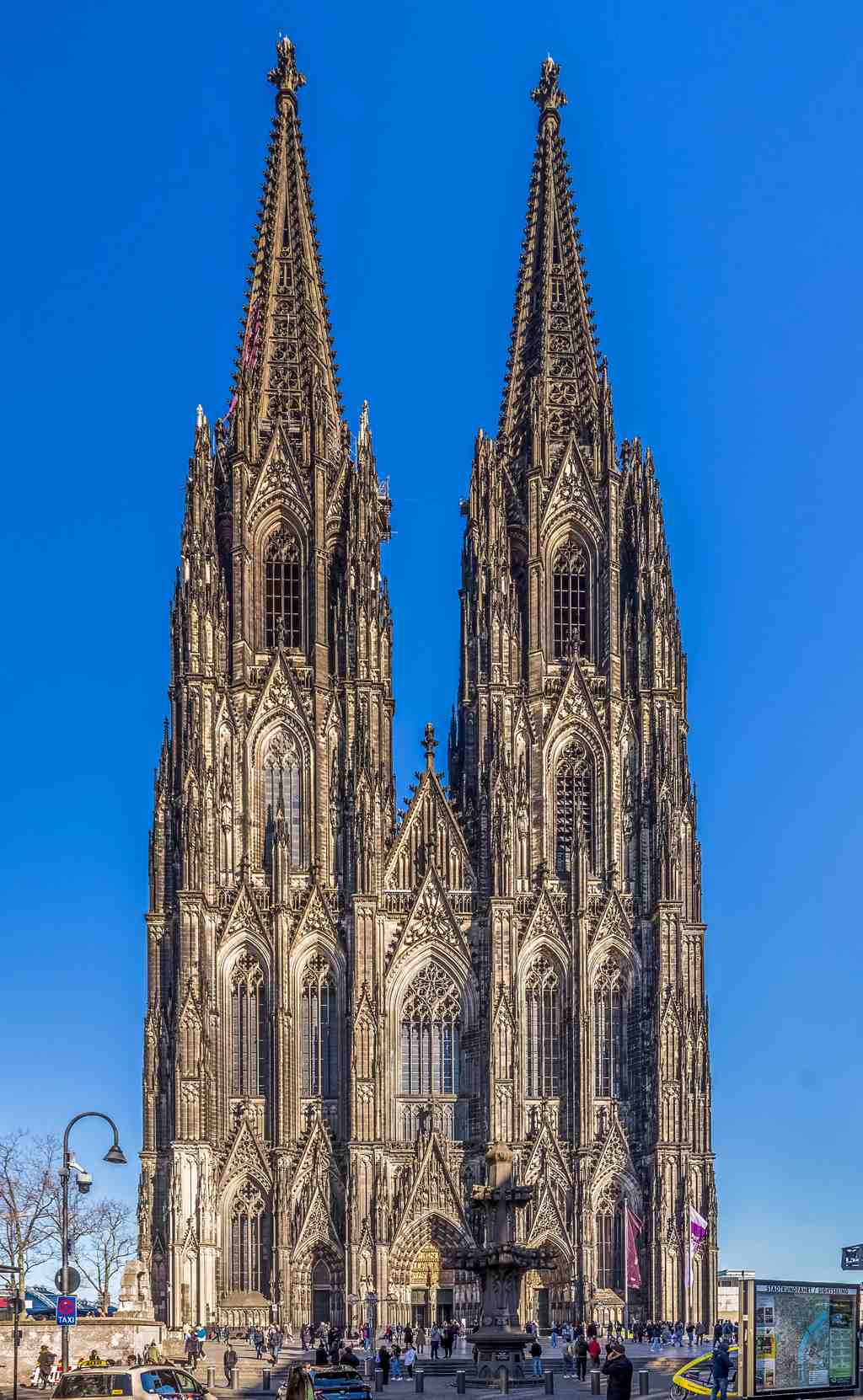
Before you rises an enormous Gothic cathedral with two soaring, almost identical towers, clearly dominating the surroundings - look straight up, and you'll see their characteristic spires and intricate stone decoration.
Imagine standing here among pilgrims from all over Europe, drawn by the vision of seeing the relics of the Three Kings - it was for them that the construction of this monumental temple began in the 13th century. The founders dreamed that the cathedral, intended to accommodate crowds and worthily represent the capital of the Roman Empire, would impress with its grandeur and the piercing sound of its bells - even now, you might feel a slight tremor in the square beneath your feet and the buzz of tourists.
Construction began in 1248, but for almost 300 years, walls were built here, towers grew slowly, and then work stopped for nearly 400 years, only to revive in the 19th century - with the support of the emperor and residents, with the help of donations and modern techniques, the cathedral was completed exactly according to the medieval plan. When the solemn fanfares and bell sounds rang out in 1880, and both 157-meter-high towers already stood above the Cathedral, it was the tallest building in the world. Its facade - the largest of all churches - attracts both tourists and pilgrims today.
However, this place did not always look so magnificent - before the Gothic cathedral stood here, there were earlier temples: first, a modest Christian dwelling from the 4th century, then a Merovingian basilica of the Frankish dynasty where queens were buried, up to the great Carolingian cathedral of Hildebold, which aspired to be a "German Vatican" and housed precious relics.
The greatest treasure that elevated the importance of this temple in Europe was the relic of the Three Kings, brought from Milan in 1164 - it was for this that the magnificent golden casket, which you will find inside, was made. Thousands of people flocked here on foot, bringing fame and wealth to Cologne. However, the old walls were too small and cramped - the decision was made to rebuild the temple on an unprecedented scale.
Although for centuries the sight of the cathedral was marred by a huge construction crane, which waited for work to resume like a silent witness to unfulfilled dreams, the towers were finally completed. The Cathedral even survived fourteen bomb strikes during World War II, when against the scorched backdrop of the ruined city, its silhouette was the only recognizable point for pilots.
The Cathedral continues to change to this day. In 2021, hundreds of thousands of photos were taken with a drone to create a virtual, precise 3D model and monitor ongoing erosion - indeed, it is rarely without scaffolding, and master stonemasons constantly battle time and weather. Even today, the Cathedral poses questions and evokes emotions: alongside old traces of music, bells, and crowds, one can also find controversial works that have recently openly encouraged engagement with topics such as Christian-Jewish relations in art.
Today, the Cathedral is a UNESCO World Heritage site, still attracting pilgrims and tourists from all over the world, offering a view from a platform at a height of 100 meters, and its largest bell - the decadent "Dicker Pitter" - rings only on the most important holidays, its powerful voice resonating throughout the entire city. Colonia semper erecta - this cathedral never fell, always remaining the pride of the city and one of the greatest symbols of faith, craftsmanship, and human perseverance against time.
If you are curious about previous buildings, ongoing renovations, or architecture, the chat section below is the ideal place to get explanations.




