
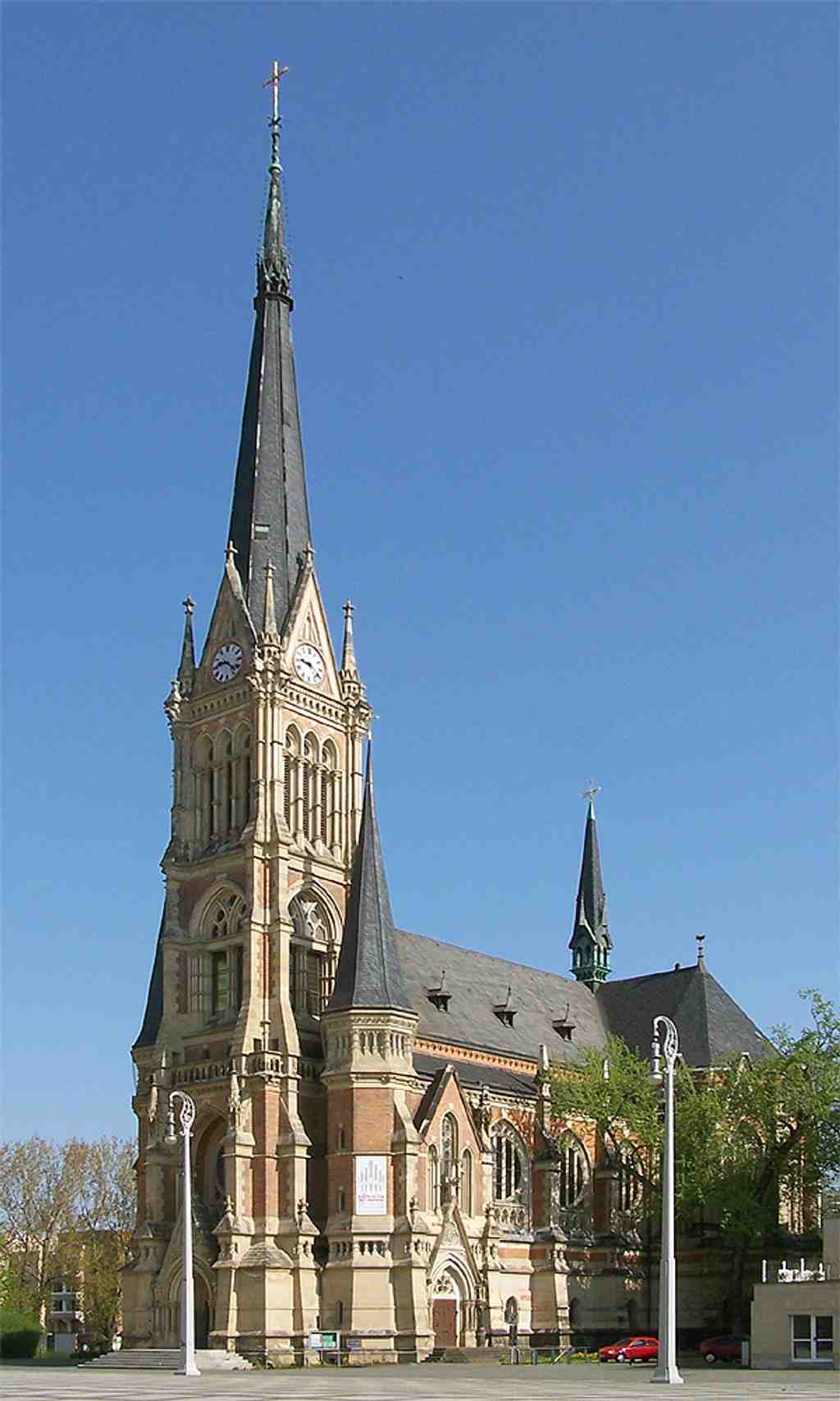
To spot St. Peter’s Church, look for the striking neo-Gothic building ahead with tall spires, a grand pointed tower soaring into the sky, and a large arched entrance framed in sandstone and brick right in front of you.
Now, as you stand before St. Peter’s Church, imagine Chemnitz in the late 1800s. This wasn’t always the proud landmark you see now; at first, the local St. Petri community had to split away from another church, and, believe it or not, they were without a home for a whole decade. It took a creative contest-over 50 architects put pen to paper-but Hans Enger from Leipzig drew up the winning vision. Construction kicked off in 1885, right here on land that the city council generously donated. By 1888, the church stood completed, costing a cool 700,000 marks-imagine how many coffee cups that would buy!
The result is more than just bricks and mortar; you’re looking at a true masterpiece combining sandstone, brick, and iron, stretching nearly 60 meters long and crowned by a magnificent spire that rises up 82 meters. Picture workmen lifting the golden cross to the very top-82 meters high-with the whole town watching, probably holding their breath and hoping the wind didn’t blow it away.
Move closer to the entrance and you’ll spot the splendid main portal, guarded by statues and topped with a mighty relief above the arch, sculpted after designs by Werner Stein from Leipzig. That relief carries a message, “Come to me, all who are weary and burdened,” echoing a sense of welcome through time. On each side, smaller staircase towers cling to the main spire, and if you peek around the sides, you’ll discover polygonal little chapels hugging the altar space-almost like the church is wrapping its arms around its sacred heart.
Let’s step, at least in our minds, into the church. Inside, there was room for 1,200 people-imagine the crowds at holidays and the cheerful chaos when everyone showed up in their Sunday best. Light streams through giant mosaic windows, filtered and colorful, making the nave glow gently by day, while in the apse, tall, pointed windows display vivid scenes from Christ’s life-his birth, crucifixion, and resurrection-all painted by master glass artists from Düsseldorf. The altar, pulpit, and baptismal font aren’t just simple furniture: they’re carved from eye-catching French limestone and serpentine, so white you might squint. There’s even more detail: two reliefs showing Isaac’s sacrifice and Christ in Gethsemane; statues of the four Evangelists clustered by the pulpit, plus Luther and Melanchthon keeping a watch from above the organ balcony. The baptismal font? That honor goes to an architect from Chemnitz himself, Theodor Roschig.
Speaking of organs, St. Peter’s original pipe organ had nearly 4,000 pipes and came alive with music in 1888, built by Friedrich Ladegast’s celebrated workshop. Over the years, the organ saw not one, but two major overhauls. In the 1970s, the organ nearly vanished for good-at one point it was literally cut off from its power when the church had to close due to structural problems. But, like a phoenix (or perhaps more accurately, like a stubborn old piano), it survived. In 2008, after a spectacular restoration helped along by fundraising efforts-let’s just say, it was a “Queen for Chemnitz”-music rang out again on the church’s 120th birthday.
And the bells? Oh, the bells have quite the tale! The first set of bronze bells thundered out B-flat major but lost two members during World War II when they were seized for metal. Only the middle bell stayed behind, its powerful tone carrying a scripture inscription: “Jesus Christ, yesterday and today and the same forever.” Later, after another Chemnitz church was destroyed and couldn’t be rebuilt, St. Peter’s inherited its three steel bells-so in a twist of fate, even its voice bridges the city’s turbulent history.
Standing here today at Theaterplatz, you’re at the crossroads of faith, artistry, and history. And if the church’s dramatic journey from idea to icon teaches us anything, it’s that determination (and a good architect!) can truly move mountains-or at least, build spires that reach for the clouds!


