
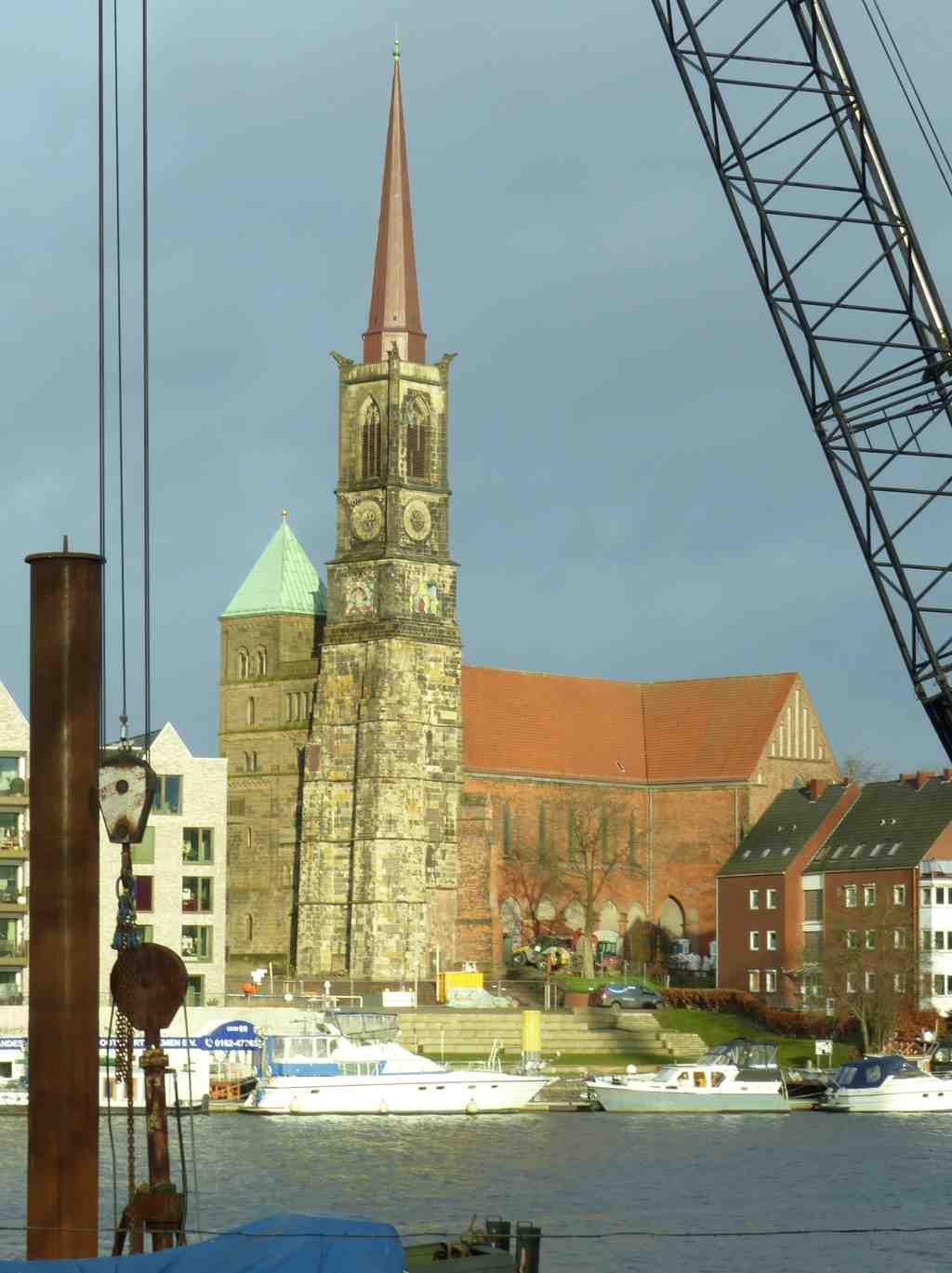
To spot St. Stephani, just look ahead for the tall, sturdy stone church with its sharp red spire shooting straight into the sky-it stands proudly at the western edge of the old city, easily visible above the nearby buildings by the riverbank.
Now, as you stand here facing St. Stephani, let’s take a little stroll through time-no time machine required, just a dash of imagination! The air around you probably feels charged, maybe a bit windswept from the nearby Weser, and the stones beneath your feet echo with almost a thousand years of footsteps and secrets.
Picture this spot around the year 1050, back when the area was more of a bustling medieval market than a cityscape, and a sandy hill called Steffensberg rose from the flat land. Here, Archbishop Adalbert I-who, rumor has it, had an amazing beard-founded this very church. He wanted a place not just for Sunday prayers but for the local citizens, travelers, villagers from Utbremen and Walle, and, let’s not forget, the odd restless bishop who found city life a little too exciting.
Back then, the church was humble, a younger sibling to Wilhadi Church, and shared its name. But, with the Reformation, it entered its teen years and decided to be called only St. Stephani, which is what stuck-teenage rebellion, church-style! The first structure was simple, with a narrow nave, but as the centuries turned, both fire and fancy renovations shaped it into what you see today.
The thirteenth century brought a fiery disaster, and the church had to be basically rebuilt. Imagine the chaos-ash in the air, masons hurrying to piece together stone and brick, and a choir loft probably echoing with more complaints than hymns. They started the new construction from the choir moving towards the west, patching things up with a curious mixture of sandstone and brick that gives the church its distinct layered look. Today, the different stones are like pages in an open history book, each telling a chapter of struggle and hope.
Move forward a few hundred years: kings and commoners may have changed, but St. Stephani remained. The southern tower, the grand spikey one, got its first pointy hat in the mid-1600s, then a simpler one after another hideous fire. Honestly, it seems like this church had about as much luck with roofs as you do with umbrellas in Bremen’s winds!
The biggest transformation came in the late 1800s, under the eye of architect Conrad Wilhelm Hase. He was a fan of the neo-Gothic and set out to craft a proper basilica-a showstopper on the Bremen skyline, with regular stones, proud arches, and a fresh energy that mixed Romanesque roots with Gothic fancy. Yet, even the fanciest facelifts couldn’t keep war at bay. During World War II, the church was bombed almost into oblivion; rubble filled the air and silence replaced song. But Bremen hearts are tough as old boots. By 1959, St. Stephani was reborn, a little simpler, a little starker-a concrete ceiling for the main nave, and just the north aisle for intimate services.
If you listen very closely (or just imagine for fun), you might hear the clang of three mighty bronze bells, named Creation, Peace, and Justice, cast in the ‘90s and still ringing hope over Bremen. And inside, don’t miss the artistically wild window mosaic behind the altar-10,000 colored glass pieces coming together in a glorious patchwork by Erhart Mitzlaff, telling tales of old and new worlds in a wash of colored light.
Over the centuries, St. Stephani has been more than a house of worship. It’s sheltered seafarers, served as a school, and resisted the “German Christians” during Germany’s darkest hours, secretly appointing true pastors and standing up against oppression. And since 2007, the church’s main nave has pulsed with culture as Bremen’s first official “Kulturkirche,” hosting concerts and events while the northern aisle keeps the faith alive.
And throughout it all, from the windswept archbishops to today’s music concerts, St. Stephani’s spire still points to the sky, as if to say, “Come in, bring your stories, and let’s make some new history together!” So, take a moment-look up, breathe in the deep smell of old stones and river breeze, and you might just feel the heartbeat of Bremen right here.
For further insights on the key data and equipment, name or the today's significance, feel free to navigate to the chat section below and inquire.




