
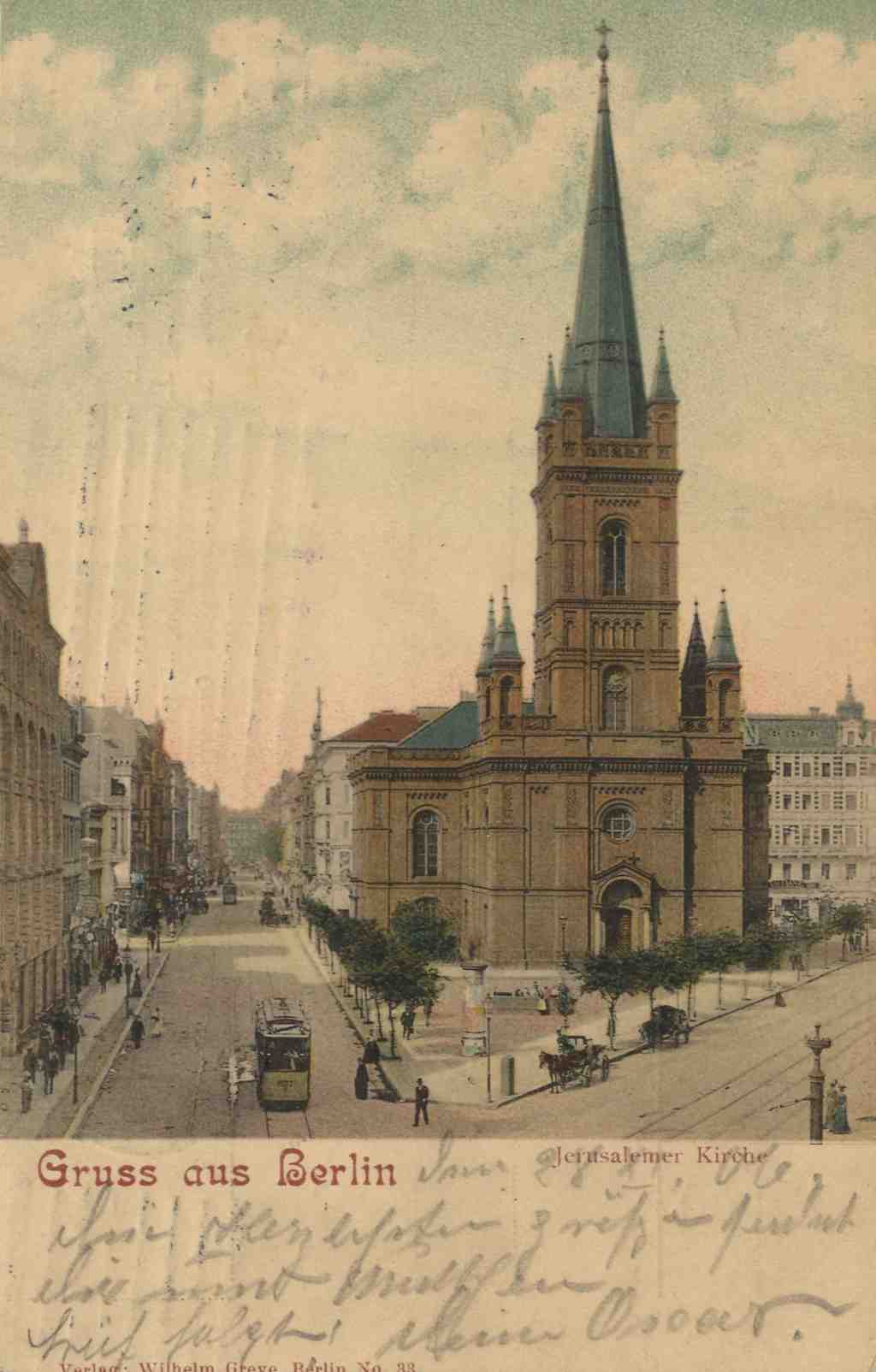
To spot the Jerusalem Church, just look for a tall, grand structure with a sharp steeple rising high above the crossroads where several streets meet-its light yellowish-brick facade and pointed tower make it stand out from the neighboring buildings.
Now, take a breath and imagine you’re standing at one of the liveliest crossroads in old Berlin-the city’s history practically hums beneath your feet. Close your eyes briefly and you might even hear the distant clip-clop of horses and the faint ringing of tram bells from days gone by. You’re facing the Jerusalem Church-or at least, you’re standing where it has stood, evolved, and, at one dramatic point, completely vanished, only to rise again.
Our story starts with fortune, fear, and a little bit of faith. Over five hundred years ago, a man named Müller, a Berliner just like you, found himself in the Holy Land, surrounded by Saracens. Remarkably, he survived, and upon returning home, he built a chapel right here in thanks. Picture the late 1400s: fields all around, the city still a short walk from here, and travelers on dusty highways heading for far-off Magdeburg or Leipzig. In 1484, official church business stepped in. The local Prince-Bishop offered an indulgence-help repair the chapel and you got forty days less time in purgatory. (That’s what I call a heavenly deal!)
Back then, this peaceful spot sat almost a kilometer outside the safety of Berlin’s walls. And the small chapel became famous, because inside, someone had built a copy of the Holy Sepulchre from Jerusalem-just as they imagined it. It was so important that the road leading here was dubbed Jerusalemer Straße, and eventually the church itself took the name Jerusalem Church.
Fast forward to the Reformation, and things get turbulent. The Elector and his people switched from Catholicism to Lutheranism, and the little chapel followed suit. But then-disaster! The Thirty Years’ War swept across Europe like a storm, decimating Berlin and leaving the chapel abandoned. For a while, it seemed this place would return to wild grass and wind.
But Berlin doesn’t give up so easily. In 1680, the area was revived-new hospitals, new city districts, and the chapel reborn as a parish church for the founders of Friedrichstadt (now part of what you walk through). Oddly enough, it was both Calvinist and Lutheran, sometimes at the same time-a real “can’t we all just get along?” moment in church history!
The years that followed saw wild debates, energetic pastors, and families so wealthy they added their own private chapels onto the church. In the early 1700s, Berlin’s royal ambitions kicked in, uniting city districts into a grand capital. The church was remodeled, expanded, and at one point had a stubby little tower because the first wooden one was just too wobbly to survive. (Guess even in the old days, do-it-yourself repairs could go spectacularly wrong.)
The church witnessed more than its share of drama during the Prussian era. In 1838, the celebrated architect Karl Friedrich Schinkel gave it a new tower-this one wasn’t going anywhere! Inside, the congregation grew, with elegant stained glass and an organ so beautiful people came just to hear it-plug your ears and imagine grand music filling the streets on a Sunday morning.
But as Berlin boomed, big companies moved in, and the congregation grew smaller until the church was almost the only residential heart left in a city of offices and bustling publishers. By the 1930s, politics crept in-a struggle between the church and the Nazi regime, with local leaders battling for their community’s very soul. Secret baptisms defied unjust rules, and the church stood as a beacon for those seeking acceptance and courage through some of Berlin’s darkest days.
A twist of fate followed. In World War II, the church switched to Romanian Orthodox use-new rituals, new congregations, and then, like much of Berlin, it was bombed to ruins in 1945. If you listen closely, you might almost sense the rumble and chaos of the bombing raids.
For decades, the ruins stood as a painful memory, until the Berlin Senate bought the land and rebuilt a new Jerusalem Church in 1968. This time, it became a place not just for worship, but for dialogue: Christian, Jewish, Dutch, and more. Today, the church is officially retired from regular Protestant services and hosts meetings, prayers, and conversations that echo the open spirit of its long history.
Before you move on, remember: beneath your feet ran the walls of centuries-old sanctuaries, and out in the city’s cemeteries, lie the stories of poets, judges, and visionaries whose lives were tied to this church. Strange, isn’t it? A simple crossroads that has witnessed centuries of faith, conflict, rebirth-and always, the hope of coming together, no matter what history throws its way.
Intrigued by the as a lutheran place of worship (1539-1682), as a calvinist and lutheran simultaneum (1682-1830) or the as a prussian union place of worship (1830-1941)? Make your way to the chat section and I'll be happy to provide further details.




