
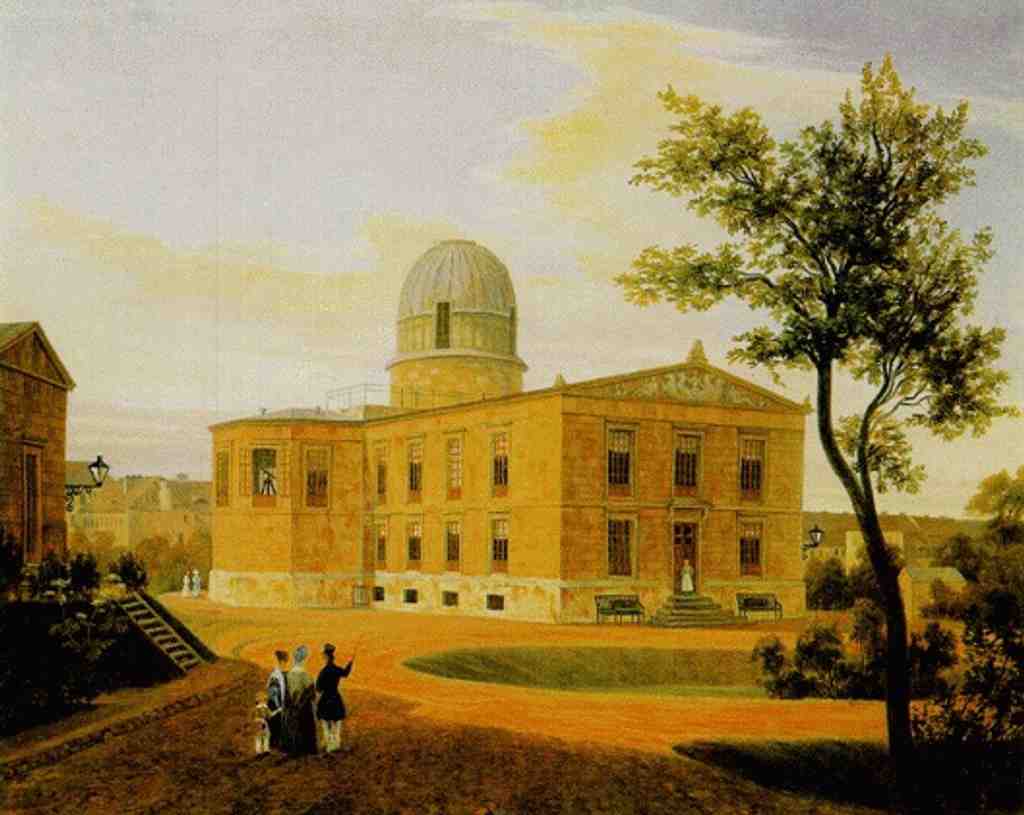
To spot the Berlin Observatory, look for a stately cream-colored building with a prominent rounded dome perched in the center of its rooftop-just follow your eyes to the cross-shaped structure with classic columns and elegant, simple lines set amid a quiet patch of trees.
Now, take a breath and imagine yourself standing here nearly 200 years ago, at the edge of a rapidly growing Berlin. The streets are quieter, carriages rumble by, and, rising above the rooftops, you see this striking observatory-its iron dome gleaming in the evening sun, as if ready to lift off to the stars. The year is 1835, and Berlin is abuzz not just with gossip and inventions, but with the thrill of discovery. Back then, King Frederick William III of Prussia, with a nudge from legendary explorer Alexander von Humboldt, has just agreed to finance a public observatory-but on one unmissable condition: it must open its heavens to ordinary people twice a week. You can just imagine the excitement, neighbors lined up with telescopes, waiting for a glimpse of Saturn’s mysterious rings or a shot at seeing new planets.
But, let’s rewind the clock even more. It all starts in 1700 with Gottfried Leibniz-yes, the very same “inventor of calculus and eternal brainiac” Leibniz-who dreamed up the Brandenburg Society of Science. At first, there's no grand building, just one ambitious astronomer, Gottfried Kirch, peering through a telescope from a makeshift observatory in a Berlin home. Kirch and his wife, Maria Margarethe, are the ultimate astronomical power couple-she even discovers a comet herself! Their daughter later keeps the accounts and helps calculate the all-important calendars. Berlin’s calendar, by the way, was so vital that its fees funded science in the city for decades. Now that’s what I call a time management plan!
Early observatories were tucked into modest towers-27 meters high, three levels packed with telescopes, instruments, and plenty of creaking wooden stairs. When the city unified its different districts in 1710, the observatory became a hub for learning: philosophers like Euler and mathematicians like Lagrange walked these halls, wrestling with cosmic mysteries over cups of coffee (probably arguing who gets to name the next comet).
Time marches on. Prussia keeps growing, Berlin keeps expanding, and scientific ambition reaches for the stars. In 1825, Johann Franz Encke takes charge, and suddenly things get exciting-royal grants pour in, famous architects like Karl Friedrich Schinkel design the new observatory, and Munich’s Joseph von Fraunhofer builds a giant 9-inch refractor telescope, the last of its kind. Picture this: the Fraunhofer refractor has just arrived, its massive lens dusted with anticipation. Berliners flock to the new building, ready to peer at Saturn with their own eyes. Humboldt himself lobbies for funding, pushing paperwork back and forth, until finally the dome is built-the first true hemisphere dome in Prussia, rotating smoothly with a slit opening to the night sky.
With the observatory finished, the next act truly sparkles. It’s 1846, and, inside that big dome, Johann Gottfried Galle and student Heinrich d’Arrest have just received a letter from Paris. The Frenchman Le Verrier claims there’s an unknown planet tugging at Uranus. Everyone else thinks he’s dreaming. But Galle, guided by Berlin’s famous “Akademische Sternkarte,” swings the observatory’s telescope into position. That very night, out of the endless dark, shimmers Neptune-the planet nobody else believed existed. Imagine the cheer in the observatory, echoing off books and brass fittings! Berlin rockets to international fame-suddenly, this city is a beacon for astronomers worldwide.
Decades pass. This once-edge-of-town observatory finds itself swallowed by Berlin’s growth. Streetlamps outnumber stars, making observations almost impossible. The solution: pack up those precious telescopes and move. By 1913, the Berlin Observatory shifts to Potsdam-Babelsberg, its land sold and dome silent, though the legend of its discoveries keeps humming through Berlin’s air.
Today, the spot holds memories: of royal dreams, comet-hunting families, and the moment a planet was found just a few steps from where you’re standing. And remember-if you spot a little glint in the sky tonight, maybe the spirit of Berlin’s astronomers hasn’t quite left their post. Shall we chase the next stop before Berlin’s stars have their say?




