
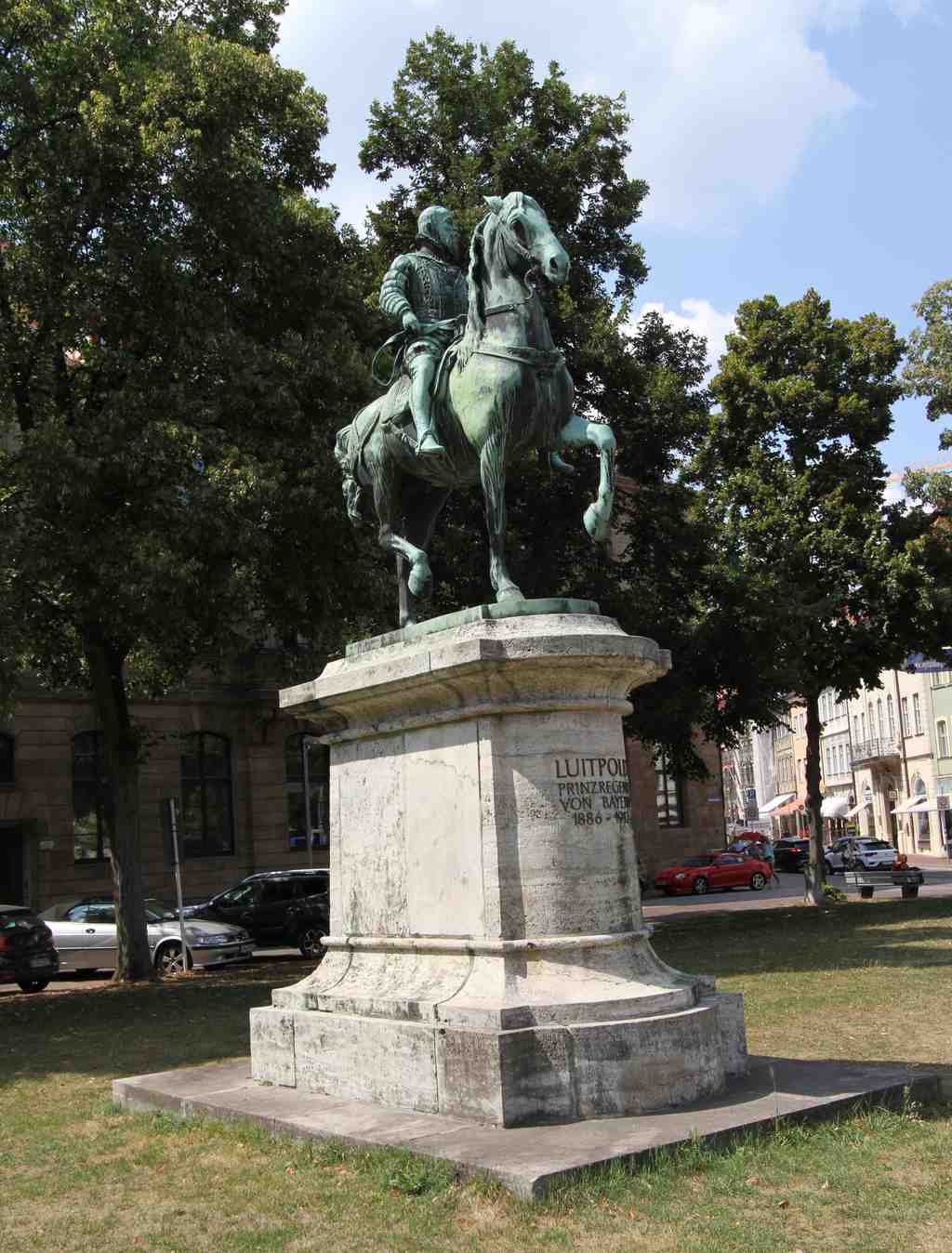
Look for the bronze rider on a horse up on a big pale stone base, standing in a small green patch with trees and traffic rolling past on all sides.
Welcome to Schönleinsplatz… although that name is actually a bit of a rebrand. For a long time this was basically “the shooting club spot,” a practical place outside the old city defenses where you could build loud, smoky things without annoying the people inside the walls… too much. You’re standing near the start of Bamberg’s long main approach into the old town, and right around here-until 1805-stood the Langgasser Gate. This wasn’t some modest doorway either. It was the city’s show-off entrance: a gate tower that worked as customs office and jail, and the ceremonial starting line where newly elected prince-bishops began their grand ride into Bamberg. Picture it: polished boots, nervous officials, a little fanfare… and just off to the side, the reminder that yes, the city also had a prison. Balance.
Back then, this whole area was flood-prone. So instead of elegant squares, you got simple huts, workshops, and the kind of businesses that don’t mind wet feet. A shooting house outside the walls made perfect medieval sense-safer for everyone involved. Later, as Bamberg’s beer culture expanded, the neighborhood around the Hain filled with hop kilns and breweries, their tall chimneys stamping the skyline well into the 1900s. If you could time-travel, you’d smell toasted malt and coal smoke, and you’d probably need to wash your clothes afterward.
Now, the name “Schönleinsplatz” comes from Johann Lukas Schönlein, a doctor born in 1793. When he died in 1864, locals quickly formed a committee to honor him. But money was tight, so instead of a full-blown bronze statue, they went for a large Carrara marble bust-still impressive, just… from the shoulders up. The sculptor was Caspar von Zumbusch from Vienna. And because a bust can disappear on a wide open square, they put it on a little hill so it wouldn’t get visually swallowed. Naturally, that hill sparked complaints-one letter even asked if the mound could be removed so the shooting club’s new building would “stand out” better. In other words: “Lovely monument… but could it stop blocking our vibe?”
The big unveiling happened on November 30, 1873-Schönlein’s 100th birthday. The city’s dignitaries gathered at his humble birthplace, then processed here with singing clubs, speeches, and enough civic pride to power a small tram system… which, fittingly, arrived later. After the ceremony, the fine folks feasted at the Hotel Bamberger Hof, and ended the day at the theater with Meyerbeer’s opera The Huguenots. That’s Bamberg for you: medicine, music, and a good dinner, all in one commemorative package.
By the late 1800s, this square became a grand Gründerzeit “front door” to the city-designed to impress visitors arriving from the station side. It got formal plantings, diagonal paths, and a fountain installed in the 1880s, later even lit up in color from the new electricity works. By 1905, trams were fanning out from here, turning elegance into infrastructure.
And then… modern life happened. Designs were simplified, lawns replaced intricate flower beds, and by the 1950s the once-glamorous Schützenhaus-Bamberg’s proud party palace-was demolished and replaced by a heavier, more practical bank building. Today Schönleinsplatz is less “strolling and flirting by the fountain,” more “crosswalk strategy and traffic awareness.” Progress has a habit of being useful.
When you’re ready, ETA Hoffmann Theater is a 4-minute walk heading south.


