
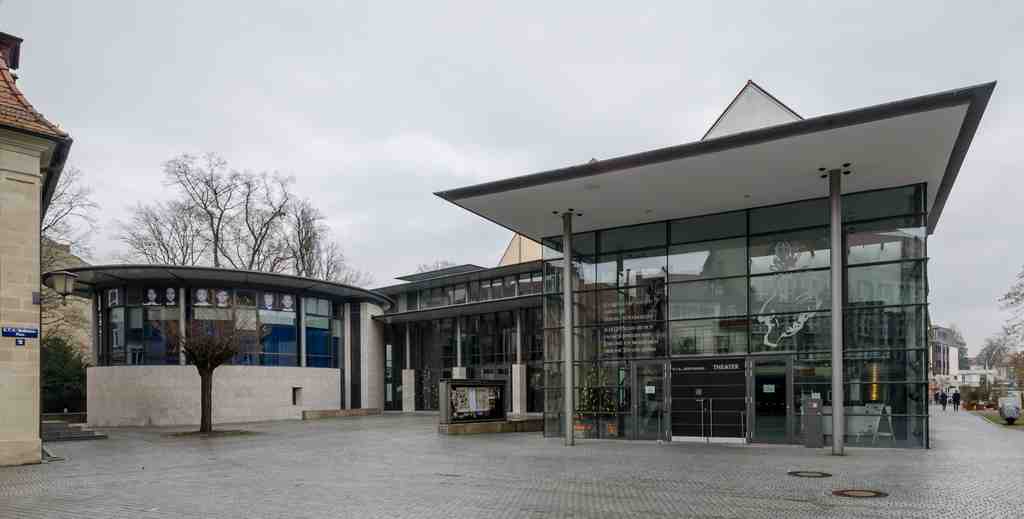
On your left, look for the modern theater building with a wide, sharp-edged roof and a big glass front like a display case for the lobby inside.
You’re standing by Bamberg’s city theater, the ETA Hoffmann Theater… and it’s a lot older than it looks. The glass-and-steel entrance you see today is the latest layer on a cultural lasagna that’s been baking since 1802.
Before it was a theater, this spot was basically the social engine room for Bamberg’s well-dressed citizens. In the late 1700s, different properties around Schillerplatz got stitched together, and one owner turned it into a “society house” - a place to meet, eat, drink, gossip, and generally pretend you’re only here for the conversation. They even built a special hall for it: about 130 people, sparkling chandeliers, big mirrors, game tables… the kind of room that says, “We are making very serious decisions,” while someone definitely cheats at cards.
Then, in April 1802, a nobleman named Friedrich Julius Heinrich von Soden took over the complex and gave Bamberg something ambitious: a proper theater. The opening performances happened on October 3rd and 4th, 1802, under the grand title of a “princely privileged stage.” Because nothing says “fun night out” like a mouthful of bureaucracy. The early theater was surprisingly forward-thinking: it had one of the first permanent ensembles around, and room for roughly 500 people - on the main floor and two balcony levels - though the stage itself was fairly compact. So, big audience… cozy drama.
In 1808, the story gets a serious upgrade. A newly built theater building opened here at Schillerplatz - and that structure still forms the historical core of what you’re looking at now. And get this: the first piece performed in the new building was an allegorical work called “The Vow,” written by E.T.A. Hoffmann himself. Yes, the guy the theater is later named after. He arrived that same year as musical director and stayed in Bamberg until 1813… but his theater job was a little chaotic. He was hired as Kapellmeister, yet he effectively conducted only one opera. Internal squabbles, rival musicians… the usual artistic “collaboration.” So he pivoted - working as a dramaturg, a ticket-taker, even painting scenery. Imagine the future literary legend ripping tickets at the door like, “Enjoy the show.” For the German premiere of “Käthchen von Heilbronn” in 1811, he actually designed the sets.
After that, the theater lived a long life of changing leadership and frequent money headaches for about 150 years, until it was shut down entirely under the Nazis. During the war, performance life went quiet. Afterward, the building was used as a refugee shelter, and the acting troupe performed wherever they could - gym halls, event rooms, whatever was available. It wasn’t until 1959 that the theater could reopen in a renovated form, and from 1970 onward it officially carried Hoffmann’s name as a dedicated drama house with musical guest performances.
Now look again at that clean modern entrance: between 1999 and 2003, the whole place was renovated and expanded. That’s why you get this welcoming glass foyer, new spaces like a studio stage with flexible seating, and all the modern stage tech… carefully hidden, so the magic doesn’t show its wiring.
Today, it’s still very much a working city theater with a resident ensemble - and since the 2025 to 2026 season, the artistic director is John von Düffel.
Ready for Drudenhaus? Just walk northwest for about 7 minutes.


