
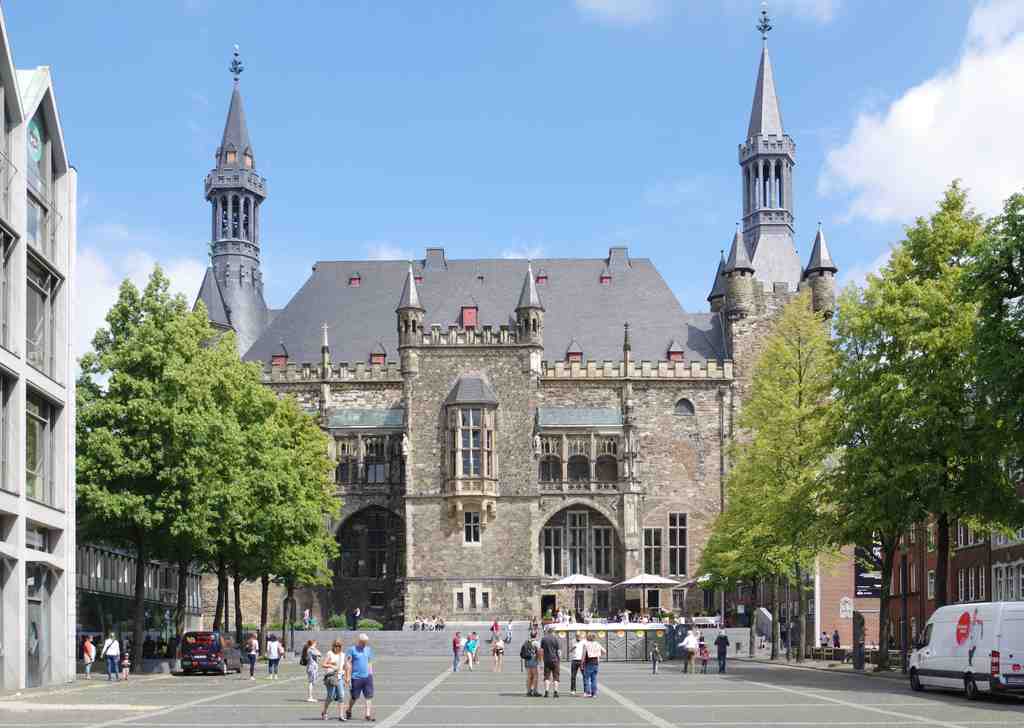
Look to your left, and you will see a massive, rough-hewn stone building crowned by two soaring, slate-tiled spires and an intricate Gothic facade adorned with statues of long-gone kings. Welcome to Aachen City Hall.
We just walked from the Cathedral, the spiritual heart of the old empire. But this building tells a very different story. It is a story of how the everyday citizens of Aachen claimed their own voice.
Beneath this very spot once stood the great king's palace hall, the Aula Regia. But by the fourteenth century, that grand imperial hall was falling into ruin. Instead of just repairing it for the emperor, the people of Aachen did something wonderfully bold. They took the physical remnants of Charlemagne's ancient palace, including Roman stones that had been recycled into its walls, and used them as the literal foundation for their own magnificent City Hall. They built their future right on top of the bones of the past.
It was a brilliant compromise of power. The city's mayor and council claimed the entire ground floor to manage the bustling, everyday life of the city. But they reserved the grand upper floor as a spectacular banquet hall for imperial coronations. For centuries, newly crowned kings would dine under the very roof that the citizens had built. It was a perfect balance. The empire got its royal pageantry, but the city held the keys.
This building has endured so much to protect that civic independence. In eighteen eighty-three, a huge fire sparked by a nearby chemical store jumped right to the City Hall's roof. Brave locals rushed inside, dodging falling beams and thick smoke, desperate to rescue the city's precious historical archives from the burning stone tower. They succeeded, saving the very documents that proved their rights as a free city.
Even the walls themselves bear the scars of modern struggles. In nineteen twenty-three, armed separatists stormed the building to forcefully declare a new republic. The citizens fiercely resisted the occupation, and if you look closely at the stunning romantic frescoes, which are large wall paintings done on wet plaster, you can still find bullet holes in the grand hall from the fierce gun battles that finally drove the invaders out. Then came the devastation of the Second World War, which left the building in ruins, but once again, the people painstakingly rebuilt their civic heart.
If you would like to explore those beautifully restored halls, the building is open daily from ten in the morning until five thirty in the afternoon.
This spirit of everyday people standing up for their place in the world did not stop in the past. Modern citizens have continued that long tradition of challenging authority to create a more inclusive community. Let us walk just one minute further to our final stop, the Ecumenical Working Group on Homosexuals and the Church.




