
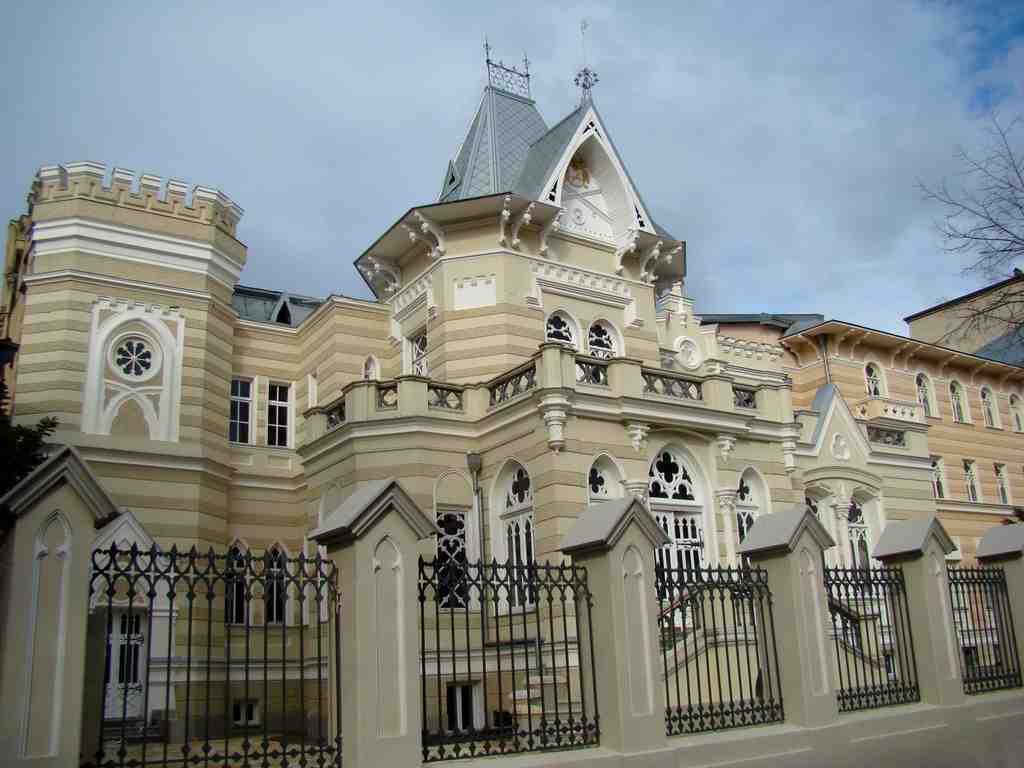
The building itself has historical value, having once been the palace of Duke Constantine Petrovich of Oldenburg. Designed by Paul Stern, a prominent architect of the time, the structure exhibits an interesting blend of Gothic and Islamic architectural styles. The interior features contributions by Polish architect Aleksander Rogojski.
The palace was a testament to Duke Constantine’s affection for Agrippina Japaridze, whom he met and fell in love with in Kutaisi in 1882. After their elopement, they settled in Tiflis, where he commissioned this palace.
In 1927, the Museum of Theatre, established by David Arsenishvili, was relocated to this building. Now, the museum comprises over 300,000 objects that chronicle the evolution of Georgian theater, cinema, circus, folklore, opera, and ballet. Among the notable exhibits is an ancient mask unearthed in Vani, offering a glimpse into classical-era artistry.
The museum’s vast collection includes works from Georgian and Russian artists, providing a comprehensive view of regional scenic design evolution. The fine arts depository features portraits, stage decoration sketches, and costumes. Of particular interest are works by Russian Silver Age painters like Konstantin Korovin, Lev Bakst, and Alexander Benua.
Additionally, the museum houses a significant collection of Persian Fine Arts, including Qajar miniatures from the 19th century and a painting of King Solomon, revered in both Christian and Islamic traditions.
The Art Palace thus serves as a monumental repository of Georgia’s cultural history, offering insight into the artistic and cultural landscape that has shaped the nation.
You are currently standing at a location enriched with a deep tapestry of historical and cultural narratives, symbolizing the confluence of love, art, and history.


