
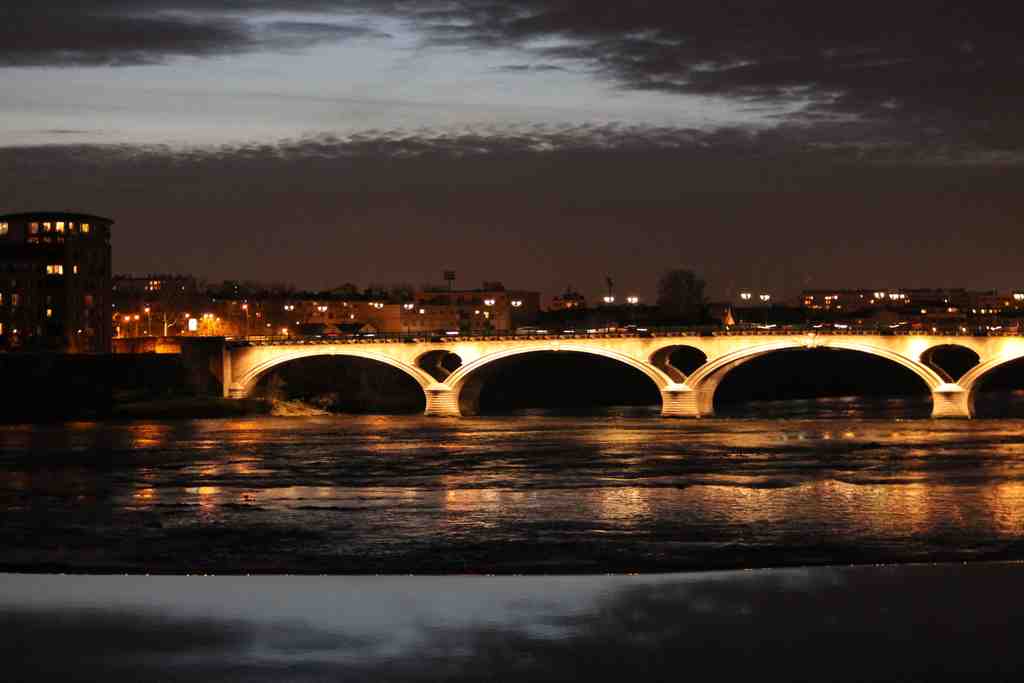
Look for a long stone and reinforced concrete arch bridge, lined with red brick side panels and pierced by shell-shaped openings, stretching broad and pale across the Garonne.
This is the Pont des Catalans, opened in nineteen oh eight, and it makes a fitting final note for Toulouse. It is a working bridge first of all: traffic, pavements, cycle lanes, the steady business of crossing. But under that ordinary duty lies a rather deliberate piece of civic theatre.
The engineer and architect Paul Séjourné shaped it. He had already made his name with the Adolphe Bridge in Luxembourg, and here he refined that idea with the patience of a craftsman. Instead of cluttering the river with many supports, he set two narrow masonry arch rings apart from one another, then let a broad reinforced concrete roadway span between and beyond them. In plain terms, the road you see above is much wider than the stone arches that carry it below. It was bold, elegant, and efficient all at once.
Toulouse had not chosen the easiest answer. In the competition of nineteen oh one, the cheapest proposal was a metal bridge with seven spans. The jury, led by Jean Résal, thought it too poor in appearance for this part of the city and urged Toulouse to aim higher. The city did. Séjourné answered with stone, concrete, and those red brick side walls, so the bridge would sit naturally in a brick-built city. If you look closely at the openings, you may notice their scallop-shell shape. That was no whim. They nod to the Hôtel-Dieu Saint-Jacques nearby, quietly tying engineering to local memory.
And then there is the name. Most people crossing it never suspect that this bridge first belonged, on paper, to the Amidonniers district. It only became the Pont des Catalans after the official visit from Barcelona’s municipal council on the fourth of June, nineteen oh seven, led by Mayor Domènec Sanllehy i Alrich. Toulouse chose the new name to make friendship visible in stone. That matters. Cities do not only build roads; they also choose what their roads mean.
Even the lamps carry memory. Some came from the old suspended Pont Saint-Pierre, reused here rather than discarded, as if one crossing lent its light to another.
In twenty eighteen, the bridge was listed as a historic monument, praised for both its technical invention and the elegance of its line. Quite right too.
So here, at the edge of the river, Toulouse leaves you with its clearest habit: it takes force, traffic, rivalry, old materials, new ideas, and even diplomacy, and turns them into a path people simply use. A bridge, in the end, is never only a bridge. It is a decision to keep the city connected.




