
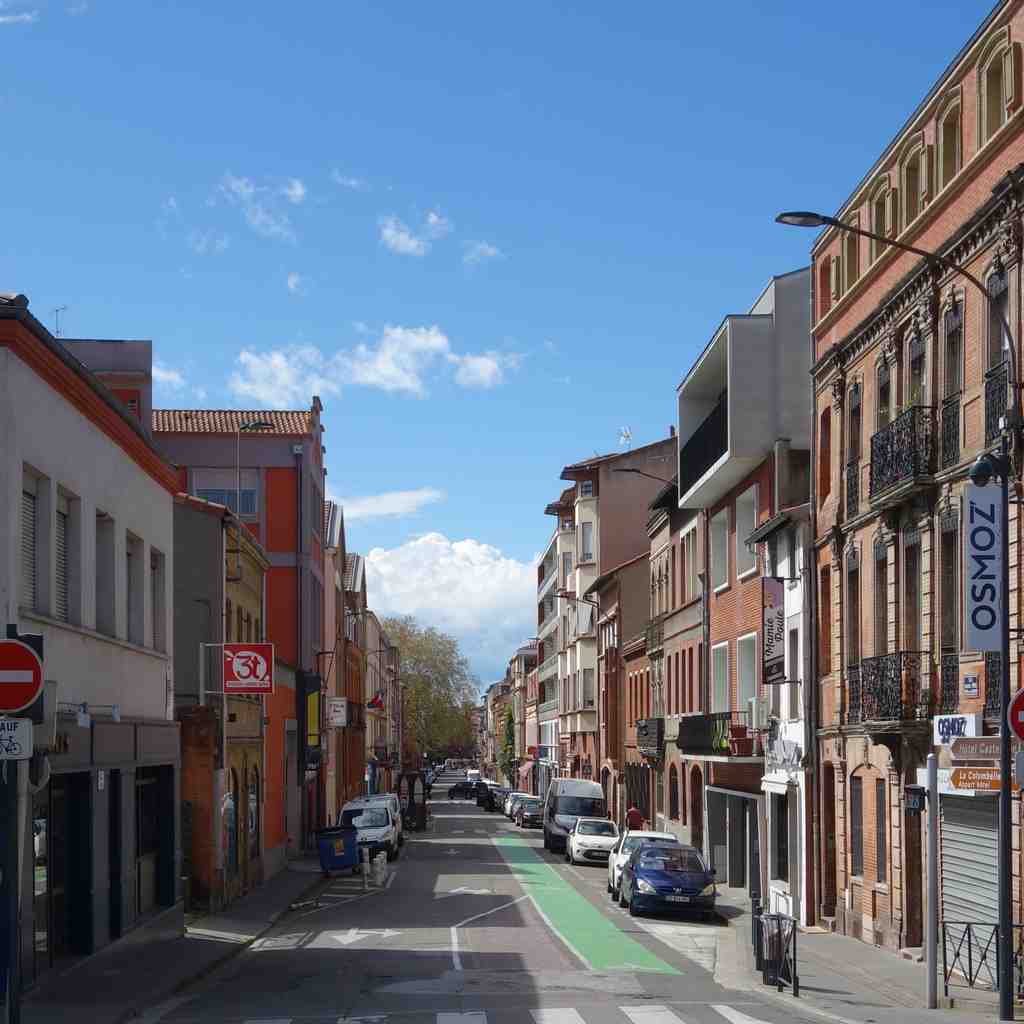
Ahead of you is Gabriel-Péri Street: just look down this straight, lively street lined with a jumble of red-brick and pale stone buildings-spot the mix of modern facades and classic wrought-iron balconies, and you’ll know you’ve arrived in the heart of Toulouse’s Saint-Aubin district.
Now, let’s let your feet take a quick break for a moment-after all, it’s only polite to pause before a street with stories this full! Imagine the gentle hum of cars and the occasional ring of bicycle bells, the scent of fresh coffee drifting from the cafés, and the cheerful chatter of locals weaving between shops, bars, and market stalls. Gabriel-Péri Street hasn’t always answered to this name: when it first opened in 1840 it was called the rue de Constantine, after a French military victory in Algeria. For more than a century, its stones echoed with a very different kind of story.
But wartime and heroism have their ways of writing themselves into street signs, and so by 1945, after the darkness of World War II, the city chose to honor a man whose courage still echoes in these brick walls: Gabriel Péri. Picture him-a sharp-eyed journalist, full of purpose, swept into the drama of the 20th century. By just 20, he was already a powerful voice among young French communists, his words sharper than a sword, his heart fixed on justice. He ran for public office time and again, and finally, in 1932, he took his seat in parliament. Politics in those days wasn’t just a matter of swinging votes or making promises-it was a matter of standing up to the world’s darkness. Péri traveled to Spain to support the republicans against Franco’s coup, and to Prague to defend Czechoslovakia from the looming shadow of Nazi Germany. Even when war broke, and he had to go underground, he kept fighting with words-writing, publishing, keeping the embers of hope alive, until his arrest and tragic execution in 1941. When you walk here, you’re walking on a street that remembers bravery-a reminder that sometimes, making history is about refusing to go quietly.
But let me pull back the veil a little further-because if there’s anywhere in Toulouse where history feels alive, it’s in these mismatched facades. Let your eyes wander to the corner of rue des Sept-Troubadours, where the impressive building at No. 1-3 has lived quite a few lives. That’s the former headquarters of Le Télégramme, one of the region’s great newspapers before it was swallowed up by La Croix du Midi, then transformed into the local tax office, reborn as a nightlife hotspot, and reincarnated once more as Café Oz. If you thought only cats had nine lives, think again! Its architecture is a delightful mishmash: a solid stone base, grand arched doors, clusters of grapes and leafy details carved above the entrance (a sly nod to the city’s vineyards, perhaps?), stately balconies, and brickwork that somehow manages to look both Parisian and distinctly Toulouse. Peek up at the attic windows-those curious round "oeil-de-boeuf"-and you’ll spot the old clock, standing watch over the years since 1912.
As you stroll, you’ll find more tales hidden in the plaster and brick. At No. 6, the Ducuing house is an eccentric beauty, built for a pioneering doctor-Joseph Ducuing, a friend to poets and a founder of Toulouse’s ground-breaking cancer center. He believed in healing not just the body, but the soul of the neighborhood, and you can almost feel a whisper of his optimism in the gentle curve of the stonework and the inviting iron balconies. Modern facades pop up beside 19th-century apartment houses; a few old shops have turned into theaters, and paper factories have become lycées, but if you listen closely, the spirit of invention, resilience, and reinvention hums just below the surface.
Of course, Gabriel-Péri is more than its stones-it’s a living, breathing street, where you might see a parade of scooters zipping by, someone unlocking a VélôToulouse bike from its rack, or buses rumbling south towards Lazare-Carnot Boulevard. It’s the kind of place that pulls you along, forward into the present, even while the past clings gently to your shoes. And with every step, you’re part of its story-an alley of resistance and reimagining, open to everyone who believes in standing up, speaking out, and maybe-just maybe-sneaking in a pastry from the bakery around the corner.
Ready to keep walking? There are more stories waiting around the next bend!




