
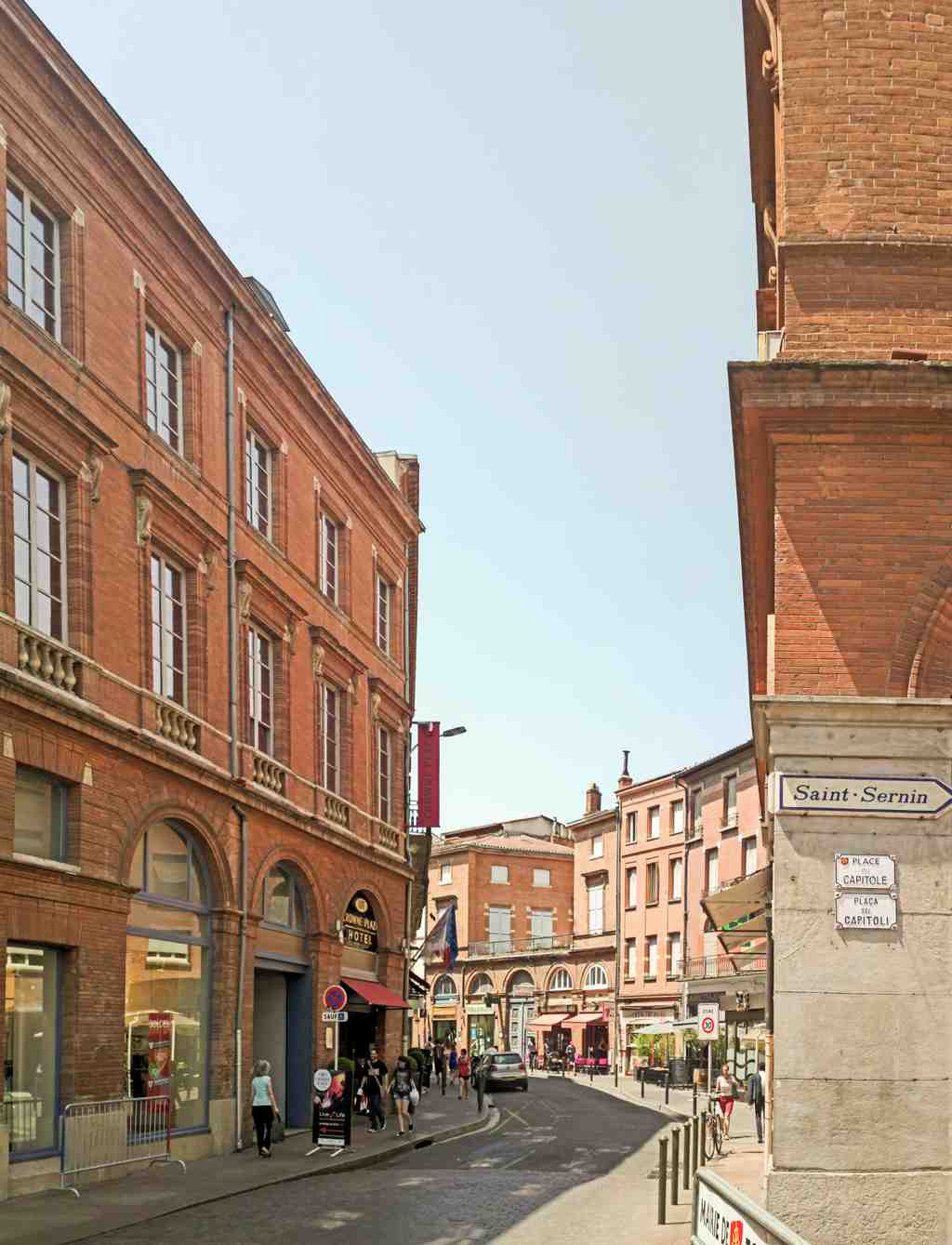
To spot Rue Léon-Gambetta, look ahead to the narrow street lined on both sides with beautiful red-brick facades, arched windows, and a lively mix of boutiques, cafes, and pedestrians stretching gently toward the heart of the city.
Now, picture yourself here centuries ago-Rue Léon-Gambetta was already buzzing, its cobblestones echoing with the rhythms of a changing city. In medieval times, this street wasn’t called by its current proud name, but Rue d’Argentières, famous for its gold-beaters and especially its silversmiths, or "argentiers." They’d set up their tiny workshops here, ready to shape treasures from metal sifted out of river sands by the orpailleurs working along the Garonne. Every clang and clatter would fill the air,, a city’s symphony of craftsmanship and life.
Step forward, and the mood shifts-at one time, the energetic clang of smithies gave way to the hum of trade. This street became home to the grand Hôtel de Bernuy, built in the early 1500s by Jean de Bernuy, a renowned merchant and later a powerful capitoul of Toulouse. His hôtel became so grand that it later welcomed colleges run by the Jesuits expelled from Pamiers, and then the Royal College, its courtyard stuffed with students and scholars bustling between arcades. Imagine the swirl of scholars in dusty black cloaks, debating ideas under arches that still stand today. Through fire and rebuilding-like the devastation of the 1463 fire-timber gave way to brick, and the homes rose anew, taller, grander, a little bit more like what you see around you now.
Rue Léon-Gambetta was never far from drama. In the Middle Ages, a triangular square formed at its end-a place of markets, justice, and gossip. Here stood its own pillory with iron yokes, an elm tree, and a well, creating a crossroads for every kind of tale. Turn the clock forward again and the street once bore the name Rue des Balances, nicknamed after the "Auberge des Balances," a lively inn that drew travelers and locals alike. For a brief time in the Revolutionary years, it was called Rue Nationale, echoing the city's hunger for change-only to revert just as quickly as times shifted.
In the 19th century, new plans straightened and broadened the road, clearing away twisting medieval lanes and giving rise to the neoclassical facades still visible today. Carriages rattled past hotels-the Hôtel des Princes, the Hôtel Domergue-each with its own tales of fortune-seekers, merchants, and poets pausing on their journeys across France.
Public life thrived: the first bustling omnibuses and trams snaked their way along the street, their bells and hoofbeats promising modernity. Waves of students poured in, crowding the royal high school, then the Letters Faculty, their laughter bouncing between courtyards and stone steps. In one corner, you could find the city’s brightest young scientists hunched over experiments in Toulouse’s first science lab, barely more than a tiled room outfitted by the ingenious Léon Joulin.
Don’t forget the artists who lived and loved here. The sculptors Jean Rancy and Pierre Affre, the painter Hilaire Pader… the secrets of their workshops are tucked away behind these very windows. Even the air sometimes tingled with change-like when Vergnes, a humble sign-painter, was tapped by revolutionaries to rename every street in town, only for the city to slide gently back to its old habits just months later.
As you scan the facades, notice the details-ornate balconies, cornices, the occasional quirky bust peering down as you pass. Behind these walls, palatial hotels hid courtyards filled with laughter or the clack of presses, like the Hôtel de Maleprade, which grew from a Renaissance mansion to an industrial printworks and now, in modern times, a tranquil residence. Literary and intellectual life bubbled in its corners; in the 1970s, the independent bookstore Ombres blanches sprouted up here, becoming a local beacon for readers.
Today, Rue Léon-Gambetta is still alive-a mix of old-world architecture and vibrant, twenty-first-century spirit. Sit at a terrace, listen to the clinking of coffee cups, the distant tune from a street musician,, and know that you’re standing in a place where every layer of Toulouse’s epic story is stacked up behind those warm red bricks, waiting for you to imagine it all.
For a more comprehensive understanding of the location and access, odonymy or the heritage and places of interest, engage with me in the chat section below.




