
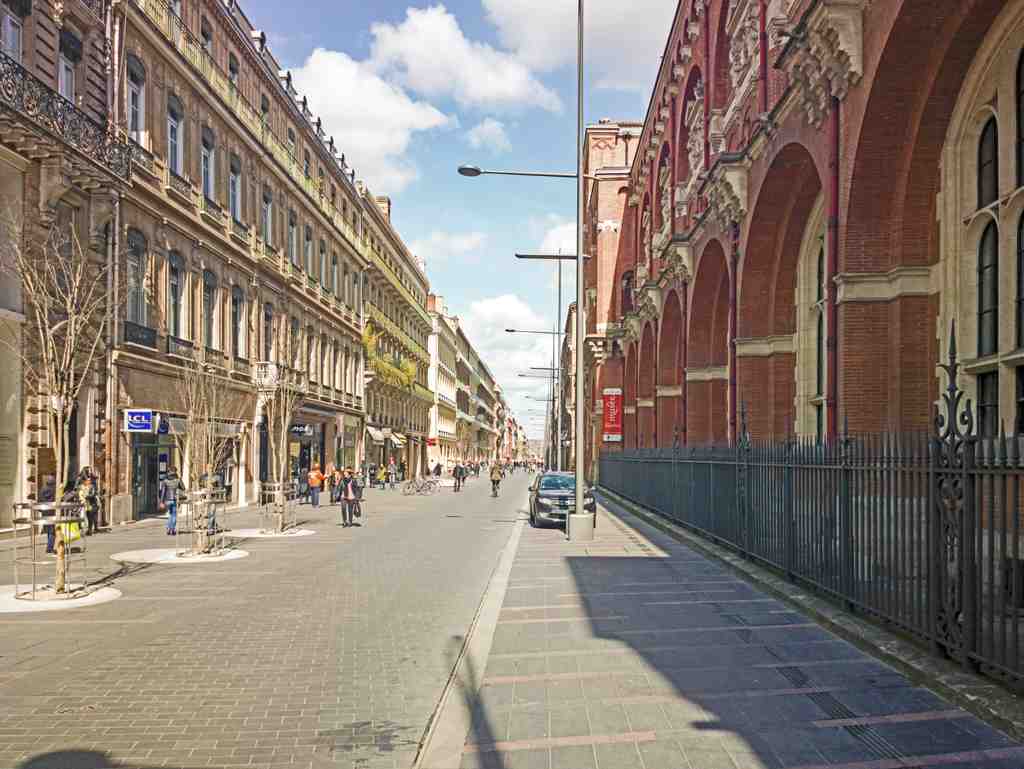
You’re looking for a long, lively avenue lined with grand, stone-and-brick buildings in both Haussmannian and Art Nouveau styles; as you step onto Rue d’Alsace-Lorraine, look north and south for a perfectly straight, bustling street bordered by elegant façades, busy shops, and the hum of city life.
Now, let me take you on a vivid journey through the story hidden behind these stones and shopfronts. Imagine yourself here in the late 1800s-not in the modern, bustling center of Toulouse, but in a maze of narrow lanes, centuries-old houses packed tightly together. Progress was the word of the day, and an ambitious engineer named Urbain Maguès had a vision: to carve two grand thoroughfares through the medieval heart of the city, one east-west, one north-south. The north-south axis, simply called the “Longitudinal Street” at first, was finally christened in 1872 as Rue d’Alsace-Lorraine, a name echoing with the sting of national loss-Alsace and Lorraine, those cherished provinces taken from France after a bitter war with Prussia just the year before.
This new street wasn’t born quietly. Picture the rumbling of carts and protests in the air as the city expropriated old houses, tearing a bold, arrow-straight line from Place Rouaix north to Boulevard de Strasbourg. The men in charge had to secure funding from a Belgian bank-it seems not everyone in Toulouse believed this was progress! By 1878, the first elegant apartments and grand stores appeared, luxurious by the standards of their time, drawing merchants and well-heeled shoppers who marveled at the novelty of city living in flats above wide, arcaded shopfronts.
As the decades passed, Rue d’Alsace-Lorraine grew into Toulouse’s main artery of business, beauty, and bustle. Hear the clatter of streetcars in the early morning as bakers and butchers opened their doors, light streaming from newly installed gas lamps-the city’s pride in 1873, illuminating 600 meters between Rue Lafayette and Place Rouaix. The street’s rectilinear avenue quickly stitched together neighborhoods which had long been separated, forming the boundary between Capitole and Carmes to the west and the stately Saint-Étienne and stylish Saint-Georges to the east.
Look around you and breathe in the layers of time. Here at No. 14 stood the Grand Hôtel Tivollier, an emblem of 19th-century glamour complete with electric bells, hydraulic lifts, and the mouthwatering scent of pâtés wafting from its basement. Further along, No. 37-39 was home to the first Monoprix, Toulouse’s answer to Parisian department stores, where the spirit of commerce blossomed spectacularly-and at No. 37-39 Au Capitole, built for Aux Dames de France, which would later become Galeries Lafayette, and now houses Primark. This was where generations of shoppers pressed their noses to sparkling windows, children’s laughter mixing with the sales pitches of eager clerks.
But the street hasn’t only been a palace for commerce. During the dark days of the German Occupation in World War II, the Grand Hôtel de la Poste at No. 38 was commandeered as the headquarters for the occupying forces. Today it stands as the consulate of Slovenia-a symbol of modern diplomacy in a place once defined by hardship.
As you make your way, look up at the mosaic façade at No. 42 bis, the Hall de la Dépêche, glittering blue and gold with Art Deco flair, designed as the proud headquarters of Toulouse’s newspaper empire in 1924. This new building, bold and modern, stood out against its Haussmannian neighbors-a reminder that the street is always changing, always ahead of its time.
Other addresses whisper their own secrets. The neo-classical palace at No. 2 once housed Toulouse’s powerful consular court, while at No. 46, the building was commissioned by an opera singer and decorated with the image of Méphisto, recalling the flamboyance of stage and song. No. 59, with its domed rotonda and grand balcony, began as a bustling bank-the city’s financial pulse beating strong-and at No. 75, the Ravel Building, statues and balconies still celebrate the spirit of industry and trade.
For centuries, Rue d’Alsace-Lorraine has mirrored Toulouse’s ambition and resilience. Once a symbol of modernity that sparked controversy, it now welcomes buses and bicycles, trams and shoppers, with much of its long stretch transformed into pedestrian paradise. At any hour of the day, the air shivers with the life of the city-whispers of the past and optimism for what’s still to come.
So as you stand in front of these proud façades, listen closely: you might just hear echoes of old protests, the first gas lamps hissing on at twilight, and the laughter of generations threading through the rhythm of Toulouse today.
Fascinated by the location and access, odonymy or the heritage and places of interest? Let's chat about it




