
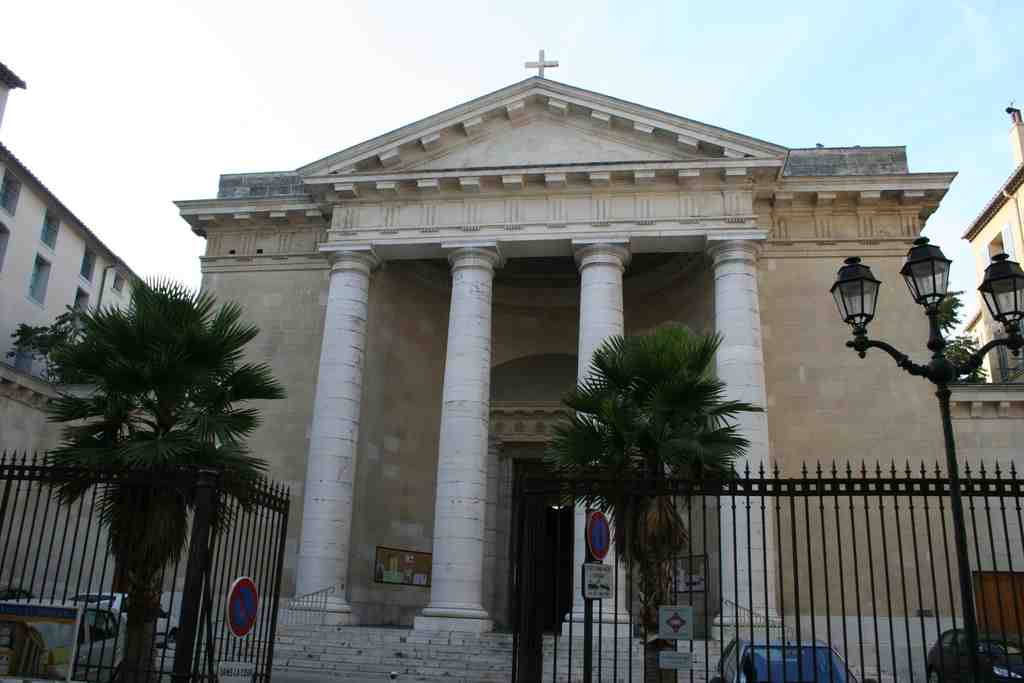
Right in front of you, you’ll spot the Église Saint-Louis de Toulon by its grand, cream-colored neoclassical façade, topped with a triangular pediment, supported by tall columns, and flanked by palm trees behind black iron gates-just look straight ahead, it’s hard to miss that dramatic entrance!
Now, let’s step back in time-imagine it’s the early 1700s in Toulon. The air is thick with the smell of the sea, and the city is buzzing with plans for a brand-new church. The ambitious Bishop Chalucet has his eye on the west side, dreaming of building a house of worship so fine it might earn a divine nod-or at least impress the neighbors. In 1709, after winning a piece of land from none other than King Louis XIV himself, construction kicks off with much excitement. The townsfolk whisper and watch the walls rise, reaching three glorious meters. But then, disaster! Suddenly, in 1720, a dreadful hush sweeps over the streets. The great plague arrives, and almost half of Toulon is wiped out. The city’s laughter vanishes overnight, and construction tools are abandoned.
Fast forward half a century, and Toulon finally shakes off the dust and misery. Work resumes, and the church nearly stands tall once again. But just when the finish line is in sight, a new “divine setback”-King Louis XVI thinks the church is blocking his soldiers' parade grounds. He calls for its demolition in 1780! The townsfolk are outraged-but wait! There’s a twist worthy of a French farce. The city council, using the ancient art of persuasion (and by that I mean, reportedly delivering 300 bottles of champagne as a bribe), convinces the king to give them another piece of land. Hooray for bubbly diplomacy!
From 1782 to 1788, the new church rises, steered by the architect Sigaud, but even then, peace isn’t guaranteed. The Revolution sweeps in, and suddenly this place is dedicated not to saints, but to the god of Reason. For a while, it even becomes a munitions depot and a soldiers’ barracks-talk about an identity crisis! Not until Napoleon himself gives it back in 1803 does the church get to act like a church again, and only in 1858 is it finally consecrated.
Today, you stand before a building that survived plague, demolition, revolutions, and even champagne-fueled negotiations-a neoclassical marvel with columns like a Greek temple and a soaring dome above its peaceful sanctuary. Let your footsteps echo where soldiers once marched and the hopeful hearts of Toulon dreamed, rebuilt, and toasted to second chances!


