
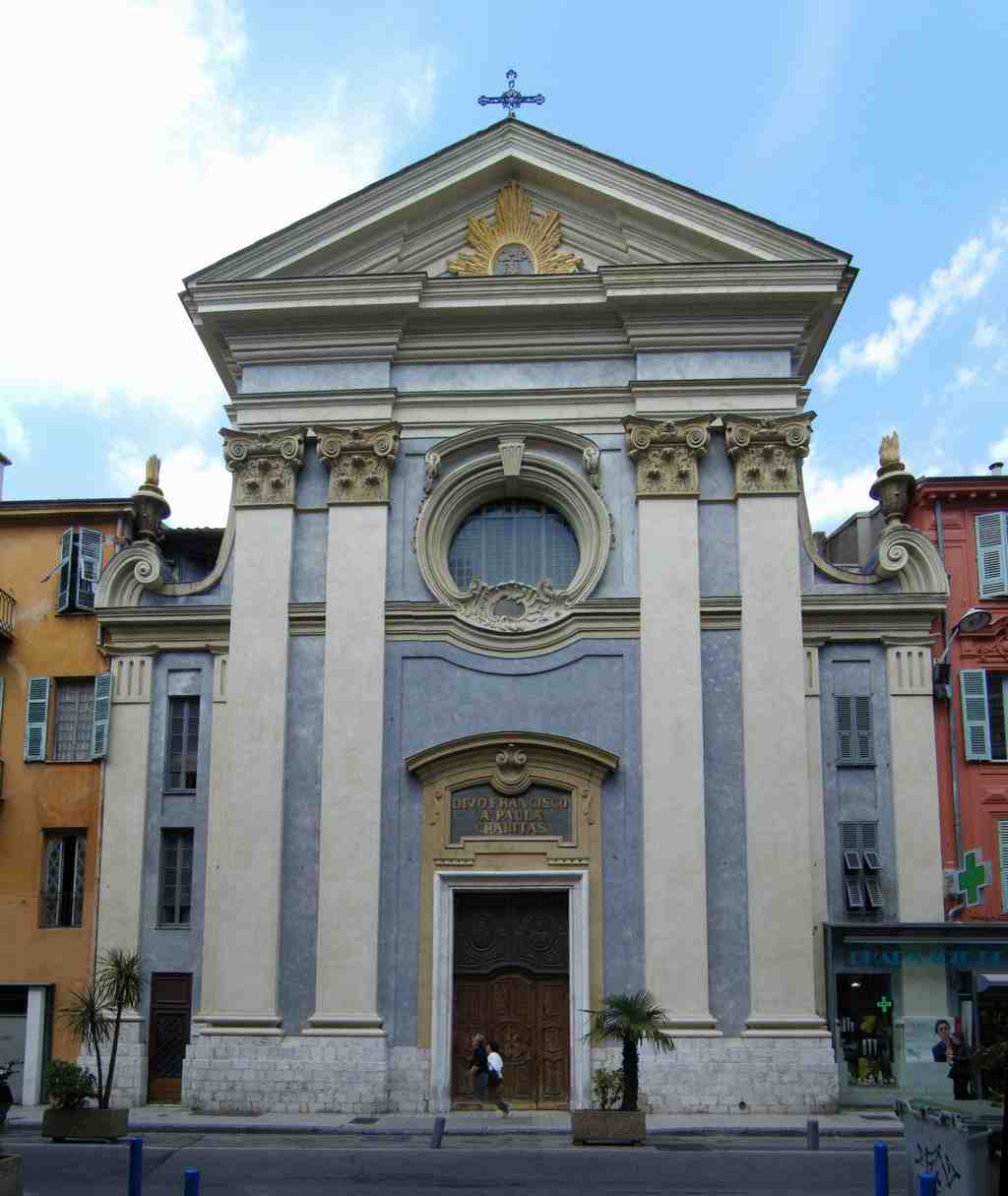
As you walk along the lively Rue Saint-François-de-Paule, look ahead for a striking stone façade rising between two colorful buildings. That’s the Église Saint-François-de-Paule right in front of you. You’ll notice its soft, bluish-grey walls and cream-colored columns, all crowned by a triangle pediment and a cross against the sky. The big wooden doors and the delicate round window above will catch your eye-especially with the word “CHARITAS” carved just above the entrance. Flanking the doors are two little palm trees, as if the church itself is welcoming you in.
Imagine it’s the early 1700s. This street is buzzing with horses, merchants, and the sounds of daily life in the most fashionable part of Nice. Now, a group of quiet, determined monks-called “les minimes”-arrive with a plan: to build a church, and a convent beside it, dedicated to Saint Francis of Paola. They want to create a place not just of prayer, but of charity and peace. As the years tick by, stones stack upon stones under the careful gaze of the famous architect Bernardo Vittone. The first stone is set in 1733, then the façade you see now is completed in 1775-after many stops, starts, and touches of elegance.
But history is rarely peaceful for long. The Revolution sweeps through France like a wild storm. The monks are driven out, and the church stands silent for a few years-until, surprisingly, it’s brought back to life as a parish for the people of Nice in 1802. By 1939, the Dominicans arrive, filling these very walls with song and ritual again.
If you look up, you’ll spot the medallion with “Charitas”-charity-above the portal. Breathe in, and picture what it was like as this street hummed with carriages and silk-dressed visitors. The church’s design itself is a dialogue between the late baroque style and the growing whispers of neoclassicism. By 2004, even modern craftsmen are called to help restore the façade to its former glory.
Step inside, and you’d find not only echoes of the monks but also treasures of art. The main altar is crowned by a dramatic painting, “The Apotheosis of Saint Francis of Paola.” In the choir, vibrant scenes tell stories of miracles, of saints being granted heavenly gifts and powers, painted by Olivotto Gastaldi in 1934.
All around, the subtle blend of history, faith, and art fills this place with a rare energy-still, somehow, just as alive as when it first opened its doors to the city of Nice. Take a moment to listen for the footsteps of old monks, the whisper of prayers in forgotten corners, and the timeless promise of charity written in stone.




