
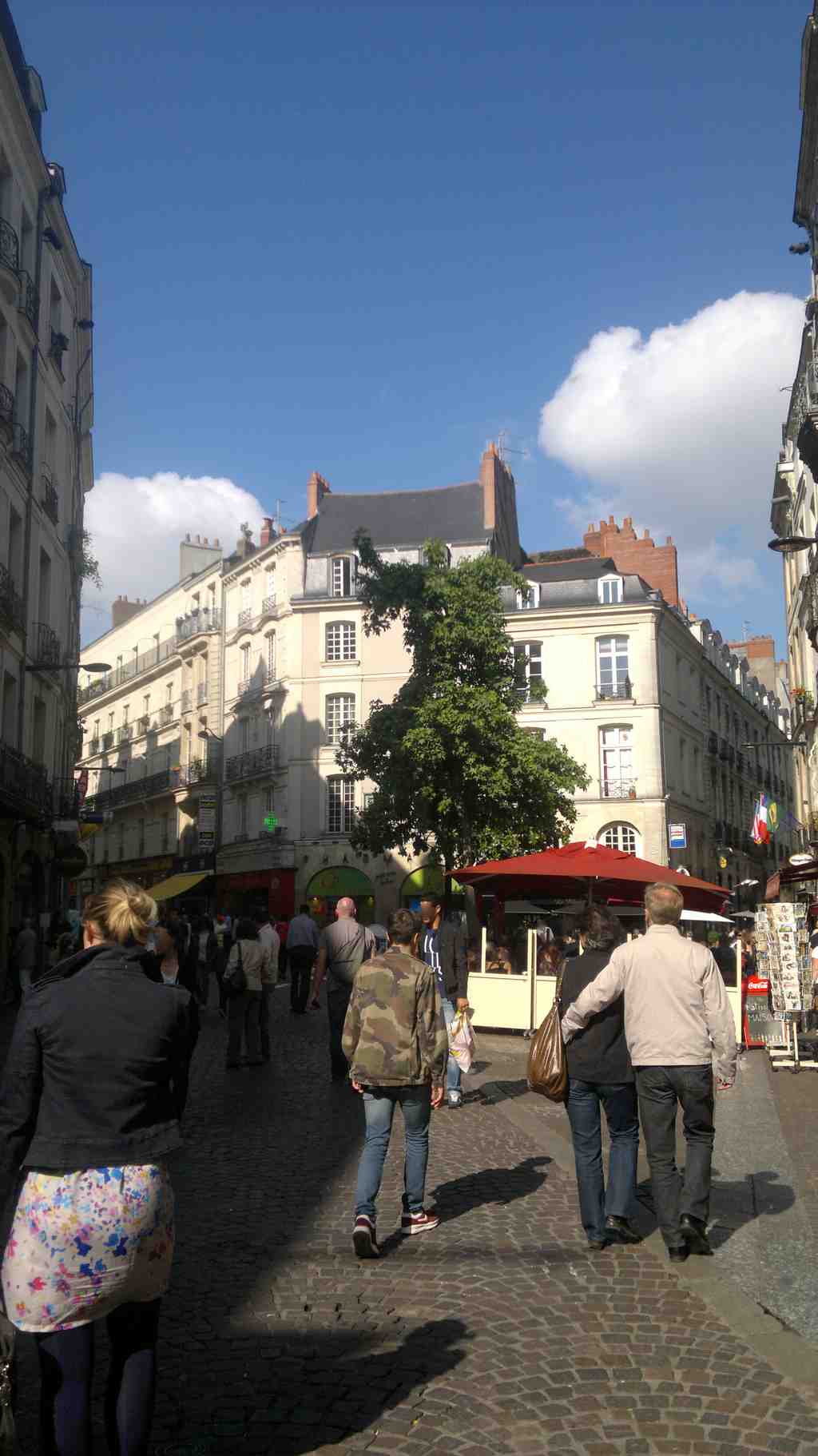
On your right, look for a small triangular paved square framed by pale stone façades, with two sweetgum trees marking its center.
This little triangle can seem modest... but for centuries, Nantes funneled itself through here. In a medieval city, the busiest streets did not stay important forever. Trade routes shifted, bridges changed the flow, river traffic pulled people one way and then another, and the city quietly rewrote its own map. Squares like this rose to the center, then slipped to the side, even while their stones kept the memory.
For a long stretch, this was one of the great crossing points of Nantes. The north-to-south route linked Port-Communeau on the Erdre to Port-Maillard on the Loire, carrying people, goods, gossip, and authority through streets that still survive under other names. Right here, that current met the road coming in from Paris through Saint-Pierre. So if you want to feel the old city breathing, this is a good place to do it. Beneath today’s pedestrian calm, another traffic pattern still hums.
Most visitors hear the name Pilori and think only of punishment... but locals will sometimes lean in and tell you not to trust the name too quickly. Around fifteen fifteen or fifteen sixteen, workers cut a triangular well here, the Grand puits salé, the Great Salt Well. They decorated it with five sculpted animal heads. Later, people shrank it to win back space, then closed it in seventeen twenty-one and finally filled it in during eighteen sixty-one. Some people think “Pilori” grew out of an older name, “Puy Lory,” tied to that lost well rather than a punishment post. A city name can mislead you just as easily as it guides you.
And yet punishment belonged here too. In fifteen fifty-five, officials moved the pillory here from Place Saint-Pierre. A pillory, if you picture it, was a public post for displaying and humiliating those condemned by the bishop’s or the count’s justice. It stayed here until sixteen thirty-two, when they carried it on to Place du Bouffay. So the square held both water and shame, necessity and spectacle... a very Nantes sort of overlap.
Then the city’s main current shifted westward in the late Middle Ages, toward the line that later ran through Place du Change and Rue de la Paix. When the bridge route over the Loire gained importance, this square lost its crown.
But people stayed. Gabriel Mellinet kept an apothecary shop here, at the corner of Rue des Chapeliers. He honored his father, a candle merchant, by placing a bee and honeycombs on his emblem. Later, the Mellinet family filled the square with print as well as medicine. Their printing house settled here, and by seventeen ninety-four it ran five presses with eight workers. One young student even came here, drawn to Father Ratier’s bookshop, feeding a taste for stories that Nantes has always encouraged.
If you glance toward number six, you may catch another local whisper: two carved faces, Jean qui rit and Jean qui pleure, laughing and crying from the façade... as if the square itself remembers both.
In a moment, we’ll leave this crossroads of changing routes and step into a narrower memory: the Street of the Juiverie, where the city still keeps a community’s trace in its name.




