
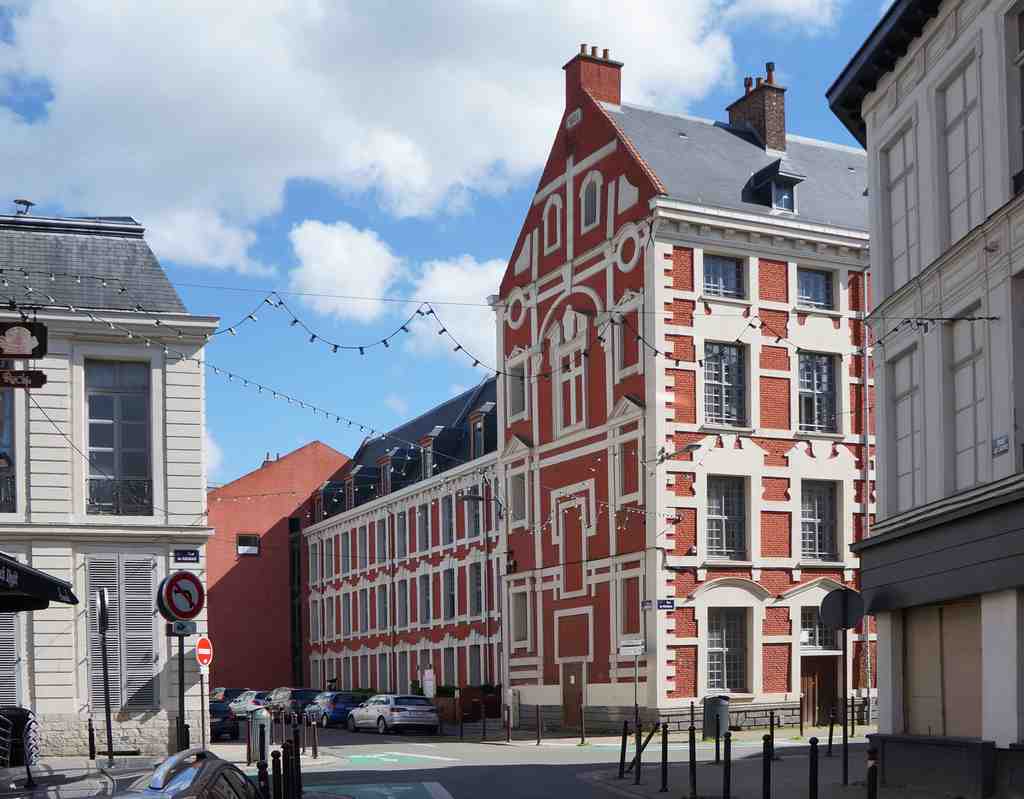
Look ahead for a bright red building with bold white stone patterns right at the corner; its detailed old façade and tall windows will help you spot Lombard Street.
Right here, in the heart of Lille, you’re standing on one of the city’s most fascinating slices of history-Lombard Street! Not just your average little road, this street almost hums with the kind of stories that can make the cobblestones want to get up and talk. Can you imagine? Just beside Lille-Flandres Station, hundreds of years of footsteps have echoed along these very stones. Maybe even some shoes from the 1600s… if only shoes could talk.
The street gets its name from the grand Hôtel du Lombard, a stately brick building you can see right in front of you. It all began in 1617, when the city of Lille decided to expand. You could call it “urban growth spurt” season. By 1626, the Hôtel du Lombard had sprung up, numbers 2 to 4 over there, and just two years later in 1628, it was open for business-not as a fancy hotel, but as a “mont-de-piété.” That’s right, this place was Lille’s version of a pawnshop! But not just any pawnshop-run by a fellow named Wenceslas Cobergher, who took his inspiration from Lombardy in Italy, which was famous for, well, lending people a bit of money when their purses felt too light.
Fast-forward to the 19th century, and the Hôtel du Lombard had gone from pawnshop to much fancier business: it became the general archive depot for the entire Nord region. Now, close your eyes for a second and imagine this huge building, room after room, floor after floor, filled with ancient scrolls, official papers, the musty smell of parchment, and archivists muttering over the fate of France’s forgotten secrets. The place was so jam-packed that at one point, they counted 15 rooms and two staircases on the ground floor, 11 rooms above, and 10 more up top-plus ten extra spaces up in the attic!
But here’s where things get a little dramatic. Around 1824, the city decided, “Why not mix some science in?” They set up a brand-new chemistry school on the ground floor, complete with an amphitheater and laboratory. Picture bustling students and, in the summer, the scent of chemical experiments wafting into the halls. Suddenly, it wasn’t all silence amongst the archives-archivists began panicking over clouds of strange-smelling gases drifting in from next door, worried their precious parchments would end up smelling more like chemistry than history! One archivist even wrote about escaping “enormous puffs of potash fumes” while students (and likely, the local cleaning crew) made a mad dash out of the room.
While chaos sometimes reigned, the chemistry school was a triumph-its star, Frédéric Kuhlmann, drew crowds of 300 people to these first classes in chemical sorcery. Imagine: industrialists, scientists, and curious merchants squeezed into the amphitheater, eager to learn secrets that might help make French industry the envy of the world. These weren’t just classes; they were the seed for Lille’s future as a hub for science and invention.
Yet the Hôtel du Lombard kept changing hats. Besides chemistry, in 1838, the building began hosting Lille’s advanced primary school. Think evening lessons in physics, geometry, and even mechanical drawing-smart kids from all over Lille learning to be the next generation’s cleverest merchants and textile tycoons. One young mind, Alfred Thiriez, studied here before founding what became Thiriez & Cartier-Bresson-the kings of cotton spinning!
And then, as if history hadn’t heaped enough on its shoulders, in the 1850s this very building cradled Lille’s first school for industrial engineers. Royal visits, endless reforms, big ambitions-the classes here eventually grew into what’s now the prestigious École centrale de Lille.
Industrial museums, vast collections of machines and tools, and the occasional panicked archivist-through war, peace, and even a little fire and brimstone-the Hôtel du Lombard just kept rolling. And let’s not forget the grand Hôtel Scrive right across the way, with centuries of weaving, business, and even a plaque for Antoine Scrive, who brought fabulous linen carding machines back to France-a true hero of the age of industrial alchemy.
So next time your boss asks you to “do more at the office,” remember: this street managed chemistry labs, archives, schools, and even a museum-all on one block. Lombard Street is Lille’s reminder that the past is never really out of reach; just a step, a whiff of chemicals, or a buried secret behind a red-bricked wall away.


