
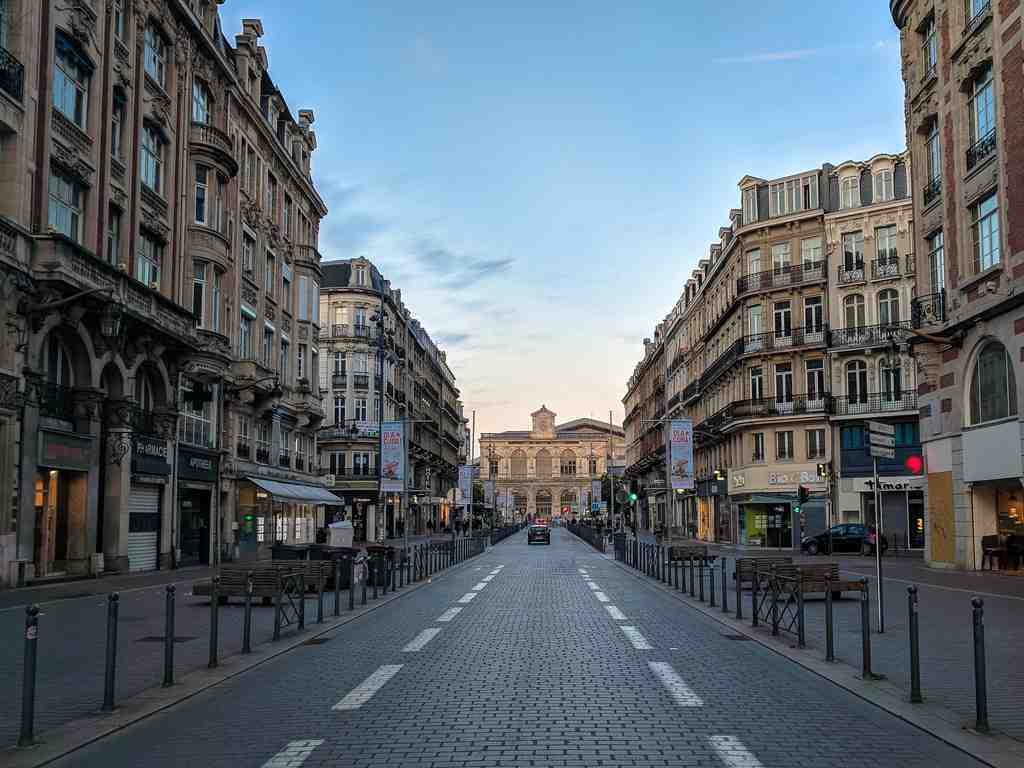
In front of you, Faidherbe Street stretches straight ahead like a grand avenue, flanked by elegant, creamy stone buildings with large windows and little wrought-iron balconies-just follow the broad cobblestone road that leads directly toward the impressive facade of the Lille-Flandres train station in the distance.
Take a good look around-this street isn’t just a way to get from A to B, it’s actually the beating heart of Lille’s history and transformation! Let’s travel back in time together-feel free to imagine you’re walking here in the late 1800s, but watch out: you might have needed to dodge a horse-drawn carriage or two!
Faidherbe Street began its story a bit like a Parisian novel-with big dreams, big demolitions, and a touch of engineering flair. Back in the 1860s, Lille was expanding quickly, and city leaders wanted to show off modern style. They looked to Paris for inspiration, bringing a bit of Baron Haussmann’s grand vision here. The engineer Masquelez, who sounds like he belonged in a detective novel, was assigned a big task: connect the business district (where everyone gossiped about grain and coal prices at the stock exchange) with the shiny new railway station just up ahead. The result? This broad, straight avenue you see now-22 meters wide and 300 meters long-cut with a boldness that would make even the most confident urban planner blush.
But change didn’t come quietly. When Faidherbe Street was drawn onto the city map in 1869, it bulldozed its way through old Lille-over 140 houses disappeared, along with the bustling fish market called the Minck, the ancient town hall, and even a chapel. It was noisy, chaotic, and dramatic, with the sounds of crashing walls and lively arguments floating over the cobblestones. Imagine the frustration of neighbors saying goodbye to their favorite bakery, or the shock of a grand-mère finding out her street would be erased!
At first, it was just “Rue de la Gare,” or “Station Street,” but when the city’s homegrown hero-General Louis Faidherbe-died in 1889, they renamed it to honor him. Faidherbe wasn’t just some random general. He was born right here in Lille in 1818 and became famous leading the Army of the North during the Franco-Prussian War. Now, his name is forever wrapped around the city’s most dynamic spot.
Take a look at the architecture on either side-a rare slice of the Haussmann style outside Paris. These colossal stone facades, spiffy balconies, and fancy domes on the corners were all about showing off Lille’s new wealth. Some buildings, though, bear a different look: after being bombed during World War I, bits of the street were rebuilt in red-brick, regional “neo-Lille” style, to keep local character alive as the city picked itself up and dusted itself off in the 1920s.
Modern Faidherbe Street is where history meets high-tech. On one corner sits an Apple Store tucked inside what was once the Grande Pharmacie de France-a chemist’s that dispensed remedies for more than a century before becoming a techie’s paradise. And in true Lille fashion, the street comes alive with wild creativity! For the big Lille 3000 festivals, you could once spot giant elephants standing tall, massive angels towering above the crowds, and lace-like sculptures hanging overhead. (If you’re lucky, you might still see some modern art installations up ahead, though I can’t promise you any live elephants today.)
So whether you’re here to shop, snap photos, or simply soak up Lille’s vibrant spirit, remember: every step you take down Faidherbe Street is a step across layers of drama, reinvention, and celebration. And if you suddenly feel like parading, don’t worry-you’re just catching the festival spirit that’s always bubbling below the surface here!


