
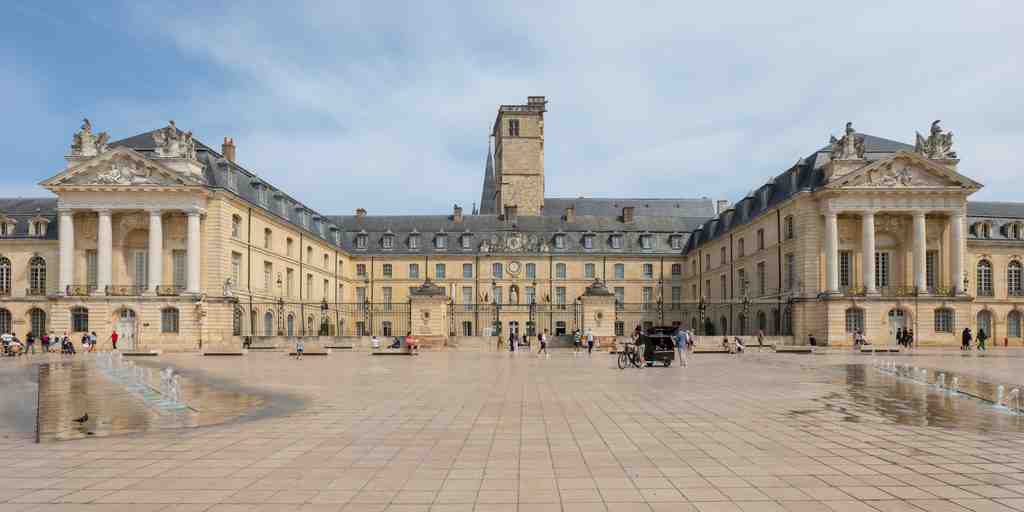
On your left, you will see a massive U-shaped complex built of pale stone, anchored by a tall square medieval tower rising straight up from the center. This is the Palace of the Dukes and Estates of Burgundy, and for nearly a thousand years, it has been the political beating heart of Dijon.
Calling this a palace feels almost like an understatement. It is a timeline carved in stone.
Back in the fourteenth century, the first Duke of Burgundy from the House of Valois, Philip the Bold, decided the old castle here was not quite grand enough. He began rebuilding the complex in thirteen sixty-five. The oldest surviving part is the Tour de Bar, a sturdy residential tower that doubled as a very exclusive prison. In the fourteen thirties, King René of Anjou was captured in battle and locked up right there. René eventually negotiated his release, but to secure it, he surrendered his own two young sons to take his place as hostages. Truly a shining moment in parenting history.
His captor was Philip the Good, a duke who thoroughly understood the power of spectacle. To feed his legendary court, Philip built the ducal kitchens in fourteen thirty-three. These were not your average cooking spaces. They featured immense double fireplaces supported by eight columns, using a central pointed arch to safely draw the smoke up and out. This engineering marvel allowed his staff to roast huge quantities of meat for the grand, theatrical feasts that made the Burgundian court famous across Europe.
Philip the Good also commissioned the central square tower you see reaching for the sky. At forty-six meters high, the Tour Philippe le Bon was completed around fourteen sixty to dominate the city skyline. It was a tall, very pointed reminder of exactly who was in charge. Philip even made the palace the official home for his elite chivalric group, the Order of the Golden Fleece. He established a daily solemn mass in the palace chapel sung by twenty-four priests, perfectly matching the twenty-four knights of his order.
But power eventually shifted. After the final duke, Charles the Bold, died in fourteen seventy-seven, the French crown took control of Burgundy. By the late seventeenth century, the royal architect Jules Hardouin-Mansart gave the palace a classical facelift. He added the elegant, symmetrical wings you see spreading out today, seamlessly blending the old Gothic might with new royal elegance. He also designed the grand semi-circle of the Place de la Libération, which we walked through earlier.
Today, this sprawling complex houses the Dijon city hall, along with the Museum of Fine Arts. The building is open for visitors every day from nine AM to six PM, except on Tuesdays.
Imagine the bustling medieval court life here. When you are ready, we can head to the next stop.




